Of course, flight prices absolutely go down. It's one of the biggest myths in travel that airfare only ever creeps up as your departure date gets closer. The truth is, prices are constantly on the move, acting a lot more like the stock market than a fixed retail tag. They rise and fall based on a dizzying mix of supply, demand, and timing.
The Truth About Finding Cheaper Flights
Watching flight prices can feel like a total guessing game, but I promise you, it’s not random. Airlines use something called dynamic pricing, which is just a fancy term for sophisticated software that adjusts fares in real time. Because of these algorithms, the price for the exact same seat can literally change multiple times in a single day.
Getting a handle on this system is the first step toward snagging a great deal for that immersive cultural experience you're planning. It's less about getting lucky and more about learning to spot the patterns that make prices drop, so you can focus on planning your off-the-beaten-path adventure.
Several key factors can trigger these price dips, and once you know them, you can start to anticipate them:
- Low Demand: If a flight isn't selling out the way an airline hoped, they'll often slash prices to fill those empty seats. This is common for routes to less-touristy destinations, perfect for a full cultural experience.
- Increased Competition: The moment a new airline opens up your route or a competitor launches a surprise sale, other carriers often drop their prices to stay in the game.
- Off-Peak Travel Times: This is the easiest one to predict. Flying during the "shoulder seasons"—those sweet spots just before or after the main tourist rush—almost always means lower fares and a more authentic local experience.
The core takeaway is simple: prices are not on a one-way track upward. They move both up and down, and knowing why they drop gives you a serious advantage in planning your trip.
Key Reasons Your Flight Price Might Drop
To really understand what's happening behind the scenes, it helps to see the main triggers laid out. These are the signals I'm always looking for when I hunt for deals to get me outside the main touristic places.
| Factor | Why It Causes Prices to Drop |
|---|---|
| Low Initial Sales | The airline overestimated demand and needs to fill seats fast. |
| New Airline on Route | A new competitor enters the market, forcing incumbents to lower fares. |
| Competitor Flash Sale | One airline runs a sale, and others match prices to avoid losing customers. |
| Off-Peak Season | You're flying during a less popular time, like a shoulder season or midweek. |
| Economic Downturn | Fewer people are traveling overall, leading to more empty seats and lower prices. |
| Route Optimization | The airline adjusts its network, and a flight's priority or pricing strategy changes. |
Spotting just one of these factors in play can be your cue to start paying closer attention to a specific route.
Timing Your Search for a Price Drop
This all leads to the million-dollar question: when do these drops actually happen? While there’s no single magic day to book, historical data shows some very clear trends. For instance, both seasonal and weekly patterns show that prices can sometimes fall as the departure date gets closer, completely busting the myth that last-minute is always more expensive.
In fact, data shows that average global airfares can dip by 5-10% in those shoulder seasons compared to peak travel times. You can dive deeper into these airfare insights and how they can inform your booking strategy.
Ultimately, your goal shouldn't be to just ask, "do flight prices go down?" but to start asking, "what conditions make them go down?" Once you can recognize those signals, you'll shift from just passively watching prices to actively hunting down the best possible deal for your next off-the-beaten-path journey.
How Airline Pricing Really Works
Ever wondered why the person sitting next to you paid a completely different price for their ticket? It’s not random. The answer is dynamic pricing, a system that’s constantly tweaking fares behind the scenes. Think of it less like a fixed price tag at a store and more like the fluctuating value of stocks on Wall Street.
Airlines use powerful, complex algorithms that chew through real-time data to set prices. This means the cost of a flight isn't a static number; it’s alive, and it can change multiple times a day. Your goal isn't just to find a cheap flight, but to understand the game so you can pounce when the numbers are finally in your favor for that immersive experience abroad.
The Invisible Tiers of Ticket Prices
At the heart of this whole system is a concept the industry calls fare buckets. Imagine every plane has its seats quietly divided into invisible groups, each with a different price and its own set of rules. The cheapest bucket might only have a handful of seats available.
Once those first few seats sell out, the system automatically bumps everyone up to the next, slightly more expensive bucket. This is why booking early can sometimes lock in a lower price—you’re snagging one of those limited seats in the cheap buckets before they vanish. But it works the other way, too. If a flight isn't selling well, an airline might quietly add more seats back into those lower-priced buckets to get people booking again.
This visual breaks down the main forces—supply, demand, and timing—that are always pushing and pulling on flight prices.
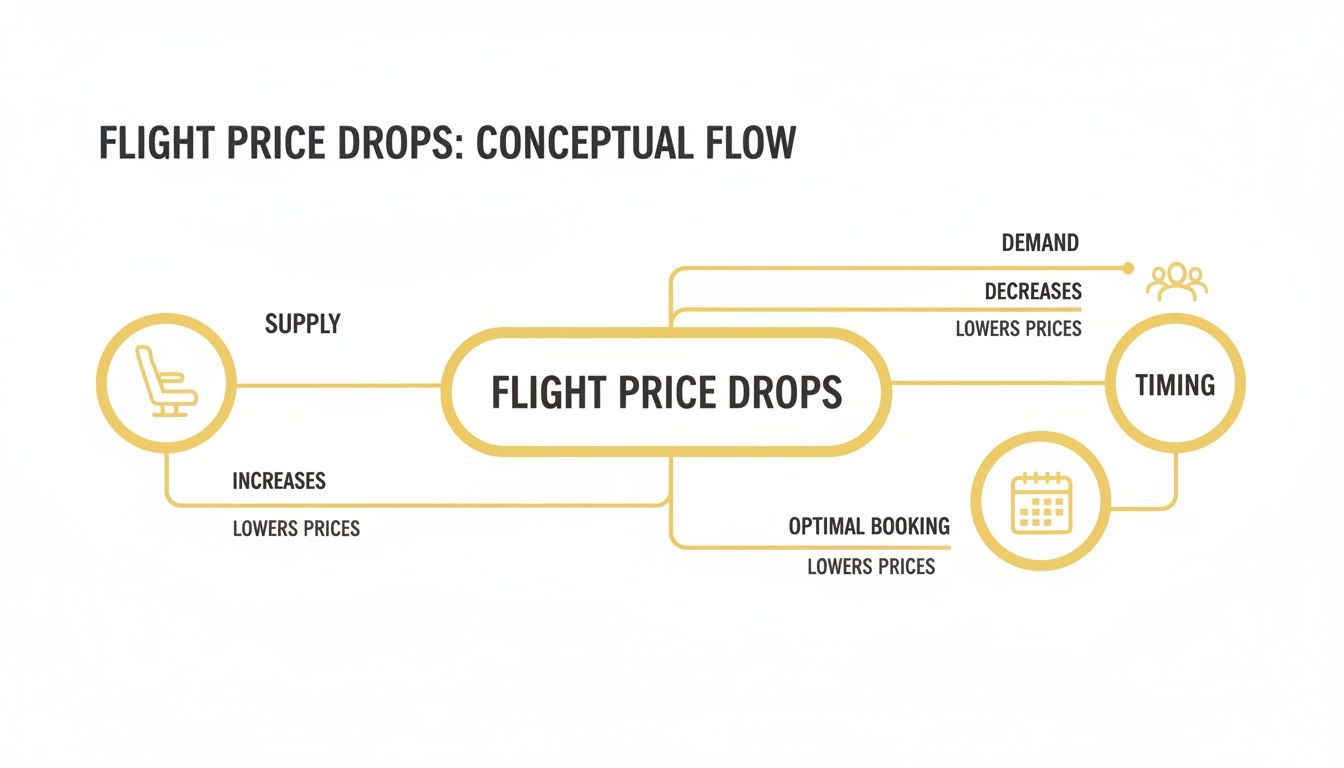
The key takeaway here? These three factors are never static. They are always interacting, creating the constant price shifts you see when you search for a flight.
Maximizing Profit on Every Single Seat
This entire strategy has a name: yield management. At the end of the day, an airline's only goal is to maximize its revenue—or yield—from every single flight that takes off. It's a constant balancing act between filling as many seats as possible and selling each one for the highest price the market will tolerate at that moment.
This explains why prices can feel so volatile. The airline's system is continuously running calculations, figuring out the probability of a seat being sold at a certain price as the departure date gets closer and closer.
An empty seat is a total loss for an airline once that plane pushes back from the gate. Yield management is the airline's high-stakes game of ensuring as few seats as possible fly empty, while also charging a premium to those who are desperate enough to book late.
Getting a handle on these mechanics is your first real step to outsmarting the system. When you see a price, you're not just seeing a fare; you're seeing a live snapshot of the airline's strategy to fill that plane. Knowing this turns what feels like a confusing, random process into a predictable puzzle you can actually solve on your way to a full cultural experience.
Finding the Best Times to Book Your Flight
Knowing why prices change is half the battle. Knowing when they change is how you actually snag a deal. When it comes to booking flights, timing really is everything.
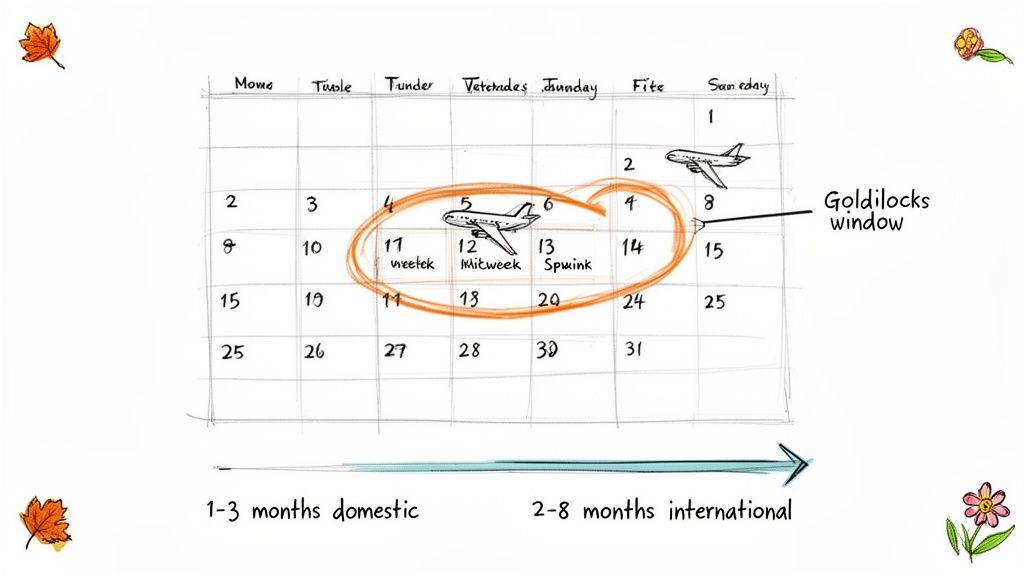
For almost every trip, there’s a sweet spot. It's not too early, and it's definitely not too late. I like to call it the "Goldilocks Window" of booking. Airlines usually release their schedules almost a year out, but those initial prices are often just high placeholders. Book way too early, and you’re paying a premium for being organized. Wait too long, and you’re paying the desperation tax.
The Goldilocks Booking Window
For most people, the single best strategy is to aim for this prime booking period. It’s that perfect moment when airlines have a good read on demand and start pricing seats competitively to make sure the plane fills up.
- Domestic Travel: Your sweet spot is between 1 and 3 months before you plan to fly. This is usually when you'll find the best balance of price and availability.
- International Travel: You need a much longer runway here. Start looking seriously from 2 to 8 months out. This gives you plenty of time to watch for price drops on flights to your off-the-beaten-path destination.
Nailing this window gives you the best odds of seeing prices drop without getting caught in the last-minute surge, which almost always kicks in during the final three weeks before takeoff.
Leverage Seasonality for Authentic Experiences
One of the most effective ways to find cheaper fares is to travel during the "shoulder seasons." These are those magical periods just before or after the peak tourist crush—think spring and fall in much of Europe. Not only are flights cheaper, but your experience on the ground will be far more immersive and less crowded.
Imagine wandering the backstreets of a historic city and talking with local artisans without the sweltering summer crowds. Or visiting a sacred temple when the weather is perfect, long after the main tourist chaos has subsided. Traveling during these times is kinder to your wallet and offers a more authentic connection to the place, away from the main touristic places.
By traveling in the shoulder season, you’re not just saving money; you're gaining access to a more authentic version of your destination, where you can connect with local guides and culture instead of just other tourists.
Debunking Travel Day Myths
Let’s clear something up: the old myth about booking your flight on a Tuesday to save money is pretty much dead. However, the day you actually fly makes a massive difference.
The Cheapest Days to Fly:
- Tuesdays
- Wednesdays
- Saturdays (often for leisure routes)
Fridays and Sundays are almost always the most expensive days to travel. They're packed with business travelers heading home and weekenders getting away. Just shifting your departure from a Friday to a Wednesday can often shave a surprising amount off your ticket price, freeing up more of your budget for that full cultural experience.
What about that unicorn, the last-minute deal? It’s the ultimate travel gamble. Yes, they exist, but they are incredibly rare and rely on a perfect storm of low demand meeting airline panic. For every traveler who scores a cheap last-minute flight, dozens more end up paying double. For a planned trip, it's a high-risk strategy that I almost never recommend. Stick to the Goldilocks Window—it's your most reliable path to a great deal.
The Surprising Truth About Long-Term Airfare Costs
When you’re hunting for a flight deal, it’s easy to get discouraged. A sudden spike from rising fuel costs or a surge in holiday demand can make it feel like travel is just getting more and more expensive. I’ve been there, watching a flight to an off-the-beaten-path destination jump $200 overnight and feeling like I missed my chance.
But if you zoom out from the day-to-day madness and look at the big picture, a completely different—and much more encouraging—story emerges.
Despite the temporary sticker shock we all experience, the real, inflation-adjusted cost of flying has actually been dropping for decades. It’s a powerful perspective shift. Suddenly, your search for a good deal isn't an impossible mission; it's part of a travel landscape that’s fundamentally more accessible for those seeking an immersive experience than it’s ever been.
What’s Pushing Prices Down?
So, how is it possible that flying has gotten cheaper over time? It really boils down to two massive shifts in the airline industry.
First, the rise of budget airlines completely changed the game. When carriers like Southwest and Ryanair entered the market with their low-cost, no-frills model, they introduced fierce competition. Legacy airlines couldn’t just ignore them; they had to lower their own prices to keep budget-conscious travelers from jumping ship.
Second, technology has made incredible leaps forward. Modern jets are engineering marvels that burn significantly less fuel per passenger—and fuel is often an airline's single biggest expense. Those massive operational savings often get passed on to us in the form of lower base fares, even if a growing pile of taxes and fees sometimes hides the trend.
The key takeaway is that the fundamental economics of flying have changed. More competition and better technology have created a long-term trend of greater affordability, making it easier than ever to plan your full cultural experience.
The Data Doesn't Lie
This isn't just a feeling; the numbers back it up. When you adjust for inflation, the pattern is crystal clear. Data from the U.S. Bureau of Labor Statistics shows that while the real cost of flying has its ups and downs, the overall trend since airline deregulation in 1978 is sharply downward. You can dig into the numbers yourself and explore the historical airfare inflation trends on usinflationcalculator.com.
This chart from the U.S. Bureau of Labor Statistics shows exactly what I’m talking about.
You can see the peaks and valleys caused by economic events, but that downward slope is undeniable. This big-picture view confirms that your quest to find out do flight prices go down isn’t just about short-term luck. You’re playing on a field that is tilted in your favor over the long run.
Understanding this helps manage expectations and build a realistic travel fund. If you're mapping out your next big adventure, our local guides can help you put that knowledge into action.
Smart Strategies for Culturally Curious Travelers

Here's the thing: your unique travel style is the single most powerful tool you have for snagging a great deal. A one-size-fits-all approach is doomed to fail because booking a trip for an immersive cultural deep-dive is a totally different game than planning a spontaneous, multi-city adventure.
Figuring out if you're a Planner, an Adventurer, or a Gambler is the first step. Each style has its own rhythm, its own sweet spot for pouncing on the best fares for a full cultural experience.
For the Planner: The Fixed-Date Immersion
You’ve got your heart set on a specific festival in a tiny village, or your vacation days are already locked in at work. Your dates are non-negotiable, which makes your primary weapon timing.
Your entire mission is to book inside that 1-3 month domestic or 2-8 month international "Goldilocks Window" we talked about earlier. Set those fare alerts the second you know your destination. This isn't about discovering a surprise location; it's about executing a precise plan to get the best possible price for the trip you’re already dreaming of.
For the Adventurer: The Flexible Explorer
You know the region you want to see, but you’re wide open on the specifics. This flexibility is your superpower. Forget searching "New York to Rome." Instead, you get to play with "fly anywhere" tools to see what’s cheap from your home airport.
This is how you uncover those hidden gems and off-the-beaten-path destinations that are almost always more affordable. Think about moves like these:
- Fly to Secondary Airports: Instead of landing at a major hub like Milan Malpensa, what if you flew into nearby Bergamo? You could save a few hundred bucks and discover a new city in the process. From there, connecting to your main destination is usually a breeze. A local guide can show you that the https://coratravels.com/blog/venice-to-milan-train is just as scenic and efficient.
- Embrace the "Where to Next?" Mentality: Fire up Google Flights' "Explore" map. Seeing airfares laid out visually across an entire continent lets the deals guide your itinerary, not the other way around.
This approach flips the script entirely. Instead of letting your destination dictate the price, you let the price reveal your next destination. You trade rigid plans for incredible value and an immersive experience outside of main touristic places.
For the Gambler: The Spontaneous Opportunist
You thrive on last-minute decisions and can pack a bag at a moment's notice. While waiting until the last second is usually a recipe for paying way too much, it can occasionally turn up some incredible deals for the truly spontaneous.
Sometimes, airlines panic. When they have unsold seats in the final days before a flight—especially for mid-week departures on less popular routes—they might slash prices. These are not guaranteed bargains. They are high-risk, high-reward gambles where you’re betting on an airline's desperation to fill an empty seat.
Beyond just flights, a savvy opportunist also keeps an eye out for bundled deals. Exploring options for cheap all-inclusive vacations can sometimes provide surprising value, especially for those last-minute getaways where the destination is less important than the experience.
Ultimately, when you align your booking strategy with your travel personality, you stop just hoping prices drop. You put yourself in the perfect position to catch them when they do.
Flight Pricing FAQs: Separating Myth from Reality
Even with the best strategy, some persistent questions always seem to surface when you're hunting for a deal. Let's clear the air and tackle the most common myths, giving you straight answers so you can book your next cultural trip with total confidence.
Do Flight Prices Really Go Down on Tuesdays?
This is the classic travel myth that just won't die, and it has a tiny grain of truth from a bygone era. Airlines used to launch sales early in the week, and by Tuesday, competitors would scramble to match them. Those days are long gone. Today's dynamic pricing means fares change constantly, all day, every day.
What the data does show, however, is that flying on a Tuesday or Wednesday is still usually cheaper than on a weekend. The real takeaway here is to focus on your travel day, not the day you hit "purchase."
Can Using a VPN or Incognito Mode Get Me Cheaper Flights?
This popular "hack" has been pretty thoroughly debunked. Airlines and booking sites set prices based on huge factors like market demand, route competition, and how many seats are left in a certain fare class—not your personal browsing history.
While it's true that different country versions of a site might show different prices based on your "point of sale" (the country you're booking from), just flipping on incognito mode won't magically unlock a secret low price. Your time is far better spent setting up fare alerts and being flexible with your dates or airports.
The most powerful "hacks" have nothing to do with tricking a website. They're about understanding the system: booking in the sweet spot, flying mid-week, and choosing less popular airports for your off-the-beaten-path journey.
Will Flight Prices Drop Closer to My Departure Date?
In almost every scenario, this is a risky gamble that will cost you a lot of money. Airlines bank on last-minute travelers—business people on urgent trips or those with family emergencies—who have no choice but to pay a premium. Prices are jacked up significantly in the last two to three weeks before a flight to capture exactly this market.
The only time you might see a last-minute drop is on a chronically underbooked route where an airline gets desperate to fill a few final seats. But for a planned cultural trip, waiting is a bet you will almost certainly lose. Stick to booking within that optimal "Goldilocks" window.
What Are Error Fares and How Do They Work?
Error fares are the stuff of travel legend. They are the unbelievable deals that pop up when an airline or travel agency makes a mistake, usually due to a simple data entry typo or a momentary tech glitch.
- What they look like: Imagine a $1,500 international flight accidentally listed for $150.
- How to find them: They are incredibly rare and can disappear within hours, sometimes even minutes. Your best bet is to follow specialized deal-hunting communities and newsletters that live for this stuff.
- The risk: There's always a small chance an airline will catch the mistake and cancel the ticket (with a full refund, of course). More often than not, though, they're honored.
For a spontaneous traveler ready to explore a new culture at a moment's notice, snagging an error fare is a thrilling way to kickstart an unexpected adventure.
At CoraTravels, we believe the best trips are built on authentic, on-the-ground knowledge. Our local guides help you move beyond the tourist traps and connect with the true heart of a destination. Start planning your next immersive cultural experience at https://coratravels.com.