Arkansas is a land of deep memory, where history isn’t confined to museums. It’s etched into the foundations of abandoned homesteads, whispered through overgrown cemeteries, and reclaimed by the Ozark forests. While tourist trails lead to polished historical markers, the true soul of the Natural State lies in its forgotten places. This guide moves beyond surface-level sightseeing to offer an immersive experience into the authentic ghost towns in Arkansas.
Forget romanticized ruins; we’re exploring the complex stories of displacement, industrial collapse, and cultural resilience that define these landscapes. Drawing on local knowledge, this plan is for the culturally curious traveler who believes the most profound journeys happen off the beaten path. To truly appreciate the profound narratives hidden within these vanished communities, it's helpful to grasp the broader concept of understanding historical significance.
We will provide the practical details, historical context, and safety tips necessary to explore these sites respectfully. This isn't just about seeing what's left; it's about connecting with the living histories they hold and understanding the communities that remember them. From Civil War-era settlements to forgotten industrial hubs, you'll gain the tools to uncover the real stories behind Arkansas's most compelling abandoned places.
1. Pea Ridge: Civil War Battlefield Ghost Town
Located near Rogers in Benton County, Pea Ridge isn't a traditional ghost town with a central, abandoned Main Street. Instead, it's a sprawling historical landscape where the remnants of a pre-Civil War community lie scattered across the Pea Ridge National Military Park and its surroundings. The Battle of Pea Ridge in March 1862 was a pivotal moment that effectively secured Missouri for the Union, but it also displaced families, destroyed homesteads, and forever altered the local community, creating one of the most unique ghost towns in Arkansas.
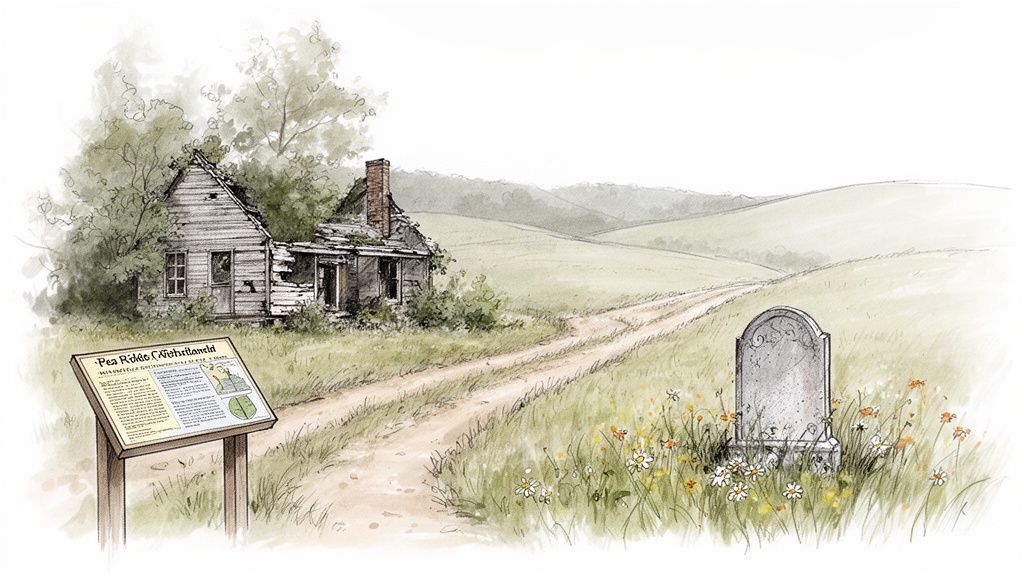
Exploring Pea Ridge is an immersive exercise in landscape memory. The park itself preserves key sites like the reconstructed Elkhorn Tavern, a crucial landmark during the conflict. However, the real off-the-beaten-path experience involves tracing the faint outlines of old farm roads and discovering forgotten family cemeteries that tell a deeper, more personal story of the people who lived and died here long before the soldiers arrived. This approach provides a full cultural experience, connecting the land's military history with its civilian roots.
Practical Tips for Exploration
- Go Beyond the Tour Road: While the official park tour is excellent, the authentic ghost town atmosphere is found on the back-country trails. These paths often follow original settlement patterns, revealing stone walls and foundations invisible from the main road.
- Find Local Expertise: For a richer narrative, consider hiring a local historian or guide. They can provide context that isn’t on the park placards, sharing stories of the families displaced by the battle and helping you locate specific sites like the Wirt family cemetery, which is still maintained by descendants.
- Respectful Documentation: Photographing old headstones is often appreciated by local historical societies and descendants, as it helps document family histories. Always be respectful, never touch or lean on fragile stones, and leave no trace.
- Timing is Key: Visit early in the morning or after 4 PM to avoid the largest crowds and experience the battlefield's quiet, reflective atmosphere. The soft light during these times is also ideal for photography.
This type of historical exploration, which focuses on the civilian impact of major events, offers a powerful way to connect with the past. For those interested in how conflict shapes landscapes across America, our guide to the ghost towns of the Black Hills offers a fascinating comparison; you can discover more about these historic sites in our South Dakota ghost towns article.
2. Eureka Springs Historic Integrity vs. Abandonment: The Ghost Town Within
Eureka Springs thrives as a perfectly preserved Victorian tourist town, but this curated image belies a more complex reality. The surrounding Ozark hills are dotted with genuinely abandoned homesteads, forgotten mining camps, and overgrown cemeteries. This creates a fascinating contrast, allowing visitors to explore how one community's history is selectively restored for tourism while others nearby fade back into the landscape, forming some of the most compelling ghost towns in Arkansas.
Exploring this area is an exercise in seeing beyond the polished facade of the main town. The real adventure lies in venturing into the national forest lands near Turpentine Creek or following maintained trails that lead to old mining operations. Here, you'll find the authentic story of Ozark settlement and decline, where nature is slowly reclaiming what was once built by hand. Discovering a place like the Leatherwood Cemetery offers a powerful connection, as this historic family burial ground is still used by descendants, creating a living link to the area's abandoned past.
Practical Tips for Exploration
- Connect with Local Historians: The Eureka Springs Historical Museum is an excellent starting point. Staff and local experts can often direct you to lesser-known abandoned sites and provide crucial historical context that transforms a simple hike into a meaningful journey.
- Seek Local Knowledge: For a truly off-the-beaten-path experience, ask for directions at independent coffee shops or local stores. Many longtime residents are proud of their heritage and will gladly share stories and point you toward ancestral cemeteries or old homesteads.
- Ethical Photography is Key: When documenting private property or family graves, always seek permission if possible. Photographing headstones can be a valuable act of preservation, but never touch, lean on, or alter fragile structures. Respect is paramount.
- Visit in the Shoulder Season: Plan your trip for April-May or September-October. The cooler weather is ideal for hiking, the crowds are smaller, and you are more likely to have a quiet, reflective experience at these forgotten sites.
3. Texarkana's Forgotten Neighborhoods: State-Line Ghost Quarters
Straddling the Arkansas-Texas border, Texarkana offers a unique urban take on a ghost town. Instead of a single abandoned settlement, its history is etched into forgotten neighborhoods and industrial zones that once buzzed with activity during the early 20th-century railroad boom. These are not romantic Western ruins but pockets of decay woven into a living city, showcasing how economic shifts and suburban flight create some of the most compelling modern ghost towns in Arkansas.
Exploring these areas reveals a story of incremental decline. The East Texas Street corridor, once a vibrant commercial district, now has a high vacancy rate, with hollowed-out storefronts standing as silent witnesses to a bygone era. Similarly, some residential areas, like parts of the Whisperwood neighborhood, became near-ghost towns within city limits, their empty homes a stark contrast to the nearby historic Ace of Clubs House. This exploration provides a full cultural experience, connecting the city’s prosperous past with its present-day challenges and renewal efforts.
Practical Tips for Exploration
- Consult Local Archives First: Before you go, visit the Texarkana Historical Society & Museum or the Arkansas State Library's online archives. Viewing historical photos of these neighborhoods in their prime provides crucial context and makes the modern-day exploration much more meaningful.
- Connect with Local Voices: The most insightful guides are longtime residents. Strike up conversations at local diners or community centers to hear firsthand accounts of the neighborhoods' transformations and get advice on which areas are safe and interesting to see.
- Focus on Daylight Hours: For safety and better photography, limit your exploration to daylight hours. Consider partnering with a local guide from a community organization who can navigate these areas and share stories that bring the silent streets to life.
- Document Respectfully: These are not just ruins; they are former homes and businesses. Photograph with a documentarian’s eye, capturing the architectural details and signs of life that once were. Always stay on public property and never enter abandoned buildings.
- Inquire About Renewal: Ask about current community redevelopment efforts. Understanding how residents are working to reclaim and revitalize these spaces adds a hopeful and dynamic layer to the ghost town narrative, showing that the story is still being written.
4. Cane Hill: Civil War Era Mountain Community Abandonment
Located in Washington County, not to be confused with the nearby historic town of the same name, this particular site represents a once-thriving Civil War era community that has been almost completely reclaimed by the Ozark wilderness. This Cane Hill is a true ghost town where only scattered structures, home foundations, and cemeteries remain. It offers visitors a chance to experience genuine, unmanaged ghost town archaeology, creating a powerful intersection of natural landscape reclamation and human displacement where history exists without commercial interpretation. It is one of the most authentic ghost towns in Arkansas for those seeking an immersive off-the-beaten-path experience.
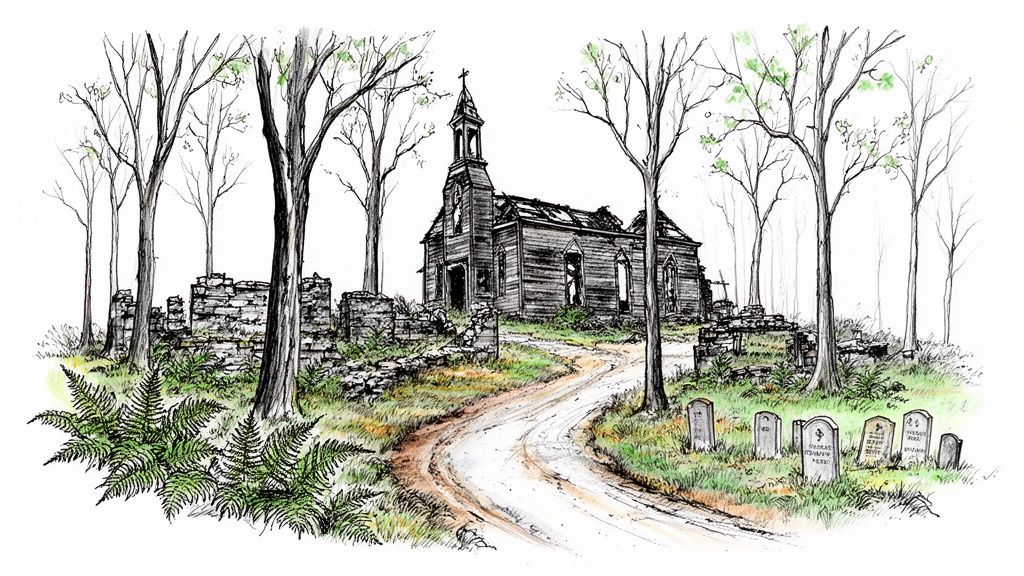
Exploring this area is a lesson in patience and observation. Tracing the faint outlines of old roads reveals home foundations slowly being overtaken by oak and hickory forests, while discovering the original mill site by a creek helps you visualize where community commerce once centered. The still-maintained Cane Hill Cemetery serves as a poignant connection, linking distant relatives to this abandoned place and underscoring the deep personal histories embedded in the land. This approach provides a full cultural experience, connecting the land's history with the lives of its former residents.
Practical Tips for Exploration
- Consult Local Historical Societies: Before your visit, contact the Washington County Historical Society. They can provide invaluable guidance, potential access notes, and historical context that is unavailable on-site.
- Use Topographic Maps: Official signage is minimal to nonexistent. Detailed topographic maps are essential for navigating the terrain and locating key features like old foundations or the mill site. GPS can be unreliable in this area.
- Respect Private Property and Cemeteries: Many of these remnants are on private land, and cemeteries may still be actively used by descendants. Always seek permission where required, tread lightly, and show the utmost respect.
- Document with Care: Consider documenting your visit through sketching or journaling rather than just photography. This slower, more deliberate method encourages deeper observation and connection with the environment, capturing the atmosphere of the place.
5. Ozark National Forest Ghost Communities: Remote Settlement Archaeology
Deep within the vast Ozark National Forest, a different kind of ghost town experience awaits. Instead of a single abandoned townsite, this exploration involves discovering the scattered remnants of homesteads, logging camps, and entire communities reclaimed by nature. These sites are less tourist destinations and more active archaeological landscapes, telling a complex story of settlement, federal land acquisition, and the often-forced displacement that created the "wilderness" we see today. Exploring these forgotten places offers a profound look at how one of the most unique collections of ghost towns in Arkansas was formed by policy and reforestation.
This journey is about landscape archaeology, reading the subtle clues left on the land. In areas like the Lost Valley Trail region, you can find visible homestead ruins integrated directly into scenic hiking paths. Similarly, the Brushy Creek area contains multiple abandoned farmsteads within miles of developed trails, marked only by crumbling stone walls or a lonely chimney stack. These discoveries provide a full cultural experience, forcing a reflection on how natural beauty often obscures a history of human displacement and forgotten lives.
Practical Tips for Exploration
- Consult Archival Maps: Before you go, contact the Ozark National Forest Supervisor's Office. They possess archival maps that document many of the abandoned sites, providing an invaluable starting point for your search.
- Embrace Off-Season Visits: Plan your exploration for late autumn or early winter. With minimal leaf cover, the faint outlines of foundations, root cellars, and old roadbeds become much more visible against the forest floor.
- Connect with Academic Experts: The archaeology department at the University of Arkansas often studies these settlement patterns. Reaching out can provide context on regional history and may even lead to information on specific, documented sites.
- Practice Strict Leave No Trace Ethics: These are fragile archaeological resources, not tourist attractions. Observe from a distance, take only photographs, and leave everything exactly as you found it to preserve the historical integrity of the sites.
This type of exploration offers a deeper, more thought-provoking connection to the past, revealing the hidden human stories embedded within a seemingly wild landscape. For those intrigued by how natural and cultural histories intertwine, our guide to the historic mining camps of Colorado provides a compelling look at similar themes in a different environment; you can learn more about these fascinating sites in our Colorado ghost towns article.
6. Murfreesboro Diamond Mining Ghost Town: Industrial Collapse Heritage
Centered in Arkansas's only diamond mining region, Murfreesboro presents a different kind of abandonment. Its story isn't tied to war or agricultural shifts but to the boom-and-bust cycles of industrial mining. The area is dotted with the remnants of past ventures, from abandoned worker housing dating back to the 1920s to deteriorating processing infrastructure, showcasing how a single-industry community falters when its primary resource wanes. This industrial heritage makes it one of the most compelling ghost towns in Arkansas for understanding economic precarity.
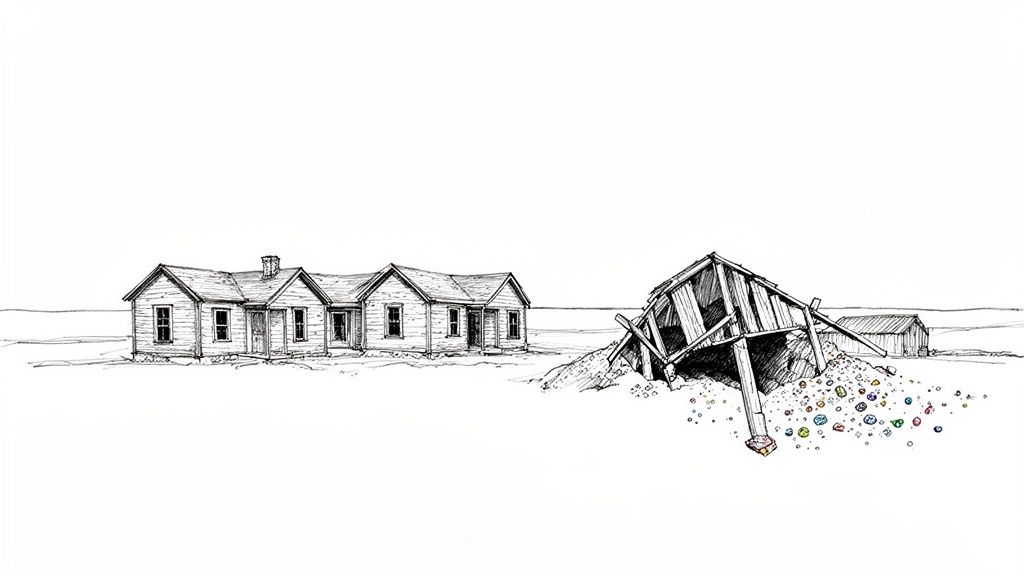
While the Crater of Diamonds State Park offers a commercialized glimpse into this history, a truly immersive experience involves exploring the genuinely abandoned sites scattered in the surrounding area. Here, you can trace the clear social stratification in the architecture of abandoned company housing or find cemeteries where graves are divided by occupation class. This exploration provides a full cultural experience, connecting the region's famous geology with the human stories of those who built their lives around it.
Practical Tips for Exploration
- Pair Park with Periphery: After visiting Crater of Diamonds State Park, dedicate time to the surrounding areas. Contact the Pike County Historical Society for a self-guided tour map of abandoned residential areas to see the direct impact of the industry's decline.
- Hear First-Hand Narratives: For a deeper connection, strike up a conversation with retired miners or their families at local cafes. Their personal stories of economic displacement offer insights you won't find in any museum or on any plaque.
- Investigate Social Hierarchies: Visit local cemeteries and note how sections are often divided by the miners' roles in the company. This provides a stark, visual lesson in the social structures of a single-industry town.
- Visit in the Off-Season: Plan your trip for late fall or winter when the vegetation has died back. This is the best time to see and photograph the foundations and ruins of abandoned structures that are otherwise hidden.
This focus on industrial collapse offers a unique lens for understanding regional history. For those interested in how different economic forces create abandoned landscapes, the mining ghost towns of the Southwest offer a powerful comparison; you can discover more by exploring these abandoned places in Arizona.
7. Buffalo River Valley: Agricultural Ghost Communities and Resettlement
Unlike a single town that faded away, the Buffalo River Valley is a landscape of ghost communities scattered along the nation's first National River. These aren't ruins from a sudden disaster but the quiet remnants of subsistence farming families and small settlements gradually abandoned or actively resettled during the park's creation in the 1970s. This area represents one of the most poignant and complex types of ghost towns in Arkansas, telling a story of conservation, displacement, and the end of a hardscrabble Ozark way of life.
Exploring this region offers an immersive cultural experience, where hiking trails often lead directly to abandoned homesteads, forgotten family cemeteries, and the stone foundations of old grist mills. Trails like the Lost Valley Trail and the Goat Trail wind through areas that were once thriving farmlands, and the physical remnants are deeply integrated into the natural landscape. The true journey here is understanding the competing claims on this land, from early settlers to the federal government, and the deep family connections that persist despite the changes.
Practical Tips for Exploration
- Book a Ranger-Led Program: Park rangers often share the complex displacement narratives that aren't highlighted on official signage. These programs provide invaluable context about the families who were moved to create the park, offering a more nuanced historical perspective.
- Genealogical Curiosity: Approach the numerous family cemeteries with a researcher's mindset. Many descendants still hold annual reunions and can be contacted for interviews by those showing genuine interest. Researching family names like Villines, Henderson, or Lackey before your visit can unlock incredible stories.
- Off-Season Immersion: Visit between November and March. With fewer crowds, you’ll have more opportunities for quiet reflection at historic sites and deeper conversations with park staff and locals in towns like Ponca or Jasper, many of whom have direct family ties to the relocated communities.
- Archival Research: For a truly deep dive, contact the Buffalo National River headquarters weeks in advance to inquire about accessing archival records related to the settlement and displacement history. This provides firsthand insight into the transition from private land to public park.
This approach transforms a simple hike into a profound exploration of cultural and environmental history. For those intrigued by the stories of communities shaped by large-scale federal projects, the ghost towns near Lake Mead offer a compelling parallel narrative, which you can explore in our guide to Nevada's ghost towns.
7-Site Comparison of Arkansas Ghost Towns
| Site | Complexity 🔄 (Implementation) | Resources ⚡ (Requirements) | Expected outcomes 📊 (Impact & Quality ⭐) | Ideal use cases 💡 | Key advantages ⭐ |
|---|---|---|---|---|---|
| Pea Ridge: Civil War Battlefield Ghost Town | Moderate 🔄 — interpretive park trails + some reconstructed sites | Low–Med ⚡ — park access, ranger programs, light walking gear | Solid historical interpretation; high educational value 📊 ⭐⭐⭐ | Guided history tours, gentle ghost‑town exploration, photography | Accessible infrastructure; ranger context; low cost ⭐ |
| Eureka Springs Historic Integrity vs. Abandonment | Moderate–High 🔄 — tourist hub plus remote abandoned sites | Med ⚡ — transport, guide, permissions for private land | Contrast-driven insights into curated vs. authentic narratives 📊 ⭐⭐ | Heritage-critique visits, shoulder‑season fieldwork, photo‑ethics studies | Dual experiences (revitalized town + raw ghost sites) ⭐ |
| Texarkana's Forgotten Neighborhoods | Low–Med 🔄 — urban walking access but legal/safety complexities | Low ⚡ — daytime visits, local contacts, basic safety prep | Urban decline documentation; strong oral-history potential 📊 ⭐⭐ | Urban archaeology, street photography, community interviews | Walkable access; authentic urban decay without staging ⭐ |
| Cane Hill: Civil War Era Mountain Community | High 🔄 — remote navigation, minimal signage, land access issues | Med–High ⚡ — topo maps, local genealogist/guide, reliable vehicle | Very authentic abandonment; powerful nature-reclamation visuals 📊 ⭐⭐⭐ | Genealogy-focused visits, immersive wilderness archaeology | Genuinely unmanaged sites; deep ancestral context ⭐ |
| Ozark National Forest Ghost Communities | High 🔄 — de‑marked sites, archival research and careful navigation | Med ⚡ — hiking gear, Forest Service archives, guided expertise | Complex conservation/displacement insights; ethically weighty 📊 ⭐⭐ | Research-oriented archaeology, conservation ethics study | Forest trails + archival records; low commercialization ⭐ |
| Murfreesboro Diamond Mining Ghost Town | Medium 🔄 — mix of commercialized park and nearby abandoned industrial sites | Med ⚡ — car travel, historical society contacts, seasonal timing | Industrial boom–bust case study; socio-economic lessons 📊 ⭐⭐ | Industrial archaeology, economic‑history tours, archival interviews | Strong local archives; clear industrial heritage contrast ⭐ |
| Buffalo River Valley: Agricultural Ghost Communities | Med–High 🔄 — NPS-managed access with sensitive displacement history | Med ⚡ — ranger programs, hiking, advance archival requests | Nuanced narratives of conservation vs. forced relocation 📊 ⭐⭐⭐ | Ethical exploration, restorative‑justice focused visits, ranger programs | Stunning landscapes + NPS interpretation; documented histories ⭐ |
A Traveler's Guide to Ethical Exploration and Local Connection
From the Civil War echoes at Pea Ridge and Cane Hill to the faded industrial dreams near Murfreesboro, the journey through the ghost towns in Arkansas is a profound exploration of the state's very soul. We've traversed landscapes shaped by conflict, economic booms and busts, and the relentless pull of nature reclaiming what was once tamed. The silent streets of Texarkana's forgotten quarters and the scattered homesteads along the Buffalo River Valley are not just destinations; they are chapters in a larger story of resilience, ambition, and the inevitable passage of time.
This guide provides more than just coordinates and historical trivia. It serves as a framework for a deeper, more meaningful travel experience. The core takeaway is that these are not empty places, but landscapes rich with untold stories. Your visit becomes a powerful act of preservation when you approach it with respect, curiosity, and a commitment to understanding the human element behind the decay.
Your Path to Deeper Discovery
To transform your adventure from a simple sightseeing trip into an immersive cultural experience, consider these actionable steps as you plan your itinerary:
- Engage with Local Keepers of History: Before you even leave home, connect with the historical societies in the counties you plan to visit. These organizations are often run by passionate volunteers, many of whom are direct descendants of the families who lived in these now-abandoned communities. They can provide invaluable context, share personal anecdotes, and sometimes even grant access to areas not open to the general public.
- Prioritize Primary Sources: Seek out local libraries and county archives near your target destinations. Reading old newspapers, studying historic maps, and looking at archival photographs can completely reframe what you see on the ground. A pile of foundation stones becomes the site of a specific family's home, and an overgrown path transforms into a once-bustling main street.
- Support the Local Economy: Your exploration of ghost towns in Arkansas directly impacts the living communities nearby. Choose to eat at the family-owned diner, stay at the local inn, and buy supplies from the town's general store. These interactions are not just transactions; they are opportunities to hear modern stories and connect with the people who are the living legacy of the region's history.
Ethical Exploration: A Traveler's Code
Remember, these sites are fragile. The most important principle is to leave no trace, and take only photographs. Never remove artifacts, disturb structures, or trespass on private property. The goal is to be a witness, not a participant in the decay.
By embracing this mindset, you are doing more than just visiting a location. You are actively participating in the preservation of Arkansas's unique and often-overlooked heritage. Your respectful curiosity honors the lives that were lived and the dreams that were built in these now-quiet corners of The Natural State, ensuring their stories continue to be told.
Ready to build your own immersive journey through Arkansas's hidden past? CoraTravels offers curated guides and interactive maps designed for travelers seeking authentic, off-the-beaten-path experiences. Discover more forgotten histories and plan your next cultural adventure with us at CoraTravels.