When you're packing for South Korea, the one little gadget you absolutely can't forget is a power adapter for Type C or Type F plugs. The country runs on a 220V and 60Hz system, which is great news because most modern electronics can handle this just fine. Think of an adapter as a simple translator—it lets your plug talk to the Korean wall socket, whether you're in a futuristic Seoul skyscraper or a quiet tea house in rural Boseong.
Your Quick Guide to Powering Devices in Korea
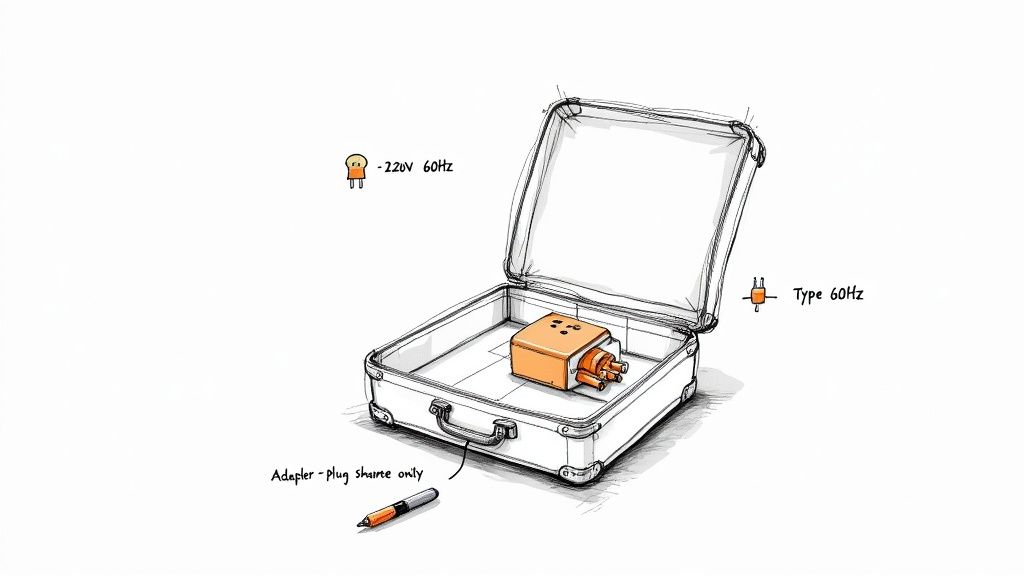
Figuring out a new country's electrical system can feel a bit daunting, but for Korea, it's actually pretty straightforward. Their setup is very similar to what you'd find in much of Europe and Asia, making things easier for travelers looking for an immersive experience beyond the main tourist hubs.
If you’re bringing the usual suspects—your smartphone, laptop, and camera—chances are all you'll need is a basic plug adapter. These modern devices are almost always "dual-voltage," meaning they're built to automatically adjust to different power inputs without needing a clunky, heavy voltage converter. This guide will give you a quick, no-fuss summary so you can get your gear charged up the second you arrive. We'll also clear up the difference between a simple power adapter for Korea and a voltage converter so you pack exactly what you need for a deep cultural dive.
To give you a clearer picture, here's a quick rundown of what you're working with in South Korea.
South Korea Electrical Standards at a Glance
| Specification | Details for South Korea | What This Means for You |
|---|---|---|
| Plug & Socket Type | Type C and Type F | You'll need an adapter with two round pins. |
| Standard Voltage | 220V | Higher than North America's 110-120V. Check your device labels. |
| Standard Frequency | 60Hz | Most modern electronics are fine with this. |
Essentially, the main thing you need to solve is the physical shape of the plug.
Understanding Korean Electrical Standards
To make sure everything goes smoothly, it helps to get your head around the three main pieces of Korea’s electrical puzzle. Getting this right means safe and speedy charging, whether you're in a high-tech Seoul cafe, a traditional hanok guesthouse in Jeonju, or a seaside inn in Gangneung.
- Plug Type: Korea uses Type C and Type F sockets. Both have two round pins, but Type F adds two grounding clips on the side for extra safety. They are compatible with each other.
- Voltage: The standard here is 220V. This is a big jump from the 110-120V found in North America, so checking your device's compatibility is non-negotiable.
- Frequency: The current alternates at 60Hz. Most of your gear won't even notice the frequency, but some very specific equipment might be sensitive to it.
A travel adapter is like the right key for a foreign lock—it doesn't change the power flowing through the wall, it just changes the shape of your plug so you can connect.
This is the most critical concept to remember. For nearly every traveler, a simple, cheap plug adapter is the only thing you’ll need to stay powered up. The next sections will show you exactly how to check your devices and pick the perfect adapter for your trip.
Getting to Know Korea's Plugs and Sockets
First thing you'll notice in your hotel room in Seoul is the wall outlet. It probably looks different from what you've got back home. The good news? South Korea keeps it simple, using just two types of sockets that are standard across most of Europe. This makes finding the right power adapter for Korea a whole lot easier, leaving you more time to explore off-the-beaten-path alleyways and local markets.
You'll be dealing with Type C and Type F plugs. They look almost identical, with two round pins, but knowing the small difference between them can save you some headaches. A wobbly, loose-fitting plug isn't just annoying—it can cut off your charge or even cause a dangerous electrical spark.
The Two Main Korean Plug Types
Let's get straight to it. Both plugs you'll see have two round pins, which is the key feature to remember. This is great news if you're hopping around Europe and Asia, as you'll see these everywhere.
- Type C (Europlug): This is your basic, no-frills plug. It has two simple round pins and is ungrounded. You'll typically find it on smaller gadgets that don't draw much power, like your phone charger or electric toothbrush.
- Type F (Schuko): This one also has the two round pins but adds two grounding clips on the sides (top and bottom). That grounding is a crucial safety feature for more power-hungry devices like your laptop or camera battery charger, protecting them from unexpected power surges.
The best part? A Type C plug fits perfectly into a Type F socket. This means you don't have to hunt for a specific outlet—they're designed to work together seamlessly.
This simple, standardized system is a big deal globally. Korean electronics giants have played a huge role in the worldwide demand for power adapters. In fact, the 200V-240V AC input type—standard in Korea—is projected to make up a massive 42.7% of the global power adapter market's revenue in 2025. That shows you just how common this setup is. If you're curious, you can find more market insights on power adapters at Mordor Intelligence.
Choosing Your Adapter with Confidence
So, what does this all mean for your packing list? Simple. You just need a travel adapter that turns your home country's plug shape into the two-round-pin design of Type C or F. A universal adapter is usually your best bet, as it'll cover Korea's plugs and pretty much any others you might run into on future trips.
Knowing what to look for means you can grab an adapter that gives you a snug, reliable fit. It’s a small detail that guarantees your gear gets a steady charge, so you can focus on navigating the Busan metro to find a hidden temple, not worrying about a dead phone battery.
Adapter or Converter: What’s the Difference and Which Do You Need?
Getting your electronics juiced up in a new country can feel a little intimidating, but figuring out if you need a power adapter or a voltage converter for South Korea is actually pretty straightforward. Get this right, and you're golden. Get it wrong, and you might accidentally fry your favorite gadget while trying to find that hidden gem restaurant your new local friend recommended.
Let’s break it down with a simple analogy.
A plug adapter is like a translator. It doesn't change the meaning of what's being said, it just changes the language so the other person can understand. Similarly, an adapter changes the physical shape of your plug to fit into Korea's round Type C or Type F sockets. It doesn’t touch the electricity itself.
A voltage converter, however, is like a currency exchanger. It takes the powerful 220 volts (220V) coming from the wall in Korea and fundamentally changes its value, "stepping it down" to a lower voltage (like 110V) that some devices from North America need.
The Magic Words on Your Power Brick
So, how do you know what your gear needs? Simple—your device will tell you.
Grab your laptop charger, phone brick, or camera battery charger and look for the fine print. You’re hunting for a line of text, usually next to the word "INPUT."
If you see "INPUT: 100-240V", you've hit the jackpot. This means your device is "dual-voltage" and can handle anything from 100V to 240V without breaking a sweat. It will automatically adjust to Korea's 220V system. All you need is a simple plug adapter to make it fit the wall.
This quick visual guide shows the two types of plugs you'll find all over South Korea.
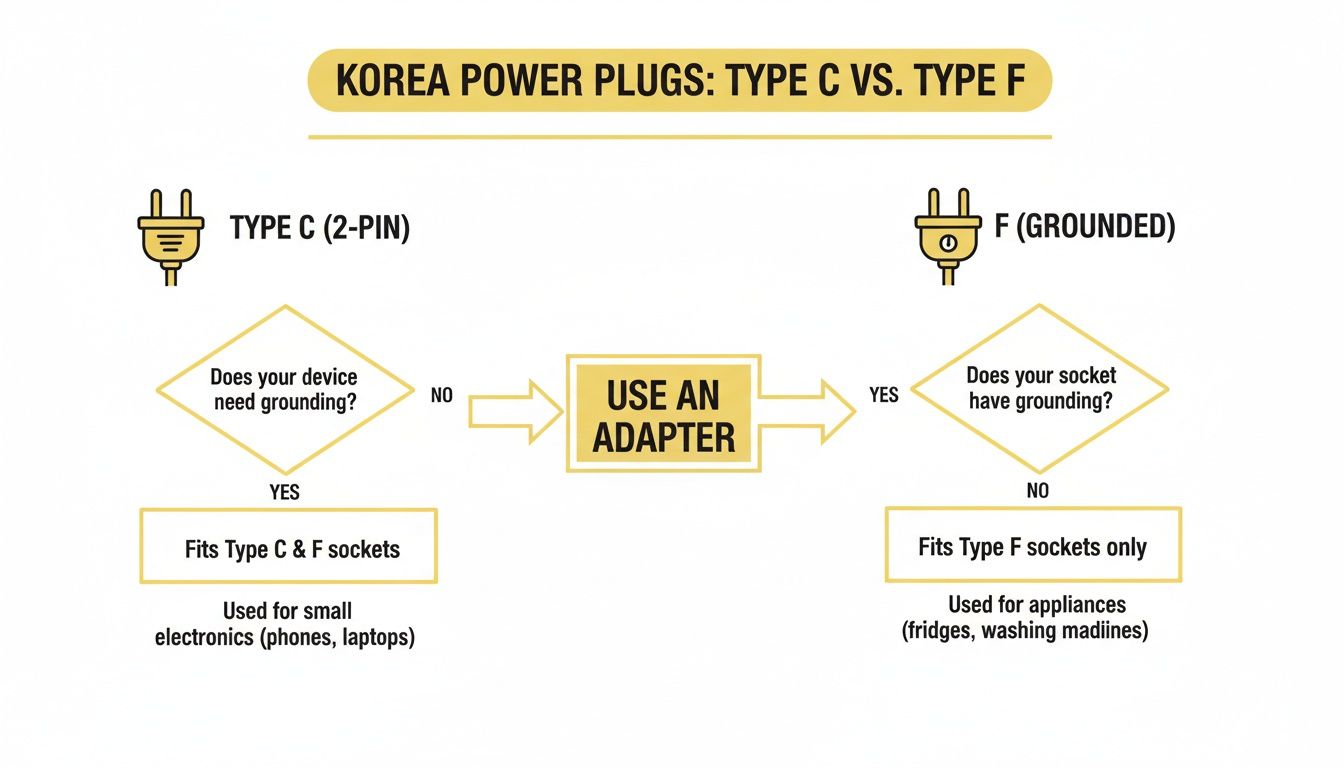
As you can see, you've got the basic two-pin Type C plug and the slightly thicker, grounded Type F. A good adapter will handle both.
When You Absolutely Need a Converter
The good news is that most modern electronics—your smartphone, laptop, camera, and tablet chargers—are designed for global travel. They’re almost always dual-voltage and won't need a clunky, expensive converter.
The exceptions are usually high-power heating appliances, especially older ones from North America. Think hair dryers, curling irons, and electric razors. These are often single-voltage and are only designed for the 110-120V system.
Plugging a 110V hair dryer directly into a 220V Korean outlet (even with an adapter) will send a massive surge of power into it, instantly overloading the circuits. Best case, you fry the device. Worst case, you start a fire.
To keep your tech safe and your trip stress-free, just run through this checklist before you pack:
- Check Every Label: Look for that "100-240V" text on every single electronic device you're bringing.
- Adapter Only: If it's dual-voltage, all you need is a simple power adapter for Korea.
- Converter Required: If your device is single-voltage (110V or 120V), you absolutely must use a step-down voltage converter.
- Leave It at Home: Honestly, for things like hair straighteners or dryers, it's often safer, cheaper, and way easier to just leave your single-voltage one at home and buy an inexpensive one when you arrive in Korea. This is a perfect excuse for a quick trip to a local shop.
How to Choose the Best Power Adapter for Your Trip
Picking the right power adapter for Korea is about more than just making your plug fit the wall. Think of it as choosing a reliable travel partner for all your gadgets. Not all adapters are created equal, and a cheap, flimsy one can be a massive headache—or worse, a single point of failure that fries your expensive gear right before you head out to explore a remote hiking trail in a national park.
Honestly, the smartest move for any international traveler is to get a solid, high-quality universal adapter. Sure, those little single-country adapters are cheap and small, but they become paperweights the second you plan a trip anywhere else. A good universal model is a long-term investment that’ll have your back from Seoul to Sydney.
Features That Make a Difference
When you're comparing options, look for the little things that add serious convenience and safety. A modern travel adapter shouldn't just be a plug converter; it needs to be your central charging hub, especially when you find yourself with only one free outlet in a busy café or a cozy guesthouse in a less-traveled city like Gyeongju.
Here’s what really matters:
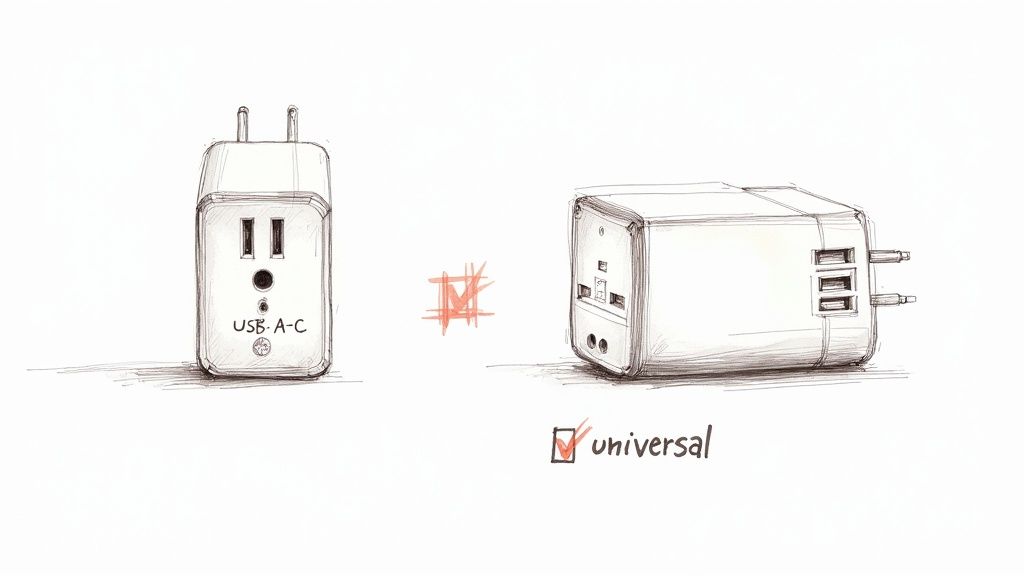
- Multiple USB Ports: Ditch the mess of bulky chargers. An adapter with built-in USB-A and USB-C ports lets you charge your phone, camera battery, and power bank all from a single wall socket. It’s a game-changer for staying organized.
- USB-C Power Delivery (PD): If you're traveling with modern gear like a laptop or a newer smartphone, a USB-C PD port is non-negotiable. It pushes out way more power than a standard USB, slashing your charging time so you can get back out and explore.
- Surge Protection: Power grids aren't always perfect, and small fluctuations can happen. An adapter with surge protection is like a personal bodyguard for your electronics, shielding them from unexpected voltage spikes that could cause permanent damage.
Think of a universal adapter as a travel multitool. It’s compact, does multiple jobs at once, and makes sure you're ready for whatever charging situation you run into on the road.
Compact Design and Durability
Finally, pay attention to the adapter's build quality. The best ones are compact, lightweight, and made from tough materials that can handle being tossed into a backpack day after day. Look for designs with retractable prongs and a smooth finish that won’t snag on your clothes or cables.
Choosing an all-in-one adapter with these features gives you a safe, efficient, and clutter-free way to keep everything powered up. It’s a small investment that pays off big by simplifying your packing and protecting your gear, letting you focus on the real reason you're in Korea—the incredible culture and immersive experiences.
Where to Find an Adapter Like a Local in Korea
So, you've just landed at Incheon, buzzing with excitement to explore, and then it hits you: your power adapter is sitting on your desk back home. Don't panic. Finding a power adapter for Korea is incredibly easy—and a great first chance to dive into local life and go beyond the main tourist areas.
Your first and most convenient stop should be one of the thousands of convenience stores. Forget the pricey airport shops. Just look for a GS25, CU, or 7-Eleven. You’ll find one on nearly every corner, and they almost always stock basic, affordable travel adapters. It's the perfect quick fix to get your phone charging right away.
Beyond the Convenience Store: An Immersive Local Guide
For a more immersive shopping trip and even better prices, do what the locals do. Head to Daiso, the beloved variety store with locations all over Korea. Here, you'll find a simple travel adapter for just a few thousand won, usually around ₩3,000-₩5,000 (about $2-$4 USD). It’s a genuine local shopping experience.
If you need something more robust, like a universal adapter with USB-C ports, the big-box electronic stores are your best bet.
- Hi-Mart and ET Land are major electronics retailers with a wide selection of premium adapters.
- For an off-the-beaten-path experience, venture into a neighborhood traditional market (sijang). Tucked among the food stalls and household goods, you'll often find small hardware shops selling all kinds of electrical supplies, including adapters. This is where you'll get a real slice of daily Korean life.
- If you're in Seoul, the Yongsan Electronics Market is an entire district dedicated to tech, offering pretty much anything you can imagine.
For a true local experience, try asking for an adapter in Korean. A simple, polite phrase is all you need: "어댑터 있어요?" (eodaepteo isseoyo?), which just means, "Do you have an adapter?"
Other Local Options and Tips
Before you even step out to buy one, always ask at the front desk of your guesthouse or hotel. Many keep a stash of adapters left by previous travelers for guests to borrow. This is especially common in places that cater to international visitors.
This kind of local knowledge is a small part of understanding Seoul's 24/7 energy. You can discover more about the city's unique pulse in our guide to Seoul's K-culture and nonstop energy.
Navigating these local spots not only solves your charging problem but gives you a small, authentic taste of daily life in Korea. And it's no surprise adapters are so easy to find; with Korean tech giants exporting over 200 million smartphones annually, the demand for power accessories is massive. It's a market projected to grow from USD 44.92 billion in 2025 to USD 112.62 billion by 2030, showing just how essential these little gadgets have become worldwide.
Beyond the Adapter: How to Stay Charged for a Full Cultural Experience
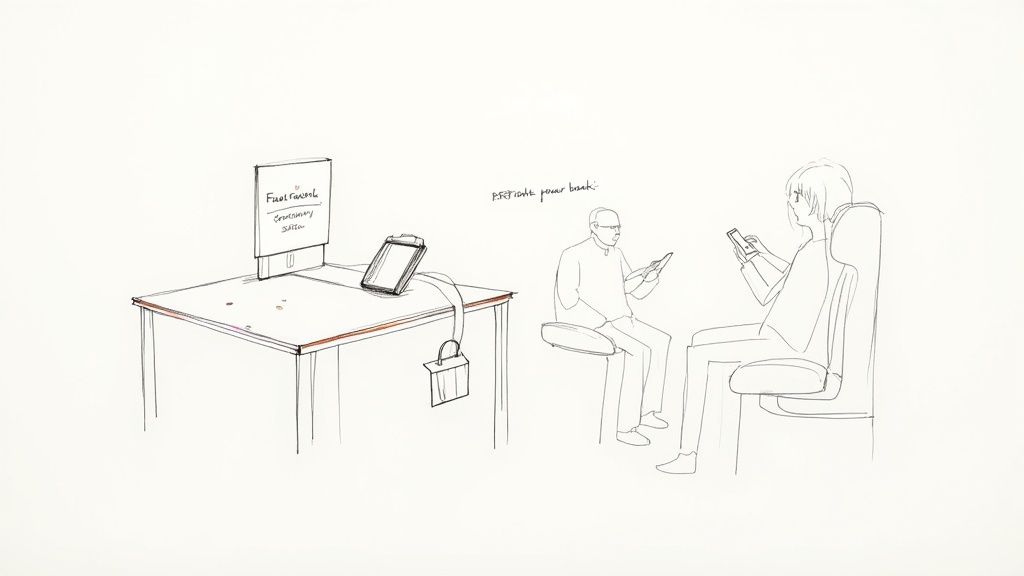
Okay, you've got the right power adapter for Korea. That's step one. But to truly immerse yourself and navigate the country like someone who lives here, you have to plug into the local charging culture—which is way more than just what comes out of a wall socket.
South Korea is hyper-connected, and the entire country is built on the understanding that a dead phone is a modern-day catastrophe. This means you are almost never far from a power source, even when you're wandering through a quiet, historic neighborhood or hiking in a national park.
Embracing the Local Charging Culture
You'll see free public charging stations everywhere: subway stations, cafes, shopping malls, and even on the KTX high-speed trains. They're a total lifesaver. Just be mindful of local etiquette—it's good form to only charge up as much as you need before letting someone else have a turn. This small act of consideration is a part of the local culture.
The real secret weapon for an immersive, off-the-beaten-path day is the portable power bank. Here, it's called a '보조 배터리' (bojo baeteoli), and carrying one isn't just a tourist tip; it’s a core part of daily life. It ensures you can keep navigating, translating, and snapping photos all day without a single worry.
This habit of being prepared is a skill every traveler should adopt. It's what allows you to say "yes" to spontaneous detours, like following a hidden alley to a local tea house or taking a long walk through a part of the city not mentioned in guidebooks.
Powering Up for Deeper Connection
Keeping your battery full is really about maintaining your digital lifeline for a deeper cultural experience. It's for your maps to find that obscure art gallery, your translation app to chat with a shopkeeper, and your ability to connect with people. A charged phone means you can always find that hidden gem of a restaurant or stay in touch with new friends.
And while you're keeping your devices physically powered, don't forget about your data connection. It's smart to look into reliable eSIM and data options for South Korea before you land. Having both a charged battery and a solid internet connection is the key to a stress-free trip where you can blend in and explore with the confidence of a local.
Power Adapter Questions You're Probably Asking
Got a few last-minute questions buzzing around? Good. Getting these details right is what separates a smooth trip from a frustrating one. Here are the most common things travelers wonder about before they land in Seoul.
So, Can I Use My European Plug in South Korea?
Yes, almost certainly. If you're coming from Europe, you're in luck. South Korea uses the same Type C and Type F sockets that are standard across most of the continent. Your trusty two-pin "Europlug" will feel right at home.
Because European gadgets are already designed for a 220-240V system, you won't need a voltage converter either. It's one of the rare times in international travel where things just... work.
What Actually Happens If I Plug a 110V Device into a 220V Outlet?
Think of it like trying to fill a small water balloon with a fire hose. Plugging a device built only for 110V (common in North America) into a 220V Korean socket without a step-down converter is a recipe for disaster. You’re sending double the electricity it was designed to handle.
The result isn't pretty. The device's internal circuits will almost instantly overload. Best case? It's permanently fried. Worst case? Smoke, sparks, or even a small fire. Always, always check the label for "INPUT: 100-240V" before you even think about plugging it in.
Are USB Ports Common in South Korean Hotels?
You'll find them more and more, especially in newer hotels, trendy cafes, airports, and even on the KTX high-speed trains. Korea is a tech-savvy place, and built-in USB ports are becoming a standard convenience.
But don't count on them exclusively, especially if you plan to get off the beaten path. If you end up in an older hotel or a charming traditional guesthouse (hanok) in a rural town, you might be out of luck. The smart move is to bring your own adapter with multiple USB ports. That way, you’re guaranteed a charging spot for all your gear, no matter where your journey takes you.
At CoraTravels, we get that the small stuff makes the biggest difference. Our guides are packed with on-the-ground knowledge to help you have a full cultural experience, not just a vacation. Discover more insider tips for your trip at CoraTravels.