
Taking the train from Venice to Milan is more than just a trip; it's a rite of passage through the cultural and economic heart of Northern Italy. With high-speed trains like the Frecciarossa and Italo, you can glide from the ethereal canals of Venice to the fashion capital of Milan in a little over 2 hours. This is a seamless journey that swaps lagoon views for city bustle, offering a unique window into the Italian way of life.
Your Essential Italian Rail Journey Overview
Think of this guide as having a local friend walk you through the process, sharing insights that go beyond mere timetables. This isn't just about getting from Point A to Point B; it's about understanding the rhythm of travel in Northern Italy, uncovering hidden gems, and turning a simple train ride into a rich, cultural experience.
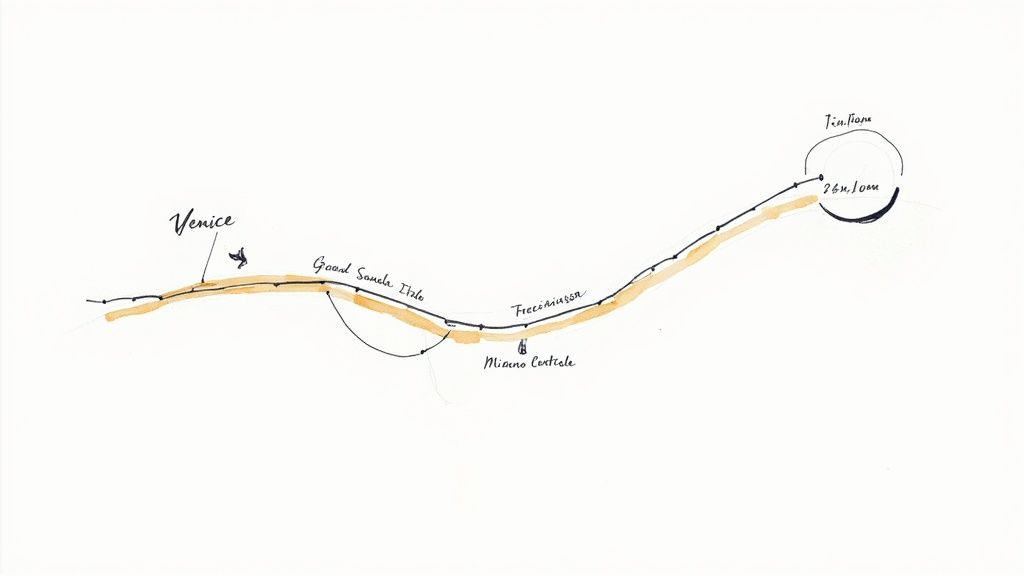
A Route Steeped in History
You're not just traveling on any old railway line. This track is one of Italy's most historic, first laid down in the 1840s when the region was still under the Austrian Kingdom of Lombardy-Venetia.
The most critical part of this project, the Ponte della Libertà, is the long bridge connecting Venice's islands to the mainland. It officially opened way back on January 13, 1846. Every time your train glides over that bridge, you're crossing a genuine piece of Italian engineering history, a vital artery that connects the unique island city to the rest of the country.
Venice to Milan Train Options At a Glance
So, what are your choices for this trip? At a high level, you're looking at two high-speed competitors and a slower, more authentic local option. This quick table breaks it down, but we'll dive much deeper into the pros and cons of each service later on.
| Feature | Frecciarossa (Trenitalia) | Italo Treno | Regionale (Regional Train) |
|---|---|---|---|
| Typical Travel Time | Around 2 hours 15 mins | Around 2 hours 25 mins | 3 hours 30 mins or more |
| Best For | Speed, frequent departures, and network size | Modern trains and often competitive pricing | Immersive, off-the-beaten-path travel |
| Primary Stations | Venezia S. Lucia → Milano Centrale | Venezia S. Lucia → Milano Centrale | Varies, makes multiple local stops |
Each of these train types offers a completely different travel experience, from the high-tech efficiency of the high-speed lines to the unhurried, immersive pace of the regional service.
This journey is a fantastic window into how modern Italy works. For a broader look at navigating the country like a pro, be sure to check out our complete guide to traveling in Italy.
Choosing Your Ideal Train Experience
Taking the train from Venice to Milan isn't just about picking a departure time; it's about choosing the kind of journey you want. The two main high-speed players, Frecciarossa and Italo, offer completely different vibes, kind of like picking between two stylish Italian cafés. Your decision shapes everything from your comfort level to the glimpses of countryside you'll get along the way.
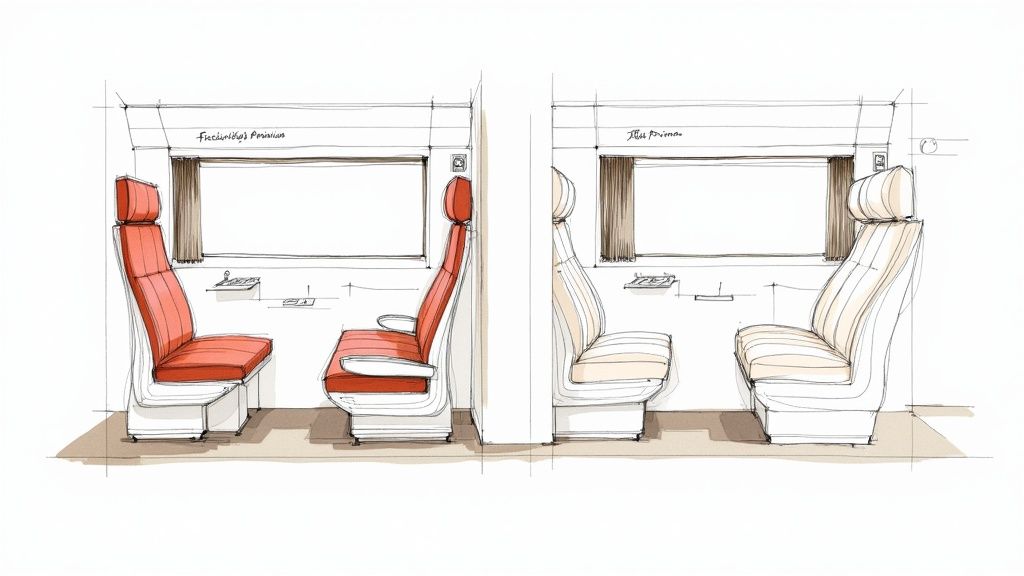
Frecciarossa, run by the state-owned Trenitalia, feels classic and established. Its carriages are comfortable and designed for efficient, no-fuss travel. Italo, on the other hand, is the sleek, modern challenger with its signature burgundy trains and interiors that feel a bit more design-forward.
The good news? Both get the essentials right. You can count on free Wi-Fi and power outlets at your seat, keeping you connected as you slice through the Italian landscape.
High-Speed Red Arrow or Modern Competitor?
Think of Frecciarossa as the dependable veteran and Italo as the chic newcomer. This rivalry is fantastic for travelers because it keeps prices competitive and service sharp.
- Frecciarossa (The Red Arrow): As part of Trenitalia's massive network, these trains offer several service levels. Standard is perfectly practical, but an upgrade to Premium gets you leather seats and a welcome snack and drink. For even more comfort, Business class provides wider seats and more personal space.
- Italo Treno: Known for its modern fleet, Italo's classes have different names but offer similar perks. Its entry-level "Smart" is efficient, while "Prima" class is a solid match for Frecciarossa's Premium, often including a complimentary drink and snack service.
Italy has a surprisingly long history with high-speed rail, introducing cutting-edge trains on major routes like Milan to Venice way back in the late 1980s. Today's Frecciarossa trains can hit speeds of up to 300 km/h on parts of this route, turning what could be a long haul into a quick jaunt.
Honestly, the best choice often boils down to the schedule and price on your specific travel day. I always recommend checking both operators before you book. One might have a killer deal or a departure time that fits your itinerary perfectly while the other doesn't.
The Slow Travel Alternative: The Regionale Veloce
If you're not in a hurry, there's a much more authentic way to travel. The Regionale Veloce (fast regional) train offers a completely different experience. It’s the local's choice—slower, simpler, and a whole lot cheaper. This is where you'll share a carriage with students, commuters, and nonnas visiting family, offering a real slice of daily Italian life.
This train makes more stops, giving you a proper look at the small towns and rolling landscapes that are just a blur from the high-speed lines. There are no seat reservations and the amenities are basic, but the trade-off is a journey that feels more connected to the land you're passing through.
It’s the perfect option for a spontaneous traveler on a budget or anyone looking to embrace a more unhurried, off-the-beaten-path approach to their Italian adventure.
While you're planning this essential Venice to Milan trip, you might also be curious about other luxury train experiences like the Palace on Wheels, which offer a completely different take on rail travel.
Navigating Venice and Milan Stations Like a Local
Italian train stations aren’t just places you pass through; they're the grand front doors to the city. Stepping off the train is your first real taste of a new place, and knowing the lay of the land can turn a potentially stressful moment into a smooth, immersive start. The venice to milan train journey connects two of Italy's most impressive, and very different, transport hubs.
Your arrival in Venice sets the entire tone for your trip. For the classic, jaw-dropping experience, make sure your ticket is for Venezia Santa Lucia. This is the one. The station doors open directly onto the Grand Canal, swapping roads and cars for vaporetti (water buses) and gondolas. It’s an arrival you won't find anywhere else on earth.
On the other hand, Venezia Mestre is on the mainland. While every high-speed train stops there first, it’s mostly a commuter hub for people staying in hotels outside the historic center. If you're heading for the heart of Venice, you absolutely must stay on the train for that final ten-minute ride across the lagoon to Santa Lucia. It's non-negotiable.
Insider Tips for Venezia Santa Lucia
Once you step out of Santa Lucia, you’re immediately in the thick of it. The area right in front can be a bottleneck of tourists taking it all in. To skip the chaos, just hang a left. You'll find the main vaporetto ticket kiosks and docks there, ready to whisk you away.
- Buying Tickets: Get your water bus passes from the official ACTV kiosks. It’s the simplest way to avoid any confusion.
- Finding Your Way: Before diving into the maze of alleys, look for the signs pointing toward major landmarks like Rialto or San Marco. For a true local experience, follow the signs to the Cannaregio district for authentic bacari (wine bars) and a quieter atmosphere.
This station is your first interaction with the city's unique, water-based rhythm. Embrace it.
Here's a local trick: before you even step outside, grab a quick espresso at one of the small bars inside the station. You'll pay a fraction of what the canal-front cafés charge just a few feet away. It gives you a moment to pause, check your map, and plan your next move away from the crowds.
Demystifying Milano Centrale
Arriving at Milano Centrale is a completely different world. Built in 1931, this place is an absolute beast—an architectural marvel of imposing Fascist-era design with incredible Art Deco details. Its sheer size can feel intimidating at first, but it’s surprisingly well-organized.
The platforms are all on the upper level. After you get off the train, you’ll ride the escalators down into the main hall, which is packed with shops and ticket counters. The metro is your best friend for getting around Milan. Just follow the big red "M" signs to connect to the subway system, which will get you to the Duomo or your hotel in no time.
Need to stash your bags? Look for the deposito bagagli (left luggage) signs, usually on the ground floor.
For a more local entry point, some trains, especially Italo, use Milano Porta Garibaldi. It's a much sleeker, more modern hub and a better bet if you're staying in the trendy, off-the-beaten-path neighborhoods of Isola or Porta Nuova.
Mastering the Art of Booking Italian Train Tickets
This is where a little planning can save you a surprising amount of money. Think of booking a high-speed train in Italy just like you would a flight—the earlier you lock in your seat, the better the price you’re going to get. It really is that simple. The trick is just knowing where to look.
You can go straight to the source and book directly with the train operators themselves, which are Trenitalia (for Frecciarossa) and Italo. This is always a solid bet. Alternatively, you can use a third-party aggregator, which sometimes offers a more streamlined booking experience if you're juggling multiple countries or just prefer their interface.
Decoding Italian Train Fares
Getting the best deal really comes down to understanding the different ticket types. High-speed trains in Italy don't have one set price; they use a dynamic system, meaning prices change based on demand and how far in advance you book.
Here’s a quick rundown of what you’ll see:
- Super Economy: This is your rock-bottom, cheapest fare. The catch? It's completely non-refundable and non-changeable. It’s perfect if your travel plans are 100% locked in.
- Economy: A fantastic middle ground. It’s still a great price but gives you a bit of breathing room. You can usually make one change to your booking for a fee, which is why it's a go-to for many travelers.
- Base/Flexi: This is the full-price, most flexible ticket. It lets you make multiple changes and often offers a partial refund if you need to cancel. If there's any chance your plans might shift, this is the safest option.
The map below gives you a sense of how you'll move from Venice's canals to its mainland train connections.
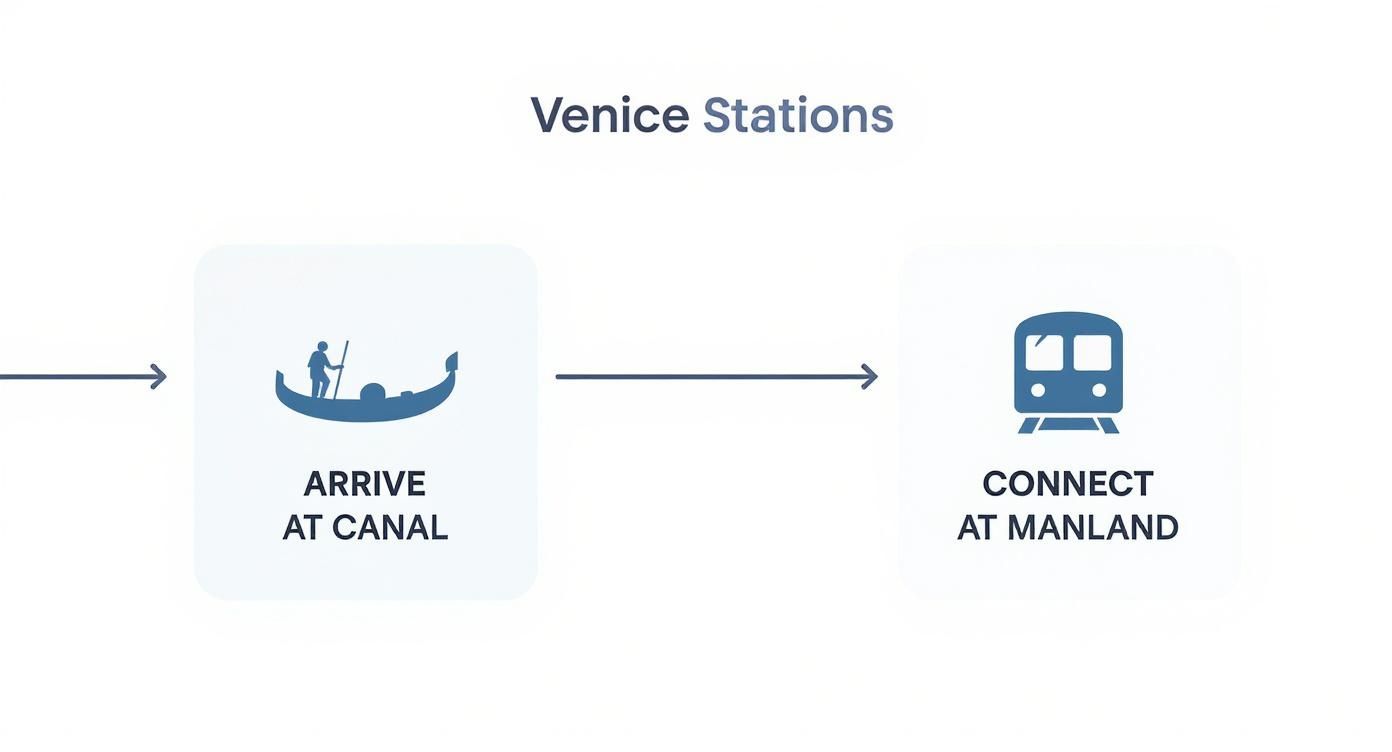 As you can see, the journey over the bridge to Venezia Santa Lucia is what truly delivers you into the heart of Venice, right on the Grand Canal.
The Most Important Rule: Ticket Validation
Okay, this is one of the most critical things to get right when traveling by train in Italy. Knowing the difference between a high-speed ticket and a regional ticket can save you from a seriously unpleasant fine.
A high-speed ticket for Frecciarossa or Italo is for a specific train at a specific time. It comes with a reserved seat and a PNR (Passenger Name Record) code. This ticket does not need to be validated. Just hop on, find your seat, and you're good to go.
A regional train ticket, on the other hand, is a different beast entirely. It’s more like an open ticket for a particular route, valid for a certain window of time. Before you get on the train, you must validate it at one of the small green, white, or yellow stamping machines (convalidatrice) on the platform.
Forgetting this step is a costly mistake—fines can be €50 or more, payable on the spot. Always, always check what kind of ticket you're holding.
Discovering Italy's Hidden Gems Between Cities
The train ride from Venice to Milan doesn't just have to be a blur of countryside flying past your window. Think of the railway line as a thread connecting some of Northern Italy's most incredible, and often overlooked, cities. If you embrace a "slow travel" mindset, what was once a simple transit day can become a multi-city adventure.
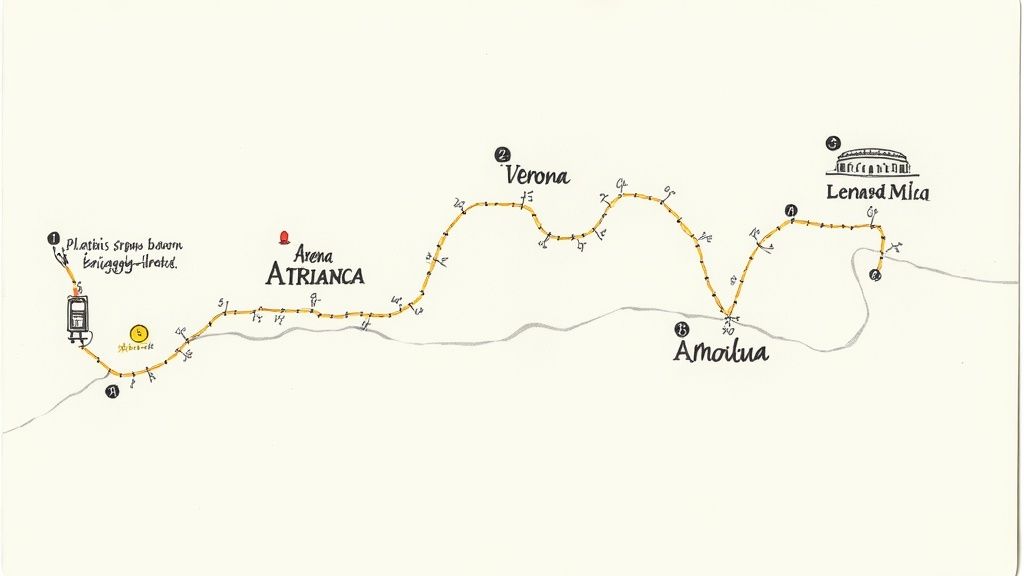
It’s surprisingly simple. Just imagine hopping off the train midway, stashing your bags, and spending a few hours wandering through a historic town square before catching your next train. This is how you find the real heart of the Veneto and Lombardy regions, far from the well-trodden tourist paths.
Three Perfect Stopover Cities
The route is practically paved with fantastic options, each offering a completely different flavor of Italian life. Here are three of the best candidates for a quick 3-4 hour cultural pit stop:
- Verona, The City of Romance: Famous as the backdrop for Shakespeare's Romeo and Juliet, Verona is a knockout. It boasts a Roman amphitheater that gives the Colosseum a run for its money and is perfect for anyone who loves history, literature, and getting lost in romantic, cobbled alleys.
- Vicenza, The Architectural Gem: A UNESCO World Heritage site, Vicenza is basically a living museum of Renaissance architecture, thanks to the legendary Andrea Palladio. It’s a must for lovers of design, art, and elegant, crowd-free piazzas.
- Padua, The Artistic Powerhouse: Home to one of Europe's oldest universities, Padua is where you'll find Giotto's jaw-dropping Scrovegni Chapel frescoes—a true masterpiece of Western art. This city has an energetic, scholarly vibe that’s perfect for art history buffs.
While you're soaking in Italy's modern beauty, it's pretty wild to think about its economic history, like the old Italian Lire currency that was in everyone's pockets before the Euro came along.
Your 4-Hour Verona Itinerary
So, let's get practical. Verona is probably the easiest and most popular place to pull this off. The main station, Verona Porta Nuova, has a reliable luggage storage facility (look for the deposito bagagli sign), making a quick visit completely hassle-free.
A stopover is the ultimate travel hack for seeing more of Italy with less fuss. For the price of a few hours and a luggage storage fee, you essentially add another city to your itinerary without booking another hotel.
Once your bags are safe, it’s a quick 15-minute bus ride or a pleasant 25-minute walk into the historic center. Here's a little guide I've put together to help you squeeze the most out of your time.
Sample Stopover Itinerary Verona
This mini-guide is your blueprint for a 4-hour immersive stop in Verona on your way from Venice to Milan. It’s fast, but you'll hit all the highlights.
| Activity | Description | Time Allotment |
|---|---|---|
| Arrive & Store Luggage | Use the deposito bagagli at Verona Porta Nuova station. Quick and easy. | 20 Minutes |
| Piazza Bra & Arena | Head straight to the main square. Marvel at the sheer scale of the Roman Arena from the outside. | 45 Minutes |
| Authentic Lunch | Duck into a side alley osteria for local specialties like risotto all'Amarone. Avoid the tourist traps on the main piazza. | 75 Minutes |
| Juliet's House & Views | See the famous balcony (it's a must!) and wander through the lively Piazza delle Erbe. | 60 Minutes |
| Return to Station | Walk back, grab your luggage, and hop on your onward train to Milan. | 40 Minutes |
This little detour lets you experience one of the vital cities that make up the economic backbone of Northern Italy. The Venice-Milan line connects key hubs like Brescia, Verona, and Padua, and taking a moment to explore one firsthand really brings the map to life.
A Play-by-Play Guide for Your Travel Day
Taking the Venice to Milan train is one of the easiest, most enjoyable parts of an Italy trip, but knowing what to expect can turn a good travel day into a great one. Here’s a simple play-by-play of the whole process, so you can walk into the station feeling like a seasoned pro.
At Venezia Santa Lucia
The journey kicks off at Venezia Santa Lucia. I always recommend getting there about 30 minutes before your train is scheduled to leave. It’s the perfect amount of time to grab a last Venetian coffee, find your platform, and just soak in the station’s crazy, wonderful energy without feeling rushed.
Finding Your Train
Your first move inside the station is to find the big departure boards. In Italy, they’re labeled “Partenze.” Scan the list for your train number (you’ll find it on your ticket) and look for the platform, or “binario,” it's leaving from.
Don’t panic if you don’t see a platform number right away. They often don’t post it until 15-20 minutes before departure. This is just how things work here. Use this time to observe the daily theater of Italian station life.
Once the binario number pops up, head to the platform. Your ticket has a carriage number (“carrozza”) and a seat number (“posto”). Just look for the numbers on the side of the train cars to find the right one before hopping on. The high-speed trains have plenty of room for bags, with big overhead racks and special luggage areas at the end of each car for your larger suitcases.
Once you’re settled in, get ready for the best part. The first few minutes of the ride are pure magic as the train glides across the Ponte della Libertà. You get this incredible, sweeping view of Venice looking like it's floating on the water. It’s a farewell you won’t forget.
Arriving in Milan
The train pulls into the upper level of the massive, impressive Milano Centrale station. Just get off and follow the flow of people down the escalators into the grand main hall. From there, getting where you need to go is a piece of cake.
- For the Metro: Keep an eye out for the big red "M" signs. They lead you straight to Milan’s super-efficient subway system.
- For Taxis: Follow the signs to the official taxi ranks, which are located just outside the main entrances.
- For an off-the-beaten-path experience: Consider taking a tram. Milan's historic trams are a charming and very local way to see the city as you head towards your destination.
With this simple flow, your travel day becomes just another seamless part of your Italian adventure. For more tips on making your journey smooth, check out our guide on how to prepare for international travel.
A Few Last Questions About The Journey
Even the most straightforward journeys can bring up a few last-minute questions. Let's clear up some of the most common queries about the venice to milan train so you can book your trip with total confidence.
Should I Book My Tickets in Advance?
For the high-speed trains? Absolutely. I can't stress this enough. For Frecciarossa and Italo services, booking weeks—or even a few months—ahead can save you a serious amount of cash. The fares climb steadily as your travel date gets closer.
However, if you're taking one of the slower Regionale trains, the prices are fixed. This offers incredible flexibility for the spontaneous traveler. You can walk up to the station and buy a ticket minutes before you travel without paying a penalty.
Which Station in Venice Should I Use?
For 99% of tourists, the answer is Venezia Santa Lucia. It's the end of the line, and the station opens right onto the Grand Canal. It’s one of the most magical arrivals in all of Europe.
Venezia Mestre is the last stop on the mainland and is more of a commuter hub. All the fast trains coming from Milan stop at Mestre first before crossing the causeway to Santa Lucia, so just stay put for that final, scenic leg of the journey.
So what's the deal with Frecciarossa vs. Italo? It’s simple: Frecciarossa is the national, state-run railway with a massive network. Italo is a private company known for its slick modern trains and competitive prices. Honestly, the best one is usually whoever has the better schedule or a lower fare for your specific date. It’s always worth checking both before you book.
At CoraTravels, we believe the best trips come from understanding a place like a local. Our guides go beyond the basics, offering the cultural context you need for an authentic and respectful journey. Discover a new way to travel at https://coratravels.com.