🇨🇿 Czech Republic
Czech Republic Travel Guide - Where Švejk Wisdom Meets Pilsner Philosophy
2 destinations · Budget level 2
Overview
Czechia is Europe's most secular country and arguably its most quietly subversive. A nation of 10.9 million shaped by centuries of foreign domination — Habsburg emperors, Nazi occupation, Soviet communism — responded not with loud nationalism but with something far more Czech: philosophical detachment, pointed dark humor, and what scholars call the 'Švejk strategy.' Jaroslav Hašek's fictional Good Soldier Švejk is the Czech national archetype: a man who cheerfully, stubbornly, and brilliantly undermines absurd authority through apparent incompetence, never breaking, never fully complying. That spirit runs through Czech DNA. The concept of 'pohoda' (roughly: relaxed ease, contentment, everything being just right) defines what Czechs actually value — not achievement or status signaling, but the simple good state of pivo in hand, friends nearby, pressure absent. Czech culture revolves around the 'hospoda' (traditional pub) as the primary social institution — not churches, not community centers, but smoky neighborhood pubs where locals have nursed relationships, settled political arguments, and conducted the serious business of life for centuries. Beer is not just a drink; it is social infrastructure. Czechia invented pilsner in 1842 in Plzeň, holds the world record for highest per capita beer consumption, and locals judge pub quality with the seriousness sommeliers bring to Burgundy. The full depth of this culture plays out in Prague's legendary beer halls and neighborhood hospody — each with its own loyal regulars and unspoken rules. The 'chata' or 'chalupa' (weekend cottage) represents the other pillar of Czech identity — a simple forest cabin where families escape city life to forage mushrooms, tend gardens, and achieve pohoda away from careers and complications. Moravia and Bohemia are distinct regional personalities within one country: Bohemians are beer-drinking, pragmatic, slightly reserved urbanites; Moravians are wine-drinking, more tradition-bound, folk-festival-celebrating, and consider themselves friendlier. Brno, Moravia's capital, captures this contrast beautifully — a city that feels a world away from Prague's tourist machinery. Both share the Jan Hus legacy — the 15th-century reformer burned at the stake for challenging church authority became a national symbol of conscience over compliance, anti-authoritarian courage, and democratic values. The 1989 Velvet Revolution and Václav Havel — playwright, dissident, president — represent modern Czech identity at its finest: non-violent, intellectually rigorous resistance that actually worked. Understanding that history makes Czech skepticism, Czech humor, and Czech directness feel not like coldness but like hard-won wisdom.
Travel tips
Greet Properly: Walk into any shop, pub, or café and say 'Dobrý den' (good day) — silence on entry reads as rude to Czechs, who value politeness even among strangers. A simple greeting transforms the interaction. Hospoda Beer Protocol: In traditional pubs a fresh beer appears on your table when your glass is almost empty — cover the glass with a coaster to signal you're done, or you'll keep receiving (and paying for) rounds. The waiter marks each beer on a paper slip at your table. Tip the Czech Way: Never leave cash on the table after the waiter leaves — that's considered rude. Instead, state the total you want to pay (including tip) when handing over money: say '200' when the bill is 185 CZK to tip 15 CZK. Round up by 10-15%, never the American 20%. Don't Call It Eastern Europe: Czechs correct this instantly and with genuine irritation — the country is geographically, culturally, and politically Central European. Calling it Eastern Europe lumps it with Soviet legacy they fought hard to leave. Skip Tourist Exchange Booths: Currency exchange offices near Old Town Square advertise '0% commission' but embed brutal rates into the conversion — you lose 20-30%. Use ATMs from major banks (Komerční banka, Česká spořitelna) or pay by card. Validate Transport Tickets: Plain-clothes inspectors board trams regularly and issue on-the-spot fines of 1,500 CZK (€60) — no exceptions, no warnings. Locals validate religiously. Cash in Traditional Pubs: Many neighborhood hospody are cash-only; ATMs are everywhere so carry CZK. Cards work fine in restaurants and modern venues. Chata Culture Understanding: If a Czech invites you to their cottage for a weekend, accept — this is genuine trust and friendship, rarely extended to strangers. Bring something to contribute (wine, food), be prepared for simple living, help with chores. Don't Rush Conversations: Czech directness means they get to the point, but they don't appreciate being hurried. A hospoda evening is not measured in hours — locals arrive, settle in, and consider leaving before midnight slightly premature. Trdelník Is Not Traditional: The chimney cake sold everywhere in Prague's Old Town is a 2000s tourist invention with no Czech culinary tradition. Locals find the reverence tourists show it mildly embarrassing.
Cultural insights
Czech cultural identity is built on a sophisticated skepticism refined through centuries of survival. The Hussite movement in the 15th century — when Jan Hus challenged papal authority and was burned at the stake, triggering Europe's first proto-Protestant rebellion — established a Czech tradition of conscience over institutional compliance. That tradition surfaces in Karel Čapek's humanist writing, in Václav Havel's dissident essays, in the 1968 Prague Spring's 'socialism with a human face,' and in the 1989 Velvet Revolution's dignified refusal. Czech secularism is among the world's most complete — roughly 48% identify as irreligious, making Czechia one of Europe's least religious nations. Czechia's layered cultural legacy is recognized in its 17 UNESCO World Heritage Sites, from the medieval silver-mining town of Kutná Hora to the historic center of Telč and the Lednice-Valtice Cultural Landscape in South Moravia. This didn't happen through anti-religious rebellion but through accumulated distrust: the Catholic Church imposed on Czechs after the 1620 Battle of White Mountain felt like an occupying force, and communism's aggressive atheism paradoxically deepened the association between religion and control. The result is a society that negotiates ethics without theological frameworks — pragmatic, humanist, and unbothered by spiritual performance. 'Pohoda' is the untranslatable cultural north star: not happiness exactly, not relaxation exactly, but a specific state of comfortable ease where things are simply right — good company, no pressure, decent beer, unhurried time. Czechs organize their leisure around achieving pohoda rather than experiences to photograph. The 'chata' weekend cottage tradition encapsulates this — millions of Czechs maintain small forest or countryside cabins inherited across generations, retreating every Friday evening to forage mushrooms (houbaření), tend vegetable gardens, split firewood, and recover from the week. It is not luxury; it is purposeful simplicity. Regional identity matters profoundly. Moravians — especially from South Moravia's wine country around Brno, Olomouc, and Mikulov — identify as Moravian first, Czech second. They maintain folk costumes, wine traditions, and festivals that Bohemians largely abandoned. The Czech-Slovak relationship is warm and complicated — languages are mutually intelligible, families often cross-border, Czechoslovakia dissolved in 1993's 'Velvet Divorce' amicably, and locals from both countries maintain sibling-like familiarity mixed with gentle rivalry. Ice hockey is the single most powerful Czech unifying force — more than politics, religion, or any cultural event. The 1998 Olympic gold medal in Nagano remains a collective emotional peak, and Czech-Russian or Czech-German matches still carry historical weight that transcends sport. Czech directness can read as coldness to visitors accustomed to social performance. Czechs don't produce enthusiastic customer-service warmth, don't small-talk with strangers, and don't perform cheerfulness they don't feel — but they also don't hold grudges, don't deceive politely, and when friendship is established it is loyal, practical, and real. The famous Czech dark humor — laconic, ironic, self-deprecating — is the inheritance of Švejk: intelligence choosing mockery over despair, subversion over submission.
Best time to visit
Spring (April-May): The Czech sweet spot — temperatures 12-22°C, beer gardens (zahrádky) open for the season, Prague Spring International Music Festival (May-June), fewer crowds than summer, and locals visibly relieved winter is over. Castle gardens bloom, cycling trails open, and prices haven't peaked. May is arguably the single best month to visit. Summer (June-August): Warm 20-30°C, outdoor culture peaks, music festivals across the country, and Czech Beer Festival in Prague (mid-May spilling into June). Popular but manageable outside Prague's Old Town — Moravian wine country, Český Krumlov, and Olomouc feel authentic even in August. Summer evenings in hospoda gardens are quintessential Czech life. Autumn (September-October): Mushroom season — Czechs invade forests with baskets starting in August, and the ritual continues through October. South Moravian wine harvest ('vinobraní') festivals fill weekends with folk music and wine tasting. Colors are spectacular in Bohemian forest regions. Karlovy Vary and spa towns are less crowded and more atmospheric. Dvořák Prague Festival (September) attracts serious classical music audiences. Winter (November-March): Cold (0-5°C) but culturally rich. Prague's Christmas markets (Advent season, late November through December 23) are among Europe's most atmospheric without being the world's most crowded. Locals retreat to pubs — winter is peak hospoda season. January-February is cheapest and most authentically local. Skiing in Krkonoše mountains (Giant Mountains near Polish border) and Šumava in the south. Avoid Czech Republic during April Easter holidays and New Year's Eve in Prague — both bring price spikes and amateur-hour crowds.
Getting around
Prague Public Transport: Metro (3 lines), trams, and buses form an excellent integrated network. A 90-minute ticket costs 40 CZK (€1.60), valid across all modes; a 24-hour pass is 120 CZK (€4.80), a 3-day pass 330 CZK (€13.20). Locals use monthly passes (550 CZK/€22). Trams are the authentic Prague experience — Line 22 passes through residential neighborhoods most tourists miss. Always validate tickets at yellow machines before boarding. Intercity Trains: Czech Railways (ČD) covers the country extensively with reliable if sometimes slow service. RegioJet and Leo Express (private operators) offer better comfort and often cheaper fares on major routes — book online in advance for best prices. Prague–Brno: 2.5 hours, 250-450 CZK (€10-18). Prague–Olomouc: 2-2.5 hours. Prague–Ostrava: 3.5-4 hours. Prague–Plzeň: 1.5 hours. Trains are the most comfortable intercity option and often cheaper than buses if booked ahead. Buses: FlixBus, RegioJet, and Student Agency buses connect cities cheaply — useful for destinations not well-served by rail. Prague–Brno bus runs frequently (2.5 hours, 200-350 CZK/€8-14). Some rural destinations only accessible by bus. Taxis and Ride Apps: Use Bolt or Liftago apps in Prague — they show fixed prices before departure and are dramatically cheaper than street taxis flagged from tourist areas. A cross-Prague trip should cost 150-300 CZK (€6-12). Never take unmetered cabs from Wenceslas Square or Old Town. Car Rental: Ideal for Moravian wine country, castle tours through Bohemia, and Šumava national park. Locals drive on the right, roads are generally good quality, motorway vignette (dálniční známka) required — 10-day pass costs 370 CZK (€15) at border crossings and petrol stations. Parking chaotic in Prague; use Park & Ride lots on metro lines. Cycling: Prague has improving but still limited cycling infrastructure. Outside cities, Czechia has excellent marked trails — the Elbe cycling route (Eurovelo 7) and South Moravian wine trails are particularly beloved by locals for weekend rides.
Budget guidance
Budget Travel (€25-45/day): Hostel dorm beds in Prague 800-1,200 CZK (€32-48), outside Prague 600-900 CZK (€24-36). Eat 'denní menu' (daily lunch specials) at neighborhood restaurants — typically soup plus main course for 150-180 CZK (€6-7), the single best-value meal in Czech food culture. Beer 40-65 CZK (€1.60-2.60) per 0.5L at locals' pubs. Tram and metro daily pass 120 CZK (€4.80). Free or cheap: walking Prague's neighborhoods, most city parks, many castle exteriors, Vyšehrad citadel. Living authentically on budget is highly achievable outside tourist zones. Mid-Range (€45-90/day): Budget hotel or Airbnb 1,500-3,000 CZK (€60-120). Restaurant meals 300-600 CZK (€12-24) per person with wine or beer. Museum entries typically 200-350 CZK (€8-14). Day trips by train to Kutná Hora, Český Krumlov, or Telč are cost-effective and immensely rewarding. Spa experiences in Karlovy Vary or Mariánské Lázně add memorable splurge options. Luxury (€90-200+/day): Boutique hotels in Prague's Vinohrady or Malá Strana neighborhoods 3,500-7,000 CZK (€140-280). Fine dining at Lokál Nad Stromovkou or La Degustation (Michelin-starred) 800-2,000 CZK (€32-80) per person. Private castle tours, beer spa treatments, cooking classes. Moravia and non-Prague regions consistently 20-35% cheaper than the capital for equivalent quality. Budget note: Prague tourist traps around Old Town Square and Charles Bridge charge 3-5x what locals pay — walk two streets in any direction and prices normalize dramatically. Czech beer is objectively cheaper than bottled water in supermarkets (Pilsner Urquell 1.5L in supermarket: about 45 CZK/€1.80 vs. 1L mineral water: 20-30 CZK/€0.80-1.20).
Language
Czech is a West Slavic language using the Latin alphabet with diacritics (háček marks: č, ř, š, ž, ě) that produce sounds unlike anything in English. The iconic 'ř' in Dvořák is a trilled 'r' with simultaneous 'zh' — genuinely difficult for non-Slavic speakers. Essential phrases: 'Dobrý den' (DOB-ree DEN — good day, formal), 'Ahoj' (AH-hoy — hi, informal), 'Děkuji' (DYEH-koo-yi — thank you), 'Prosím' (PRO-seem — please / you're welcome), 'Promiňte' (PRO-min-te — excuse me), 'Na zdraví!' (nah ZDRA-vee — cheers!), 'Jedno pivo prosím' (YED-no PEE-vo PRO-seem — one beer please, possibly the most useful phrase in the country), 'Kde je záchod?' (KDEH ye ZAH-khod — where is the toilet?), 'Kolik to stojí?' (KO-lik to STO-yee — how much does it cost?). English is commonly spoken among people under 45 in Prague and major cities, and in the tourism sector. Outside Prague — especially in smaller Moravian towns and villages — German is often more useful than English for the older generation (Habsburg legacy). Czech and Slovak are mutually intelligible; Czechs understand Slovak television, films, and conversation without translation. Locals appreciate any attempt at Czech, even hopelessly mispronounced — the effort reads as respectful, and Czechs will often find it endearing rather than frustrating. Never say you're visiting 'Czechoslovakia' — the country has been gone since 1993.
Safety
Czechia consistently ranks among Europe's safest countries — violent crime against tourists is rare, and Prague regularly scores below Vienna on crime indices. The risks are almost entirely opportunistic and avoidable. Currency Exchange Scams: The biggest and most consistent tourist trap in Prague. Exchange booths on tourist routes post '0% commission' signs but bury a terrible exchange rate into the conversion — you can lose 25-40% of value. Use ATMs from established banks (Komerční banka, ČSOB, Česká spořitelna) or pay by card wherever possible. If you must exchange cash, use licensed bureaux in the city center away from tourist zones, never on the street. Taxi Overcharging: Unlicensed taxis near tourist areas charge 5-10x the legitimate rate. Always use Bolt or Liftago apps, which show fixed prices before you confirm. Uber operates in Prague too. A legitimate airport-to-center fare should be 550-750 CZK (€22-30). Pickpockets: Operate on Prague metro (especially Line A between Můstek and Hradčanská), on trams in tourist areas, and around Charles Bridge. Keep valuables in front pockets or zipped bags. Not violent — purely opportunistic. Fake Police: Any 'plainclothes officer' who stops you on the street and asks to check your wallet is almost certainly a scammer. Real Czech police carry visible ID and do not demand cash checks on the street. Ask to go to the nearest police station. Restaurant Overcharging: In bars within 200m of Old Town Square, always request a menu with prices before ordering — some establishments charge tourist rates dramatically above normal. 'Na příkopě' (the boulevard) and Wenceslas Square area have better regulated prices. Nightlife Safety: Prague's club scene is generally safe; the main issue is expensive 'strip club' venues in Žižkov and Wenceslas Square that target men with bill fraud. Emergency numbers: 112 (general European emergency), 158 (Czech police), 155 (ambulance), 150 (fire brigade) — all operate in English. Tap water is excellent quality throughout the country. Healthcare is high-quality; EU health insurance card (EHIC) covers EU nationals, travel insurance recommended for all others. Major Prague hospital for foreigners: Nemocnice Na Homolce (English-speaking staff).
Money & payments
Czech Crown (CZK, Kč — 'koruna česká') is the currency. Despite EU membership since 2004, Czechia has not adopted the euro and has no imminent plans to do so — Czechs are quietly proud of koruna independence. Exchange rate in 2026: approximately 24-25 CZK per euro, 22-23 CZK per US dollar. Euros are not accepted in most shops and restaurants, unlike some neighboring countries — always carry CZK. ATMs widely available across the country; use bank-owned ATMs rather than independent Euronet machines (higher fees). Cards accepted in most restaurants, hotels, and modern businesses; traditional pubs and markets often cash-only. Typical prices in Prague: 0.5L beer in a local pub 50-70 CZK (€2-2.80), tourist area pub 120-200 CZK (€4.80-8); lunch menu (soup + main) 160-200 CZK (€6.40-8); dinner per person 400-700 CZK (€16-28); tram/metro 90-min ticket 40 CZK (€1.60); street food (langos, klobása sausage) 80-150 CZK (€3.20-6); supermarket beer (0.5L bottle) 20-40 CZK (€0.80-1.60). Outside Prague: budget for 15-25% less across all categories. Tipping: round up or add 10% in restaurants — state the total you want to pay (including tip) when handing over money, don't leave cash on the table. No tipping expected for quick counter service.
Destinations in Czech Republic
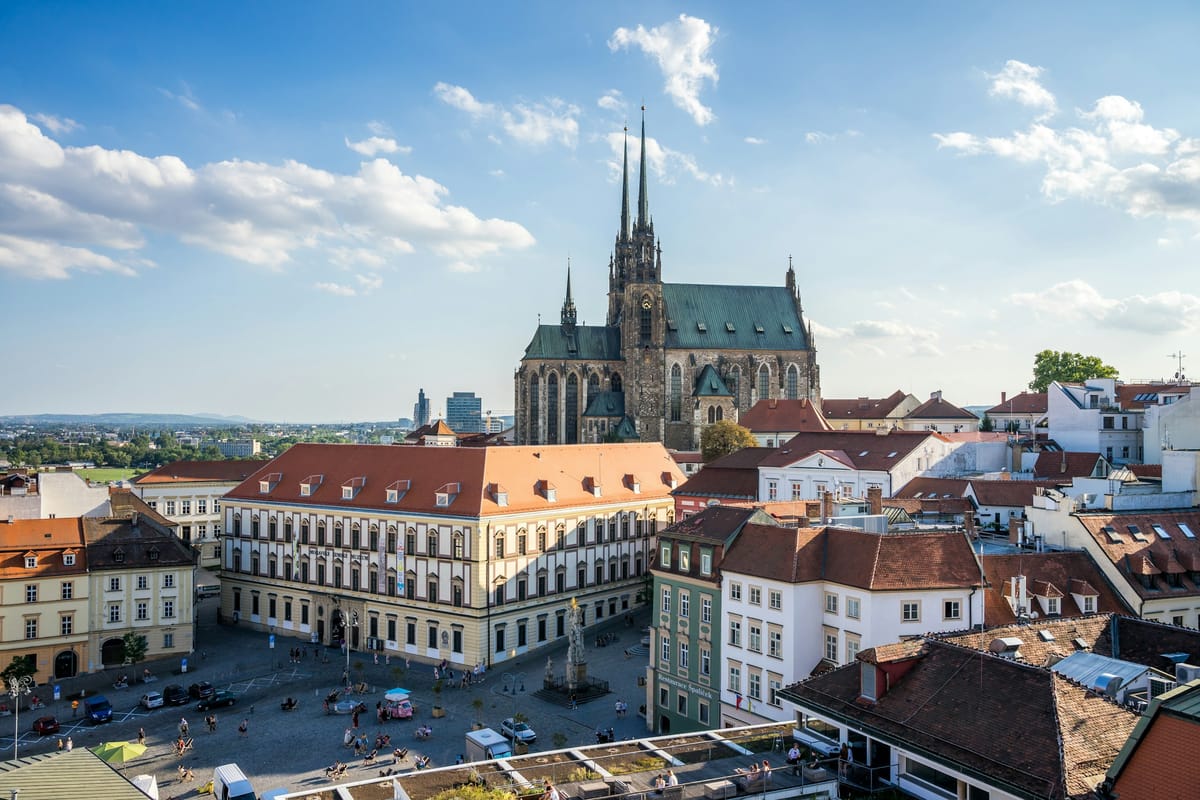
Brno, Central Europe
Brno: Moravian Soul, Wine Cellars & Central Europe's Best Kept Secret
The Dragon in Town Hall: Hanging from the ceiling of Old Town Hall is a large stuffed crocodile that locals call the Brno dragon. In the 17th century, the Bi…
Prague, Central Europe
Prague: Beer Culture Meets Bohemian Soul in Heart of Europe
Beer Cheaper Than Water: Half-liter pivo (beer) costs less than bottled water in most pubs, locals drink beer daily and judge quality strictly. Tram Ticket I…