Figuring out the best time to travel to Iceland boils down to a single, fundamental choice: are you chasing the ghostly dance of the Northern Lights or the endless golden hour of the Midnight Sun?
These two phenomena define the Icelandic experience, and you can't have both at once. Your perfect trip hinges entirely on which version of this incredible island you want to see.
Your Quick Guide to Iceland's Travel Seasons
Think of Iceland’s calendar as having two distinct acts: a lush, vibrant summer and a stark, dramatic winter. Each one offers a completely different world, and picking between them is a game of trade-offs—daylight for darkness, accessibility for solitude, ice caves for lupine fields. There’s no single “best” time, only the best time for you.
For most first-timers, the summer months from June to August are the obvious draw. This is Iceland at its most welcoming and accessible. The weather is as mild as it gets, and with nearly 24 hours of daylight, you can pack in an incredible amount of sightseeing. It's no surprise that August is the peak month, drawing around 281,000 international visitors, with July right behind.
The combination of warmer temps, fully open roads (including the highland F-roads), and a packed calendar of festivals makes summer the most popular season for good reason. You can dive deeper into these trends in this great overview of Icelandic tourism statistics.
Choosing Your Icelandic Adventure
So, how do you make the call? It starts with your non-negotiables. Are you willing to embrace the cold and the dark for a chance to witness the aurora borealis? Or does the thought of hiking a glacier at 10 PM under a bright sun get your heart racing?
This simple flowchart breaks down the two main paths for planning your trip.

As you can see, your primary goal—whether it's seeing the Northern Lights or experiencing the Midnight Sun—is the first domino to fall. It dictates everything else.
To make this even clearer, here’s a quick-glance table comparing what each season has to offer.
Which Iceland Season Is Right for You?
| Season | Key Highlights | Average Daylight | Best For | Cost and Crowds |
|---|---|---|---|---|
| Winter (Nov-Mar) | Northern Lights, ice caves, glacier hiking, snowy landscapes, fewest crowds. | 4-7 hours | Aurora hunters, photographers, budget-conscious travelers, those seeking solitude. | Low |
| Spring (Apr-May) | Longer days, melting snow, puffin arrivals, lower prices, fewer crowds than summer. | 14-19 hours | Wildlife watchers, road trippers, those wanting a balance of good weather and lower costs. | Shoulder |
| Summer (Jun-Aug) | Midnight Sun, accessible Highlands, lush green scenery, puffins, whale watching. | 20-24 hours | First-timers, hikers, campers, road trippers who want to see everything. | High |
| Autumn (Sep-Oct) | Fall colors, Northern Lights return, fewer crowds than summer, decent daylight. | 8-13 hours | Photographers, aurora seekers who also want decent driving conditions, budget travelers. | Shoulder |
Ultimately, choosing your season is a deeply personal decision.
Think about these key questions:
- Northern Lights vs. Midnight Sun: Are you a night owl hoping for auroras or an early bird ready for endless daylight?
- Crowds and Costs: Do you thrive on the energy of peak season, or do you prefer the quiet and savings of the shoulder or off-seasons?
- Must-Do Activities: Are you dreaming of things that are season-specific, like crawling through an ice cave (winter only) or hiking through the green Highlands (summer only)?
Summer: The Land of the Midnight Sun
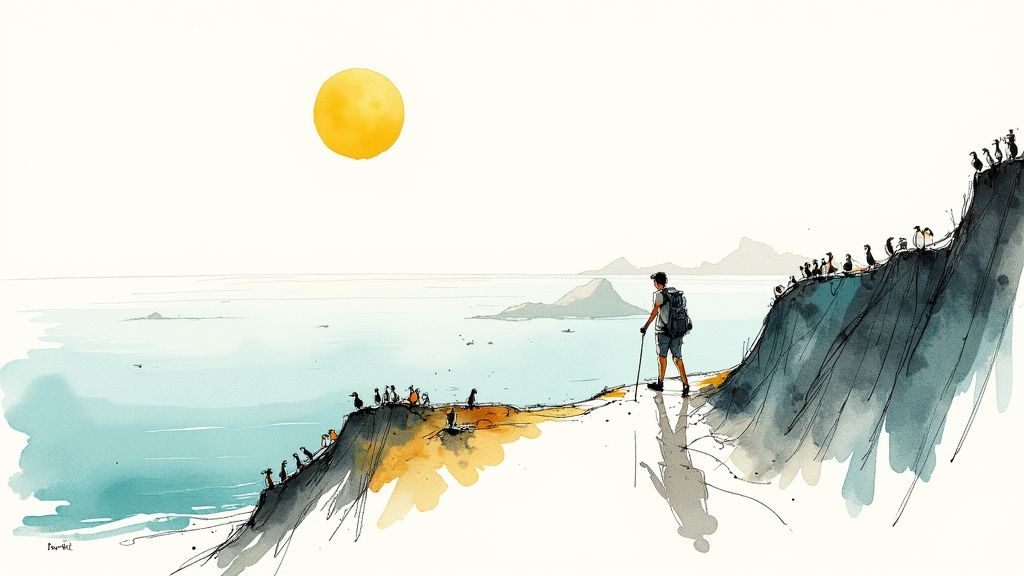
Picture this: it’s 11 PM and you’re hiking towards a roaring waterfall as the sun hangs low on the horizon, splashing the clouds in shades of pink and orange. That’s not a dream—that’s just a normal summer night in Iceland. From late May through August, the country is transformed by the Midnight Sun, a wild phenomenon where you get nearly 24 hours of daylight. Your itinerary suddenly becomes a limitless canvas for adventure.
This endless light completely changes the game for travelers. It means you can hit the most popular spots well after the tour buses have called it a day, or catch a sunrise at 2 AM. A drive along the famous Ring Road feels less like a race against the clock and more like the flexible journey it should be. The vibe is a lot like the long summer days you find in other far-north places; if you're curious how it compares, you can get a feel for a similar adventure by checking out what it's like visiting Alaska in July.
Embracing the Endless Daylight
On a practical level, constant daylight is a huge advantage. You can take that spontaneous detour or extend a hike for another couple of hours without ever worrying about getting caught in the dark. But more importantly, it’s your secret weapon for dodging the peak crowds that define summer, which is Iceland’s busiest and most expensive season.
Big-ticket attractions like the Golden Circle or the South Coast waterfalls can feel like a theme park between 10 AM and 4 PM. With the sun always on your side, you can just flip your schedule. Go explore Seljalandsfoss after dinner or visit the Jökulsárlón glacier lagoon when most people are still asleep—which might only be a few hours before your own "bedtime."
"The Midnight Sun doesn't just give you more time; it gives you a different kind of time. It's a surreal, quiet energy that lets you connect with the landscape in a more personal way, long after the daytime crowds are gone."
Off-the-Beaten-Path Summer Experiences
While the Ring Road is a classic for a reason, summer is when Iceland’s more remote corners finally open up. This is the only time of year you can drive the rugged interior F-roads, which lead to the otherworldly landscapes of the Highlands. Places like Landmannalaugar, with its rainbow-colored rhyolite mountains, and the Kerlingarfjöll geothermal area become accessible to anyone with a 4x4.
For a true local experience, try venturing beyond the main tourist loops to find quieter alternatives and authentic cultural moments.
- Skip the Crowded Hot Springs: Instead of heading to the busiest lagoons, check out the local swimming pools, or sundlaugar. Almost every town has one, and they are the heart of Icelandic social life. You’ll get a genuine slice of local culture, complete with geothermal hot pots, for a fraction of the price.
- Explore the Westfjords: This remote, finger-like peninsula is often skipped by tourists rushing along the Ring Road. In summer, its winding coastal roads are finally clear, revealing dramatic cliffs packed with birdlife, tiny fishing villages, and hiking trails that feel completely untouched. It’s an Iceland that is wild and beautifully isolated.
- Find Secluded Waterfalls: For every Skógafoss, there are dozens of lesser-known waterfalls hiding just out of sight. Ask a local guide or your guesthouse owner for their favorite spot. You might discover gems like Gljúfrabúi, tucked away behind a cliff face near Seljalandsfoss, or the powerful Aldeyjarfoss in the north, framed by stunning basalt columns.
Summer in Iceland is a trade-off. You swap the ethereal Northern Lights and quiet solitude of winter for vibrant green landscapes, puffin colonies, and the absolute freedom to explore 24/7. If you use that endless daylight strategically, you can craft a trip that feels both epic and intimate, experiencing the full grandeur of the island while still finding those quiet moments all to yourself.
Winter: A Realm of Ice and Light
From October to March, Iceland trades its summer green for a dramatic cloak of white. This is a season of stark, beautiful contrasts. The world shrinks to just a few hours of ethereal, low-angled sunlight before plunging into a deep, aurora-filled darkness. Winter here isn’t just a season; it's an entirely different world, one that asks for your respect but offers profound, otherworldly beauty in return.
This is, of course, the classic time for chasing the Northern Lights. But the magic of an Icelandic winter goes so much deeper than the celestial dance. It’s about experiencing the land in its rawest, most elemental state. While summer gives you easy access, winter offers a more immersive sense of adventure for anyone willing to embrace its challenges.
Embracing the Cold: An Immersive Winter Experience
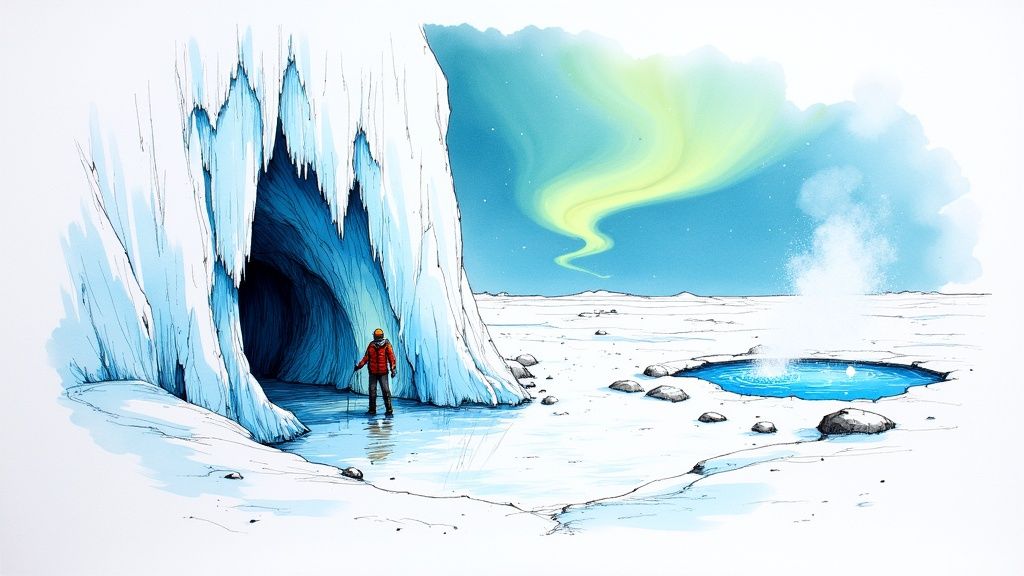
Forget the packed summer crowds. A winter trip gives you a sense of solitude that's impossible to find during peak season. The whole experience shifts from sightseeing to surviving—and thriving—in a wild landscape. It’s about feeling the crunch of crampons on a thousand-year-old glacier or hearing the surreal silence inside a crystal blue ice cave, a natural wonder only accessible during these cold months.
These unique activities are the heart of the winter journey. You don't just view the landscape; you become part of it.
- Ice Caving: From November to March, glacial meltwater freezes to create temporary, sapphire-blue caves. Venturing inside one with a local guide is like stepping into a giant gemstone—an experience that is both beautiful and humbling.
- Glacier Hiking: The glaciers of the South Coast, like Sólheimajökull or Vatnajökull, become dramatic worlds of blue ice, deep crevasses, and towering ice sculptures. A guided hike is non-negotiable for safety and gives you an incredible perspective on these powerful forces of nature.
- Geothermal Soaking: There is nothing quite like soaking in a geothermal lagoon, like the Secret Lagoon or a local sundlaug (swimming pool), while snow gently falls around you. It’s a core part of Icelandic culture and the perfect way to warm up after a day of icy exploration.
These are the rewards for braving the cold—a full cultural and physical immersion into Iceland's winter identity.
Navigating Winter Like a Local
Traveling in Iceland during winter requires a different mindset. Flexibility is everything, as the weather is notoriously unpredictable and can change in an instant. This is where local knowledge becomes your most valuable tool.
"In winter, the weather is the boss. A local guide doesn’t just show you the sights; they read the wind, understand the road conditions, and know when to push forward and when to respect the storm. That’s the secret to a safe and unforgettable adventure."
Driving demands your full attention. While the Ring Road is generally maintained, conditions can become treacherous. A 4x4 vehicle is highly recommended for better grip and safety on icy surfaces. Always, always check road conditions on Road.is and weather alerts on Safetravel.is before setting out each day. As any local will tell you, a sudden road closure isn't an inconvenience; it's a chance to explore a hidden gem in the area you’re already in.
Choosing to travel in winter also has a real impact. The Icelandic economy is heavily seasonal, with tourism contributing around 8.5% to the nation’s GDP. The summer months generate the vast majority of this. By visiting in the off-season, you help support local businesses—from guesthouses to tour operators—during their quieter period. This fosters a more sustainable, year-round tourism model that helps communities thrive. You can dive deeper into these trends in this insightful overview of Iceland's tourism industry.
Ultimately, winter is the best time to travel to Iceland if you’re looking for raw beauty, quiet contemplation, and a true sense of adventure. It’s a season that asks more from you, but it delivers an experience that is deeply, unforgettably magical.
Shoulder Seasons: The Secret to a Quieter Iceland
If you're looking for that perfect sweet spot between adventure and breathing room, the shoulder seasons are your answer. For my money, spring (April-May) and autumn (September-October) are the best times to travel to Iceland. These months are the country's best-kept secret, dodging the summer tourist crush and the deepest winter darkness.
Think of it as catching Iceland in its most dynamic moments—either waking up from its long winter nap or easing into a cozy, colorful autumn glow.
The main draw is simple: fewer people and lower prices. While summer throngs every viewpoint, the shoulder months let you have a more personal, unfiltered experience. You can actually stand in front of a thundering waterfall without a forest of selfie sticks, or find a quiet corner in a geothermal lagoon. It's a chance to connect with the landscapes on a deeper level.
Spring Awakening: April and May
As Iceland shakes off its winter coat, spring gives you a front-row seat to the island’s incredible rebirth. In April and May, the days stretch out fast, hitting nearly 19 hours of daylight by the end of May. All that melting snow supercharges the waterfalls, making them unbelievably powerful, and the first hints of green start painting the black volcanic terrain.
This is a season of unique hybrid opportunities, a true off-the-beaten-path experience.
- Puffin Arrivals: The beloved Atlantic puffins start showing up on coastal cliffs in late April, giving you a fantastic chance to see them before the summer crowds descend.
- The Last Northern Lights: In early April, the sky is still dark enough for one last shot at seeing the aurora borealis before the Midnight Sun takes over for the summer.
- Accessible Roads, Fewer Crowds: The main roads, including most of the Ring Road, are clearing up, which means you can do that classic road trip with a fraction of the summer traffic.
This time of year is perfect for anyone who wants summer-like daylight for exploring but craves a more serene and authentic vibe.
Autumn's Fiery Farewell: September and October
Autumn in Iceland is a photographer's dream. The short but spectacular fall foliage sets the landscapes ablaze in fiery reds, oranges, and golds—a stunning contrast against the dark volcanic rock. The air gets crisp, and a peaceful, cozy energy settles over the island as it gears up for winter.
For a full cultural experience, the shoulder seasons let you see Iceland as the locals do—during the quiet, beautiful moments of transition. It's less about the main touristic attractions and more about the natural rhythm of the island itself.
This season also brings back the darkness, and that means one thing: the Northern Lights are back. Starting in September, your chances of seeing the aurora climb every single night. It’s the perfect time to pair daytime adventures in autumn landscapes with nighttime sky-watching, a combo you just can't get in the summer.
The real magic of the shoulder seasons is their balance. Iceland’s tourism exploded from just 211,000 visitors in 1995 to nearly 2.5 million a year before the pandemic. You can find more on these tourism trends at TheGlobalEconomy.com. Traveling in these quieter months helps spread out the impact and offers a more sustainable way to visit. By choosing spring or autumn, you get a more intimate glimpse into Iceland, experiencing its raw beauty without the peak-season filter.
A Month-by-Month Iceland Planner
For the kind of traveler who lives for the details, a simple seasonal overview just doesn't cut it. The real magic of planning an Iceland trip comes down to what each specific month brings to the table—the festivals, the wildlife, the fleeting moments that define the Icelandic calendar.
This is your granular guide to aligning your trip perfectly with your passions, whether you're hoping to catch a local music festival or find the puffins before they disappear for the year.
January to March: The Deep Winter
This is Iceland at its most raw and elemental. Daylight is a precious commodity, stretching from a mere 4.5 hours in January to a more generous 11.5 hours by late March. It's the undisputed prime time for Northern Lights hunting and for finding a quiet, introspective version of the country.
- January: The darkest month of the year, making it the ultimate playground for aurora chasers. On January 6th, you can catch Þrettándinn (the thirteenth day of Christmas), where locals mark the end of the holiday season with bonfires and celebrations.
- February: Reykjavík lights up for the Winter Lights Festival, a beautiful celebration of art and light during the darkest days. It’s also the best time for ice caving—the sub-zero temperatures keep the glacial caves at their most stable and brilliant blue.
- March: Daylight comes rushing back, giving you much more time for activities like glacier hiking and exploring the South Coast. You still have a great shot at the Northern Lights, but now you get to pair them with stunning, long sunrises and sunsets over snowy landscapes.
April to June: The Spring Thaw and Midnight Sun
Spring in Iceland is a season of dramatic, powerful transformation. As the snow recedes, the island’s waterfalls roar back to life with glacial meltwater, and the whole country seems to reawaken. It’s a fantastic time to visit if you want to watch the landscape change right before your eyes.
- April: A true shoulder month that offers a bit of everything. You might catch the very last aurora of the season in early April, while the end of the month brings the first puffins back to the coastal cliffs. Sumardagurinn Fyrsti (The First Day of Summer) is a quirky public holiday celebrated with parades, even if there's still snow on the ground.
- May: The landscape absolutely explodes with green, and towards the end of the month, the famous purple lupine flowers begin their takeover. With nearly 19 hours of daylight, it’s a perfect time for a Ring Road trip before the main summer crowds descend.
- June: The Midnight Sun is in full effect, with the sun barely dipping below the horizon. Iceland's National Day on June 17th is a massive celebration, with parades and festivities in towns all across the country. It’s a fantastic opportunity to see Icelanders celebrating their culture.
July and August: The Peak of Summer
This is Iceland in full-blown, vibrant, and accessible mode. The days are endless, the weather is as warm as it gets, and every activity is on the table. This is also the only time of year when the rugged highland F-roads open, unlocking access to interior wonders like Landmannalaugar.
- July: Whale watching is at its absolute peak, especially in the northern town of Húsavík, Iceland’s whale-watching capital. The highlands are fully open, inviting hikers to explore remote trails that are completely impassable for the other nine months of the year.
- August: While it's the busiest month for tourism, it also hosts some incredible local events. For a truly unique experience, check out Þjóðhátíð in the Westman Islands—one of the country's biggest and most legendary outdoor music festivals. Keep in mind, the puffins usually start heading back out to sea around the middle of the month.
September and October: Autumn Colors and Returning Darkness
Autumn strikes a beautiful balance. You get enough daylight for solid exploration, but the darkness returns, bringing the Northern Lights back with it. The landscape is painted in fiery shades of red, orange, and gold, creating a moody, dramatic backdrop for photography and hiking.
- September: Ask any local or seasoned Iceland traveler, and many will tell you September is the best month to visit. The summer crowds have thinned out, prices begin to drop, and the aurora makes its grand return. The Reykjavík International Film Festival (RIFF) also kicks off, drawing film lovers from around the world.
- October: The days get noticeably shorter, and the first snows often dust the mountain peaks, adding another layer of beauty. It’s a great time for a cozy road trip, stopping in small villages and enjoying the calm before the deep winter sets in again.
For an immersive cultural experience, time your visit with a local festival. Events like the Iceland Airwaves music festival or a traditional town celebration provide a window into the nation's creative spirit and community life, far from the main tourist trails.
November and December: The Festive Winter
As winter truly takes hold, Iceland becomes a magical wonderland. The short days are filled with a beautiful, low-angled light that photographers dream of, and the long, dark nights are perfect for curling up in a cabin or heading out to search for the aurora.
- November: The Iceland Airwaves music festival completely takes over Reykjavík, showcasing incredible Icelandic and international talent in venues all over the city. This month also marks the official start of the ice cave season, as guides confirm the new season's caves are safe to enter.
- December: The holiday spirit is everywhere. Reykjavík is draped in festive lights, and you can learn all about the 13 mischievous Yule Lads of Icelandic folklore. New Year's Eve is a massive deal here, celebrated with huge community bonfires and a staggering amount of fireworks lighting up the entire sky.
To help you visualize the year at a glance, we've put together a calendar highlighting some of the key events and natural windows for planning your trip.
Icelandic Events and Activities Calendar
This table breaks down the best of each month, from cultural happenings to wildlife and outdoor adventures, so you can pinpoint the perfect time for your visit.
| Month | Key Cultural Events | Wildlife Viewing Opportunities | Best Outdoor Activities |
|---|---|---|---|
| Jan | Þrettándinn (End of Christmas), Dark Music Days | Minimal; focus is on landscape | Northern Lights hunting, ice caving, glacier hiking |
| Feb | Winter Lights Festival, Food and Fun Festival | Minimal; best for solitude | Ice caving (prime conditions), glacier hiking, snowmobiling |
| Mar | Reykjavík Folk Festival, Beer Day (March 1st) | Reindeer in the East | Northern Lights, glacier hiking, South Coast exploration |
| Apr | First Day of Summer (Sumardagurinn Fyrsti) | Puffins begin to arrive, migratory birds return | Last chance for Northern Lights, waterfall viewing (peak flow) |
| May | Lupine fields begin to bloom | Peak puffin viewing, whale watching season starts | Ring Road trips (fewer crowds), hiking at lower elevations |
| Jun | National Day (June 17th), Secret Solstice Festival | Puffins, Minke whales, humpbacks | Midnight Sun photography, hiking, F-roads begin to open |
| Jul | Various town festivals | Peak whale watching (Húsavík), abundant birdlife | Highland hiking (Landmannalaugar), kayaking, camping |
| Aug | Þjóðhátíð (Westman Islands), Reykjavík Pride & Culture Night | Whales still active, puffins begin to depart | Highland access, hiking, backpacking |
| Sep | Reykjavík International Film Festival (RIFF), Rettir (sheep round-up) | Northern Lights return, whale watching continues | Autumn color photography, hiking, Northern Lights viewing |
| Oct | Imagine Peace Tower lighting | Reindeer sightings | Northern Lights, glacier hiking, less crowded road trips |
| Nov | Iceland Airwaves Music Festival | Minimal; focus on winter activities | Ice cave season officially begins, Northern Lights |
| Dec | Christmas & New Year's Eve celebrations | Minimal; enjoy the festive atmosphere | Northern Lights, festive city exploration, ice skating |
No matter when you decide to go, each month offers a completely distinct version of Iceland. Use this guide to find the one that speaks to you, and you're guaranteed to have an unforgettable trip.
Experience Iceland Like a Local
If you want to find the best time to visit Iceland, the real answer has less to do with the season and more to do with connecting to the country’s soul. Getting off the Golden Circle route isn't just about seeing different things; it's about shifting your entire mindset. It’s about valuing the quiet moments, respecting the local way of life, and making a genuine connection instead of just ticking off a checklist. This is how a good vacation becomes an unforgettable one.
True immersion happens when you leave the main tourist artery for the country's quieter veins. Instead of barreling down the Ring Road, just slow down. Take a detour into the often-skipped Eastfjords, where every tiny fishing village has its own personality and a story to tell. The roads there are winding, the scenery is dramatic, and the pace of life forces you to stop, take a breath, and just be present.
Beyond the Blue Lagoon
One of the most authentic Icelandic experiences you can possibly have is embracing the local swimming pool culture. These geothermal pools, known as sundlaugar, are the true heart of every community. They’re where people socialize, relax, and connect—think of them as the Icelandic version of a town square or a neighborhood pub.
For a real cultural deep-dive, skip the crowded tourist lagoons and find a local sundlaug. You'll learn the unspoken rules, share a hot pot with Icelanders, and get a genuine peek into the daily rhythm of their lives.
Before you jump in, you need to know the etiquette. The single most important rule is to shower thoroughly—without your swimsuit on—before getting into the water. This isn’t a polite suggestion; it's a non-negotiable part of the culture that keeps the pools clean with minimal chlorine. Embracing this simple custom shows respect and is your first step to feeling less like a tourist.
Finding Authentic Flavors and Trails
To eat like a local, you have to find the dishes that Icelanders themselves actually eat. While Reykjavík has incredible fine dining, the country's culinary soul is often much simpler. Find a small, unassuming café and order a bowl of kjötsúpa, a hearty, traditional lamb soup. It's the ultimate comfort food, especially after a long hike in the crisp air.
Getting off the beaten path is just as simple. You just have to ask.
- Ask for the 'Other' Waterfall: When you check into your guesthouse, ask the owner about their favorite local waterfall or hiking trail that doesn’t show up in the guidebooks. They always have one.
- Embrace 'Þetta Reddast': This Icelandic motto means "it will all work out in the end," and it's a way of life. When bad weather ruins your plans, don't get frustrated. See it as a chance to discover something unexpected right where you are.
- Travel Respectfully: The Icelandic landscape is stunning but incredibly fragile. Always stick to marked paths, never drive off-road, and follow Leave No Trace principles. Respecting the land is the deepest way to respect the culture.
This kind of travel is about more than seeing new places; it’s about engaging with them on a much deeper level. For more ideas on crafting a trip with real substance, you can explore our guide to designing immersive travel experiences. By slowing down and looking just beyond the obvious, you’ll discover an Iceland that most visitors completely miss.
Answering Your Big Iceland Questions
Let's cut to the chase. When you're planning a trip this big, you have questions. Here are the straight-up, no-fluff answers to the logistics that every Iceland traveler needs to figure out.
How Many Days Do I Really Need in Iceland?
If you're a first-timer aiming to hit the famous South Coast highlights, give yourself a solid 5-7 days. That's enough time to see the big stuff without feeling like you're in a constant sprint.
Want to tackle the whole Ring Road? You’ll need at least 10-14 days to do it right. Trying to rush it is a classic mistake, especially in winter when a single storm can throw your whole schedule off track.
Is a 4x4 Vehicle Actually Necessary?
In the summer, a standard 2WD car will get you around the paved Ring Road just fine. But if you’re dreaming of the raw, remote Highlands, a 4x4 is legally required for the F-roads that lead there. Those gravel tracks are only open from about June to September.
For any trip between October and April, we strongly recommend a 4x4. It’s not about off-roading; it's about having better grip and safety when you inevitably hit icy patches or snowy conditions.
The best time to travel to Iceland often comes down to logistics. A longer trip allows for spontaneity and the chance to explore off-the-beaten-path regions like the Westfjords, while the right vehicle ensures you can do so safely.
When Can I See Both Puffins and the Northern Lights?
Ah, the holy grail of Iceland timing. This is a tough one because their seasons barely kiss. Your only real shot is during a very narrow window in late August or the first few days of September.
By mid-August, most puffins have already headed back out to sea for the winter, which is right when the sky finally gets dark enough for the aurora to make its first appearances. It’s a gamble, but it’s your only one.
Before you lock everything in, it's smart to think about the bigger picture of staying safe on the road. This guide has some great essential tips for safe travels abroad that are worth a read.
At CoraTravels, we believe the best trips are built on local knowledge. Our insider guides help you understand the unspoken rules and cultural rhythms of your destination, so you can explore with confidence and respect.