Real travel is about more than just snapping photos of famous buildings; it's about understanding the life that pulses around them. The secret to those truly memorable, authentic travel experiences isn't found on a postcard—it's in the local customs and traditions that set the rhythm of daily life, far from the main touristic places.
Beyond the Postcard: How to Unlock Truly Immersive Travel
Forget trying to memorize a long list of rigid rules. Immersing yourself in a culture starts with a simple shift in mindset: moving from a passive observer to an active, respectful participant. This is about getting past surface-level tourism and digging into the 'why' behind a place's unique heartbeat for a full cultural experience.
Think of customs as the unspoken social grammar of a destination. They're the subtle gestures, the timing of meals, the way people greet each other—the small interactions that make up the fabric of daily life. These are often completely invisible to anyone rushing between the main tourist sites, but learning to read them turns a simple vacation into a profound connection.
This is your starting point for experiencing a place not as a tourist, but as a welcome guest. It’s about learning to see the world through a different lens, where every market stall and quiet neighborhood holds a story.
This approach is what separates a good trip from a great one. Instead of just working through a checklist of sights, you'll start building a framework for becoming a mindful observer. We'll show you how a small, respectful gesture—like understanding mealtime etiquette or learning a simple local greeting—can open doors to genuine interaction. You can learn more about finding these moments in our guide to authentic travel experiences.
This journey is all about:
- Stepping outside your comfort zone to engage with local life directly.
- Choosing local guides and small businesses over the big, impersonal tour operators to get an off the beaten path perspective.
- Showing genuine curiosity about the social codes that shape everything from market-day haggling to neighborhood gatherings.
When you start to understand these unwritten rules, you can navigate new places with confidence and respect. Every interaction becomes an opportunity to learn and connect. This, right here, is the essence of traveling deeper.
Decoding the Culture: Customs vs. Traditions Explained
To really get under the skin of a place, you have to feel its social heartbeat—the rhythm set by its customs and traditions. But what’s the real difference, and why does it matter for the kind of immersive experience we're after?
Think of customs as the unwritten traffic rules of daily life. They’re the subtle, constant actions that guide how people interact: the way they greet each other, the amount of personal space they keep in a crowd, or the right way to pay at a local market. These are the small, consistent behaviors that keep society running smoothly, often found outside of main touristic places.
Traditions, on the other hand, are the culture's landmark parades. These are the bigger, less frequent events that a community celebrates together, often passed down through generations. Think of major festivals, national holidays, or annual ceremonies that bookmark a culture’s history, values, and shared story.
Customs: The Daily Social Grammar
You learn customs by watching and doing. In Tokyo, for example, the custom of standing on the left side of an escalator isn't a law, but it’s a powerful act of social harmony. Ignoring it instantly marks you as an outsider. These are the details that transform a trip from just looking at things to actually experiencing them.
And sometimes, just translating the words isn't enough. To truly grasp a custom, you have to understand the cultural nuances, tone, and even the implied meanings that are deeply rooted in the culture itself.
Traditions: The Generational Storytelling
Traditions are the big, communal stories a culture tells about itself, often tied to specific dates, seasons, or life events. A perfect example is the Day of the Dead in Mexico. It's a multi-day holiday where families welcome back the souls of their departed relatives. This isn't just a party; it's a profound tradition rooted in indigenous beliefs, history, and community bonds, all expressed through vibrant altars, food, and family gatherings.
The hierarchy below shows how moving beyond just seeing landmarks and starting to understand daily customs is the key to unlocking true cultural immersion.
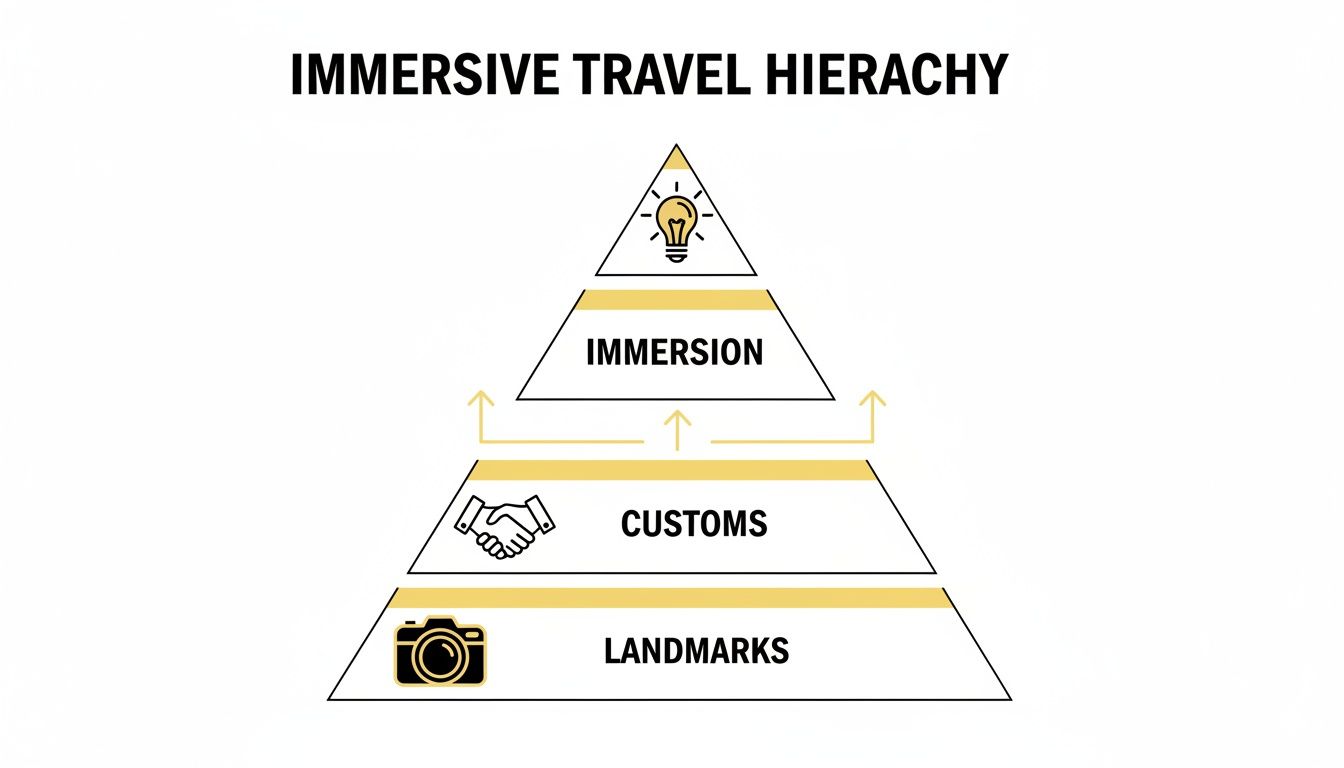
As you can see, seeing the sights is just the foundation. The real journey begins when you start engaging with the local customs—that’s the bridge to a full, immersive experience.
Here’s a quick way to tell them apart on the ground.
Customs vs. Traditions: A Traveler's Quick Guide
Quickly differentiate between the everyday 'rules' and landmark 'events' of a culture with these practical travel examples.
| Aspect | Customs (The Daily Rhythm) | Traditions (The Landmark Events) |
|---|---|---|
| Frequency | Daily or very frequent | Annually or for major life events |
| Scale | Individual or small group actions | Community-wide participation |
| Visibility | Subtle, often unnoticed by outsiders | Highly visible, often major celebrations |
| Example 1: Japan | The unspoken rule of quiet on public transport. | The Obon festival, honoring the spirits of ancestors. |
| Example 2: Italy | The evening passeggiata, or stroll, before dinner. | Ferragosto, the national holiday on August 15th. |
| Example 3: Morocco | Pouring mint tea from a height to create foam. | Eid al-Fitr, the feast marking the end of Ramadan. |
Understanding both gives you a complete picture of the social landscape you're exploring. Customs show you how to navigate the day-to-day, while traditions reveal what the community holds most sacred.
Understanding the distinction between the daily 'how' (customs) and the celebratory 'why' (traditions) is your first step to navigating new environments with confidence and respect, turning you from a simple visitor into a thoughtful guest.
The Art of Observation: How to Read a New Culture
Here’s the thing about travel: the most valuable skill isn’t knowing everything before you arrive. It’s knowing how to learn by watching once you’re on the ground. This is where you transform a simple trip into a deep, immersive experience. It means going beyond a checklist of dos and don'ts to actually reading the social environment in real time, especially when you're off the beaten path.
It all starts by paying attention to the little things—the non-verbal cues that speak volumes. Notice how people interact in a park or a café outside of main touristic places. What are their gestures? Their tone of voice? How much eye contact do they make? These tiny details are your first breadcrumbs on the trail to understanding local customs and traditions.
Watch and Mirror Local Behaviors
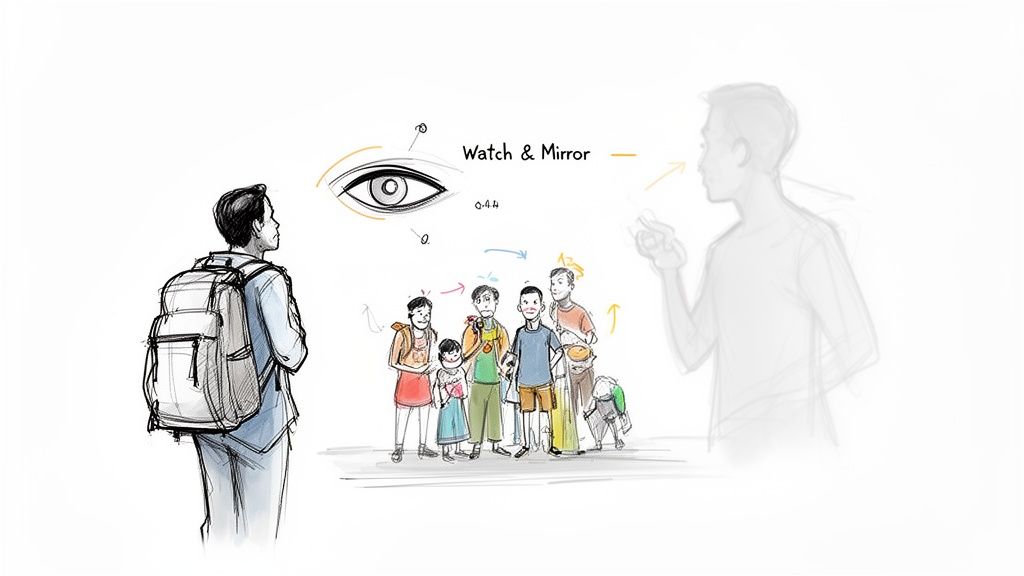
One of the most powerful ways to adapt is to simply watch and mirror. This isn’t about becoming a perfect copycat. It's about respectfully following the local lead. Before you jump in a queue, order your coffee, or enter a shop, just pause for a second. See how it’s done.
That small moment of observation gives you a ton of information. Do people greet the shopkeeper when they enter? Do they pay before or after getting their food? The goal is to blend in, showing you respect their way of doing things. This simple habit helps you sidestep common cultural blunders and makes for much warmer interactions.
Observation empowers you to decode social situations on the fly, turning potential cultural blunders into valuable learning moments and fostering genuine connections with the people and places you visit.
This same principle applies to understanding a culture’s sense of time. Is showing up ten minutes late for a dinner invitation a major insult or completely normal? The rhythm of daily life will give you the answer long before any guidebook can.
Observe the Elders and Social Cues
Another pro tip: observe the elders or people who seem to be in positions of authority. How are they greeted? Who gets to speak first in a group? Watching these interactions reveals a goldmine of information about a culture’s social hierarchy and its core values around respect.
Take navigating an escalator in Japan—it’s a masterclass in social harmony. A 2022 survey revealed that a staggering 92% of people in Tokyo stick to standing on the left side, a custom born from a deep-seated value of societal cooperation. But head to Osaka, and you’ll find locals standing on the right, a regional quirk that tells a different historical story. By simply watching the flow of the crowd before stepping on, you’re not just avoiding a clumsy mistake; you're showing you get it. You can read more about how traditions shape daily life in this Statista forecast.
By sharpening these observational skills, you’re building a toolkit that works anywhere on the planet. You learn to read the room, understand the unwritten rules, and adapt with grace. And that’s what turns a good trip into a great one.
How Modern Life Reshapes Ancient Traditions
Don't mistake customs for dusty relics frozen in time. They're living, breathing parts of a culture, constantly bending and shifting to fit the modern world. Sometimes, they're even born from brand-new problems, giving you a real-time window into a community's creativity and grit. Watching this evolution is a key part of an immersive experience.
Nowhere is this clearer than in Cape Town, South Africa, where a modern headache has forged a powerful new custom. Since 2007, the national power utility’s scheduled blackouts, known as load-shedding, have become an unavoidable reality. This isn't just an inconvenience; it's a social force that has completely rewired how the community connects outside of main touristic places.
Necessity Forging New Rituals
When the lights go out, Capetonians don't just sit in the dark. A new ritual has taken root: the candlelit braai (barbecue). What was once a planned weekend activity is now a spontaneous, regular gathering that turns a shared frustration into a reason to come together. Neighbors gather around the fire with whatever food they have, sharing stories and strengthening community bonds in a way scheduled events rarely can.
It's a perfect example of adaptation in action. Eskom's rolling blackouts have impacted 60 million residents, weaving themselves into the fabric of daily life where apps like EskomSePush, with 5 million users, are now essential tools. As a direct result, neighborhood braais held under candlelight have jumped by an estimated 40% since 2020, becoming a powerful symbol of community spirit. For more on this, check out the Pew Research Center's insights on customs and national identity.
By turning a systemic failure into a reason to connect, Capetonians demonstrate how customs are not just inherited—they are actively created in response to the present moment. This is cultural resilience in action.
When Old Traditions Meet New Realities
In other places, the clash between ancient traditions and modern life is a bit more complicated. Take Valencia, Spain, the home of paella. The tradition of eating paella for lunch, usually between 1 and 3 PM, is tied directly to the region's agricultural past. It was a hearty midday meal for laborers who needed fuel for a hard afternoon's work in the fields.
This long-standing practice now runs headfirst into the expectations of global tourism. Many visitors, used to eating their main meal in the evening, go looking for paella restaurants at night. To Valencians, though, ordering paella for dinner is a cultural blunder—a dead giveaway that you're a tourist.
This creates a fascinating tension for travelers:
- The Authentic Experience: To eat paella like a local, you have to adapt your schedule to theirs. You'll need to find the restaurants that only serve it for lunch. A local guide can be invaluable for finding these spots.
- The Tourist Economy: Many spots now cater to visitor demand, putting paella on their dinner menus even if it goes against the grain of local tradition.
This shows how traditions can become battlegrounds. For the traveler looking to get off the beaten path, understanding this dynamic is everything. It’s a chance to see beyond the menu and into the story of a culture grappling with economic pressures while fighting to hold onto its identity. These living stories are what make a full cultural experience stick with you.
Tasting Culture Through Local Culinary Customs
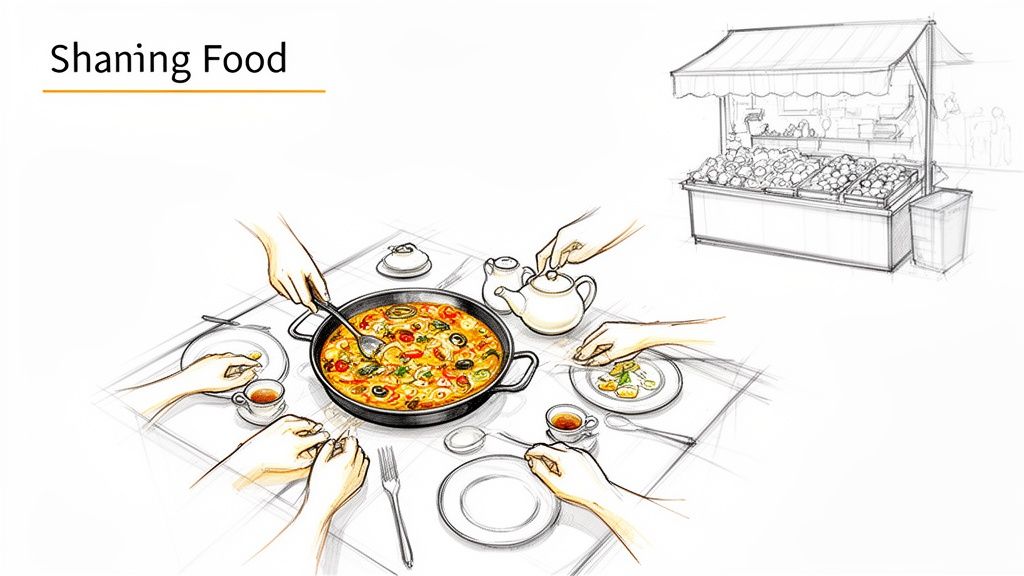
Food is the fastest, most delicious way to get to the heart of a place. Forget museums for a second. The real story is often told through flavor, in rituals shared across generations, and it’s one of the best ways to get off the beaten path and into the rhythm of local life.
But understanding a place through its food is about more than just what’s on the menu. It's about knowing how people eat, and more importantly, why.
Sharing a meal is rarely just about eating; it’s a profound act of community. In Morocco, the ritual of preparing and sharing mint tea isn’t just about quenching your thirst. It's a deep-rooted symbol of hospitality and friendship. The slow, deliberate process is an experience in itself, offering a quiet moment of connection you’d completely miss by just ordering a quick drink.
Appreciating food not just as sustenance, but as a story of a place and its people, connects you directly to local traditions. It turns every meal into an opportunity for a full cultural experience.
Beyond The Menu: The Timing and Rituals of Food
The real cultural immersion begins when you start to notice the unwritten rules that surround a meal. Take paella in Valencia, for example. Locals have a very strict schedule for this dish.
Born in the 19th-century rice fields, paella was traditionally a farmer's lunch, cooked over an open wood fire between 1-4 PM. Local polls show that a solid 65% of Valencians consider eating paella at night a bizarre tourist invention. For anyone serious about food, this means finding a proper workshop serving it during the day and skipping the glossy tourist traps at night.
Even something as common as rice tells a story. It's a global staple that forms the foundation of countless culinary traditions, and understanding its role in a local diet can offer huge insights.
Navigating Local Markets and Social Etiquette
A bustling local market is an incredible immersive experience, but you have to go in with respect. Before you jump in and start buying, just stand back for a minute. Watch how locals interact with vendors. A good local guide can also help translate both the language and the unspoken rules.
Knowing the etiquette for accepting or refusing food is just as critical. A polite "no, thank you" in one culture might be a serious insult in another.
To get the most out of your food adventures, keep these tips in mind:
- Watch the Locals: Before buying, see if people haggle or just pay the listed price. Following their lead is a simple sign of respect.
- Learn a Few Phrases: Just knowing how to say "please," "thank you," and "delicious" in the local language can completely change an interaction.
- Accept Graciously: If a vendor offers you a sample, it’s almost always best to accept. It's a gesture of hospitality that can open the door to a real connection.
By paying attention to these small details, you move from just tasting the food to truly tasting the culture. For more ideas, check out our guide to the best places to visit for foodies.
A Practical Guide to Respectful Travel
Knowing the “why” behind customs and traditions is one thing, but figuring out the “how” on the ground is what really opens up a destination. This guide is all about turning those big ideas into a simple, practical mindset you can actually use. Think of it less as a strict rulebook and more as a compass for navigating new places with awareness and respect.
It’s about making real connections—whether you're trying to buy fruit in a market miles from the tourist trail or you’ve been invited to share a meal in a local home. It’s about leaving people feeling good about your interaction.
The goal isn’t perfection—it's presence. Being a respectful traveler means prioritizing curiosity over assumptions and observation over impulse. This mindset is your key to a full cultural experience.
Below is a simple framework to keep in your back pocket. It's designed to help you navigate new cultural landscapes with confidence and grace, turning every interaction into an opportunity for a genuine exchange.
Your Go-To Framework for Mindful Travel
Use this simple Do/Don't list to guide your actions and gut feelings in any new place.
| Action | Do (Proactive Habits) | Don't (Common Pitfalls) |
|---|---|---|
| Observe | Observe Before You Participate. Watch how locals queue, greet shopkeepers, or order coffee. Mirroring their behavior is the highest form of respect. | Don't Assume Your Norms are Universal. Remember that your way of doing things is just one of many. What's polite at home might be rude elsewhere. |
| Communicate | Learn Key Local Phrases. Even a simple "hello," "please," and "thank you" shows you're trying, and that effort opens doors to much warmer interactions. | Don't Expect Everyone to Speak Your Language. Make an effort to communicate on their terms first. Use translation apps if you get stuck. |
| Interact | Show Genuine Curiosity. Ask thoughtful questions about a local dish or a custom. Hiring a local guide can facilitate these conversations and provide deeper context. | Don't Photograph People Without Asking. A person's image is personal. Always seek permission with a smile and a gesture; it's a basic sign of respect. |
| React | Embrace Humility. You will make mistakes. When you do, a sincere apology and a humble laugh can turn a clumsy moment into a memorable connection. | Don't Judge What You Don't Understand. A custom might seem strange at first, but it has deep roots. Approach differences with an open mind, not with judgment. |
Your Cultural Etiquette Questions Answered
Stepping into a new culture can feel like learning a new dance on the fly. It's totally normal to feel a bit clumsy at first. Below are a few common questions travelers have, with some real-world advice to help you find your rhythm and connect with locals in a way that feels good for everyone, especially when you venture off the beaten path.
How Do I Politely Turn Something Down?
Declining an offer—whether it's food, a gift, or an invitation—is a delicate art. A flat "no" can come across as cold or ungrateful in many cultures. The trick is to use the “no, thank you, but…” approach.
Instead of a simple refusal, show your appreciation first. For example, if someone offers you a snack you can't eat, you might say, “That looks incredible, thank you so much, but I just ate.” Placing a hand over your heart is also a near-universal gesture that signals sincere gratitude, softening the refusal.
What if I Mess Up and Offend Someone?
Let's be real: it’s not a matter of if you’ll make a cultural mistake, but when. We've all been there. The most important thing is how you recover.
A genuine, humble apology works wonders. Most people will see you're a visitor trying your best, and they'll appreciate the effort. A simple smile and a heartfelt, "I'm so sorry, I'm still learning," can completely defuse an awkward moment. Often, it even turns into a friendly teaching opportunity with a local guide or new acquaintance. Humility is your best travel companion.
When you inevitably make a mistake, don’t panic. A sincere apology and a willingness to learn are far more important than achieving cultural perfection. Locals appreciate the effort, not flawless execution.
How Should I Actually Research a Place Before I Go?
Good research goes beyond just knowing the top tourist sites; it’s about understanding the pulse of daily life to prepare for a full cultural experience. Here are a few ways to get a real feel for a destination's customs before you even pack your bags:
- Watch Local Vlogs: Forget the polished travel shows. Search YouTube for "a day in the life" videos from creators living in the city you're visiting. It’s an unfiltered peek into everything from public transport etiquette to how people order at a local café.
- Find Guides Written by Residents: Look for blogs and guides created by people who actually live there. These are the sources that reveal the unspoken rules and social quirks that generic travel sites always miss, pointing you to spots outside of main touristic places.
- Go Beyond the Basics with Language: Learning "hello," "please," and "thank you" is a great start. But adding a phrase like "excuse me" or even just "delicious!" shows you're putting in that extra bit of effort that locals really notice.
At CoraTravels, we live for this stuff. We build our guides on deep local knowledge to help you decode the unspoken rules and cultural rhythms of your destination. Travel like a local with us.