Taking the ferry from Seattle to Victoria is a classic Pacific Northwest experience, but your first big decision sets the tone for the whole trip. Are you after a quick, direct shot across the water, or a more scenic, road-trip-style adventure that lets you dive deep into the local culture?
It really boils down to two things: are you bringing a car, and what kind of journey do you want to have?
Choosing Your Ferry Adventure
Think of the ferry trip from Seattle to Victoria as having two distinct flavors. One is like a direct flight—fast, efficient, and designed to get you to your destination. The other is more like a scenic drive, where the journey itself is a huge part of the fun and a chance for an immersive local experience.
Your main choices are the FRS Clipper, a passenger-only catamaran that zips straight from downtown Seattle to Victoria's Inner Harbour, and the Black Ball Ferry Line's MV Coho, a traditional car ferry that sails from Port Angeles. The Coho route means you'll first enjoy a beautiful drive up the Olympic Peninsula before you even get on the boat—a perfect opportunity to discover some off-the-beaten-path gems.
Understanding the Two Main Routes
If you're traveling without a car (as a "foot passenger"), the FRS Clipper is your most straightforward option. It’s a seamless city-to-city link that takes about 2 hours and 45 minutes, dropping you right in the heart of Victoria. This is perfect for a weekend getaway where you want to maximize your time exploring the city's unique neighborhoods on foot.
On the other hand, the MV Coho is built for road trippers seeking a deeper cultural experience. This journey starts with a drive from Seattle to Port Angeles (which takes a couple of hours on its own), followed by a beautiful 90-minute ferry crossing. The payoff? You get the freedom of having your own vehicle to explore all of Vancouver Island, from its hidden coves to its old-growth forests, plus you get to experience the authentic small-town life of the Olympic Peninsula on the way.
This decision tree breaks it down visually. The first question is always: car or no car?
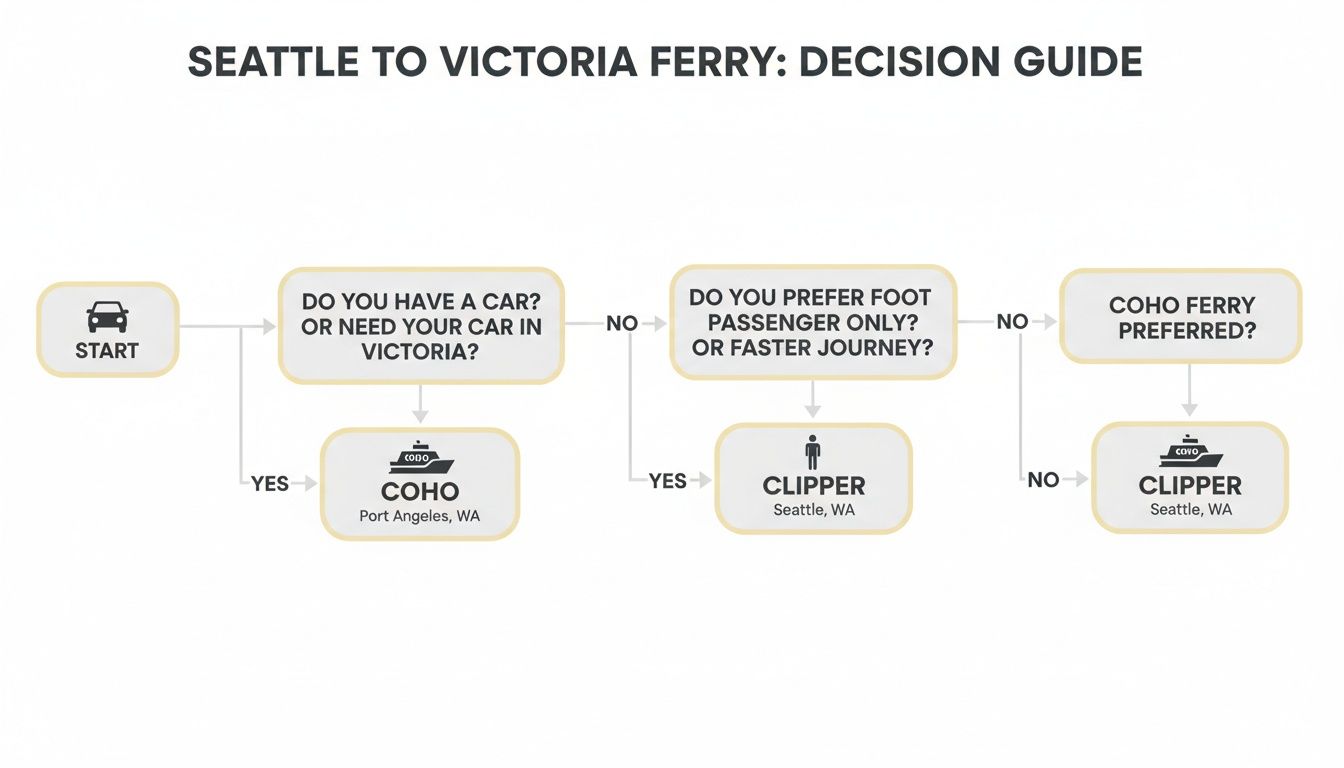
As you can see, whether or not you need your car is the single biggest factor in picking the right ferry for your immersive adventure.
To make it even clearer, here’s a quick side-by-side comparison of the two main services.
At-a-Glance Comparison Seattle to Victoria Ferry Options
| Feature | FRS Clipper (Direct from Seattle) | Black Ball Ferry Line (MV Coho) |
|---|---|---|
| Travel Type | Passenger-only | Car and passenger ferry |
| Departure Point | Pier 69, Downtown Seattle, WA | Port Angeles, WA |
| Arrival Point | Inner Harbour, Downtown Victoria, BC | Inner Harbour, Downtown Victoria, BC |
| Crossing Time | 2 hours 45 minutes | 90 minutes |
| Total Travel Time (from Seattle) | 2 hours 45 minutes (plus check-in) | 3.5 - 4 hours (drive + ferry) |
| Best For | Foot passengers, quick weekend trips | Travelers with cars, deep cultural exploration |
Ultimately, both routes are fantastic ways to travel between these two iconic cities. Your choice just depends on the kind of trip you're planning.
The Direct Downtown Route Aboard the Victoria Clipper
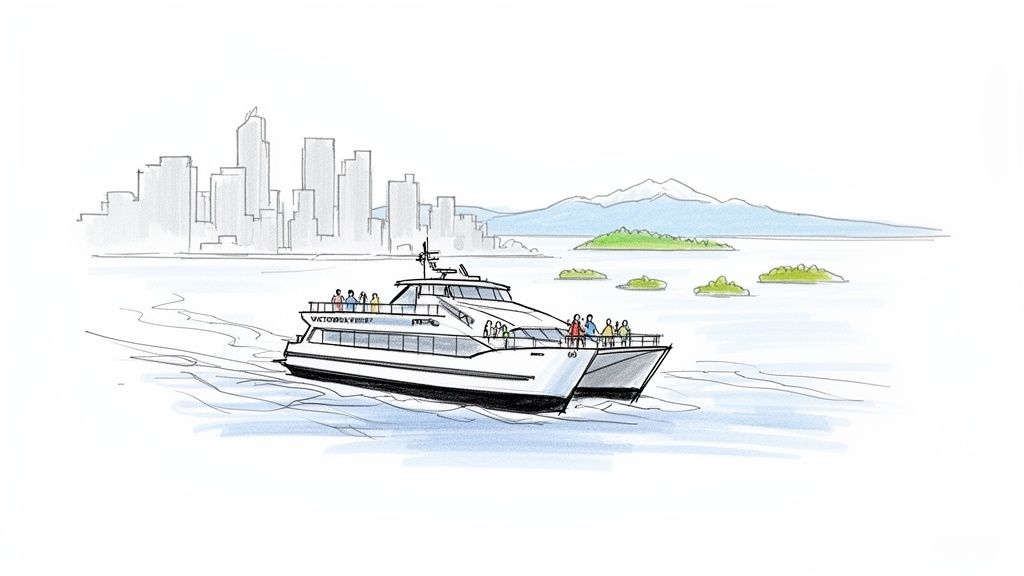
If you want the fastest, most straightforward way to get from downtown Seattle straight into the heart of Victoria without a car, the Victoria Clipper is your answer. Period. It's a high-speed catamaran designed specifically for this route, linking two iconic city centers and turning the journey itself into part of the adventure.
Imagine this: you leave Seattle's bustling Pier 69, the city skyline shrinks behind you, and in less than three hours, you're stepping off the boat directly into Victoria’s charming Inner Harbour. No driving, no transfers, just a beautiful ride across Puget Sound. The boat is designed with huge windows, so you won’t miss the coastal scenery, from the scattered islands to the stunning Olympic Mountains looming on the horizon.
What to Expect Onboard
Forget the idea of a basic ferry. The Clipper feels more like a floating lounge with incredible views. The seating is airline-style, but with way more legroom and the freedom to get up and wander around. They have a decent selection of locally sourced snacks and drinks for sale—perfect for grabbing a coffee on the morning trip or a local craft beer to kick off your vacation.
Clipper Navigation has been running this service since 1986, and they've got the downtown-to-downtown route perfected. Their modern catamarans can hold up to 525 passengers and zip across the water at speeds up to 36 knots. The whole trip takes about 2 hours and 45 minutes, making it the go-to choice for anyone traveling between the cities on foot. You can read up on the history of this key PNW ferry service if you're curious.
Local Tip: When you arrive in Victoria, you’ll clear Canadian customs right inside the terminal building. Have your passport or other valid travel documents handy to make it a quick process. Usually, you're through in minutes and on your way to explore the city, ready to dive straight into a local neighborhood.
A Few Insider Tips for the Journey
To get the most out of your trip on this popular ferry from Seattle to Victoria, here are a few things I've learned over the years:
- Scenery Strategy: For the best views of the Seattle skyline as you depart, snag a seat on the port (left) side. As you approach Victoria, the starboard (right) side usually offers better glimpses of the coastline and the charming seaside homes of Oak Bay.
- Book in Advance: I can't stress this enough. During the peak season (May-September) and on weekends, the Clipper often sells out completely. Booking at least a few weeks ahead is a really good idea.
- Whale Watching: Keep your eyes peeled! The route cuts through waters frequented by orcas and humpback whales, especially from spring through fall. You might just get a free wildlife show with your ticket, a truly immersive Pacific Northwest moment.
The Road Trip Adventure on the Coho Ferry
If you’re the kind of traveler who believes the journey is half the fun, then the MV Coho ferry is your ride. Taking this ferry isn’t just a simple crossing; it’s a full-blown Pacific Northwest road trip that starts well before you even smell the salt in the air. Opting for the Coho means you first get to drive from Seattle through the breathtaking Olympic Peninsula, transforming a boat ride into a genuine cultural adventure.
Choosing this route means you’re embracing the open road and the slow travel movement. You’ll cruise past the deep, moody blues of the Hood Canal and snake through impossibly green forests on your way to the classic coastal town of Port Angeles. This gives you total freedom—your car, your timeline, and endless chances to pull over and discover something amazing along the way. If you need more ideas, our guide to the best American road trips can help get your wheels turning.
A Journey Steeped in History
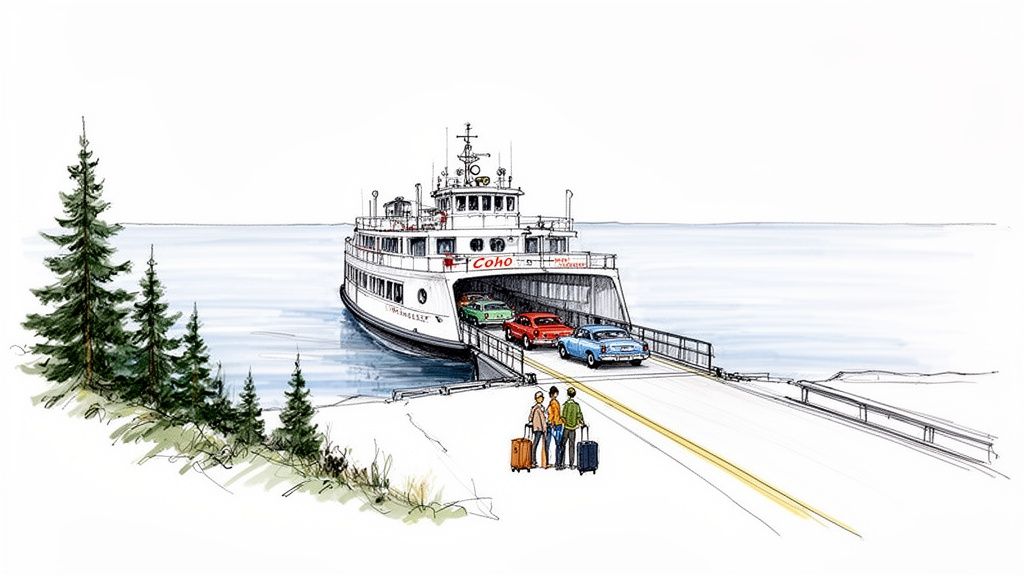
The MV Coho is more than just a boat; it's a floating piece of local heritage. Run by the Black Ball Ferry Line, this ship has a classic, sturdy character that feels worlds away from its sleek, high-speed cousins. The 90-minute journey across the Strait of Juan de Fuca is wonderfully unhurried. It’s just enough time to leave your car, grab a coffee from the galley, and scan the horizon for whales from the breezy outdoor decks.
This vessel is a true workhorse of the Salish Sea. Since its very first commercial trip on December 29, 1959, it’s become an institution. Think about this: by its 60th anniversary, the Coho had already made over 100,000 sailings, carrying about 26 million passengers and 7 million vehicles. It’s still the only ferry that runs year-round taking cars from Washington State right into downtown Victoria. You can dive deeper into the Coho's storied history on cohoferry.com.
Local Insight: Try to get to Port Angeles with some time to kill. It’s a great little town, not just a ferry terminal. Grab a pint at a local brewery, walk the waterfront to see the fishing boats, or check out the independent bookstore. The pre-boarding line-up is just part of the experience—a perfect moment to chill out before the last leg of your trip.
Booking and Boarding Your Vehicle
Getting your car a spot on this popular ferry requires a bit of planning, especially during the busy summer months. Here’s the lowdown:
- Reservations are a must: Foot passengers can usually just walk on, but vehicle spots sell out fast. We’re talking weeks, sometimes even months, in advance for peak season. Book online as soon as you know your dates.
- Show up early: You have to be checked in at the Port Angeles terminal at least 60 minutes before the ferry is scheduled to leave. This ensures there’s enough time to get everyone lined up in the staging area without any rush.
- Kick back and enjoy the ride: Once you’ve parked on the car deck, you’re free to roam the ship. Find a comfy seat in the passenger lounge or head outside to the promenade decks. The views of the Olympic Mountains behind you and Vancouver Island ahead are absolutely worth braving the wind for.
Experience Victoria Like a Local
So, your ferry from Seattle has docked. You've made it. But the real journey into what makes this city tick is just getting started. To have a full cultural experience, you need to venture beyond the postcard-perfect Inner Harbour and into the neighborhoods where Victorians actually live, work, and play.
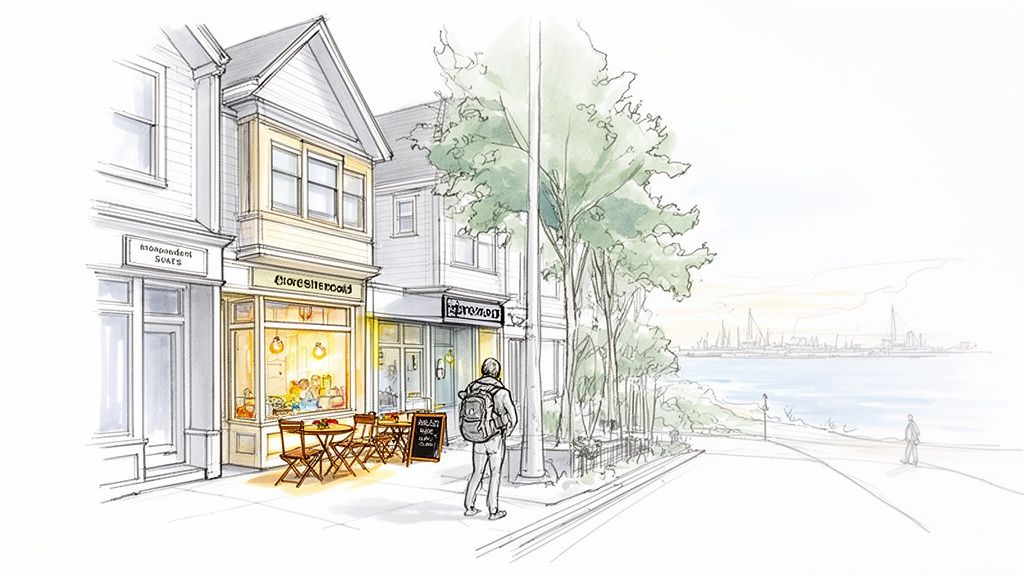
Think of the Inner Harbour as the city’s beautiful front porch—it's welcoming and gorgeous, but it's curated for guests. The real character of the house is just a short walk or bus ride away, tucked into distinct little enclaves, each with its own personality and rhythm.
Discover Victoria's Authentic Neighborhoods
To kick off your off-the-beaten-path exploration, point yourself toward Fernwood. This bohemian hub feels a world away from the tourist throngs. The heart of it all is the intersection of Gladstone and Fernwood, home to a quirky pub, an independent theatre, and some of the city's most beloved local cafes. It's the kind of place where community notice boards are still a primary source of information.
From there, make your way to Cook Street Village. This charming, tree-lined street is the perfect spot to grab a coffee and just watch the world go by. While it leads directly to the famous Beacon Hill Park, the village itself is the real destination for locals hunting for artisanal bakeries, boutique shops, and a genuinely relaxed vibe. For an authentic experience, pick up some picnic supplies from the local grocer and enjoy them in the park.
For a taste of true coastal life, go explore James Bay, Victoria's oldest residential neighborhood. Wander its quiet streets lined with heritage homes, then make your way to Fisherman's Wharf to see the colorful float homes and grab fresh fish and chips from a dockside vendor, just like the locals do.
Local Tip: Whatever you do, don't miss the Moss Street Market on Saturdays (it runs year-round but really comes alive in the summer). It’s so much more than a place to buy produce; it's a weekly social event where you can listen to local musicians and chat with farmers. Go early to get the best stuff, and bring your own reusable bag if you want to blend right in.
Getting Around Like a Victorian
Victoria's public transit system, BC Transit, is efficient and something residents actually use. Grabbing a DayPASS is a smart move, giving you unlimited rides for a great price. Hopping on the bus not only saves you money but also gives you a real feel for the city’s daily flow.
Here are a few ways to really immerse yourself:
- Ride the #7 Bus: This route is fantastic. It takes you from downtown right through Fernwood and Oak Bay, offering a perfect cross-section of local life.
- Rent a Bike: Victoria is incredibly bike-friendly. For a real adventure, cycle the Galloping Goose Trail and watch the landscape morph from urban to suburban to straight-up rural. Stop at one of the small breweries or cafes you'll find along the trail.
- Walk Everywhere: Honestly, many of the best neighborhoods—like James Bay and Fairfield—are easily explored on foot. Just start wandering and see what you stumble upon.
Discovering the Olympic Peninsula's Hidden Gems
The drive to Port Angeles for the MV Coho ferry is so much more than just getting from point A to point B. Think of it as the opening act for your whole island adventure and a chance for a full cultural experience. So many travelers just blast up the highway and miss out on what makes this corner of the world so special.
Honestly, the Olympic Peninsula is a living museum of the Pacific Northwest. Every little town, every scenic pull-off has a story. This is your chance to really connect with the region before you even step foot on the ferry seattle to victoria.
Turning the Drive into an Experience
Instead of rushing, give yourself time to slow down and explore. The Hood Canal, for example, is legendary for its oysters. You absolutely have to pull over at a roadside spot like Hama Hama Oysters for an unbelievably fresh taste of the Salish Sea. It’s not fancy, but it’s real—a perfect way to connect with the local waters.
A bit further on, the Victorian seaport of Port Townsend is a non-negotiable stop. Its historic streets are filled with quirky art galleries and little artisan shops. This isn't just about buying souvenirs; it’s a town that lives and breathes creativity, giving you a real peek into the region’s artistic soul. Grab a coffee at a local roaster and just wander.
Local Knowledge: When you head into places like the Hoh Rainforest, there's an unspoken etiquette. Keep your voice down, stick to the trails, and practice Leave No Trace. That immense, profound quiet is a huge part of the magic, and respecting it is how you honor the place and experience it like a local.
Connecting with Local Heritage
To truly get a feel for the peninsula, make time for the Indigenous cultural centers. The Jamestown S'Klallam Tribe's campus in Blyn, with its stunning totem poles and art gallery, offers essential context for the land you're traveling through. It really deepens your understanding of the area's history and the people who have stewarded it for millennia.
When you treat the drive this way, it stops being a task and becomes a genuine cultural immersion. You'll find that many of the best small towns in Washington state are scattered along this very route, each offering a unique slice of local life. By the time you get to Port Angeles, you won't just be a traveler waiting for a ferry; you'll be an explorer who has already started their journey.
Getting to Know the Washington State Ferries
While the direct Seattle-to-Victoria trip is handled by private companies, you can't really understand how people get around here without knowing about the Washington State Ferries (WSF) network. This isn't just a collection of boat routes; it’s basically our floating highway system, the lifeblood connecting islands and peninsulas all over Puget Sound.
Think of WSF as critical public transit, not a tourist cruise. For folks on Vashon, Bainbridge, or up in the San Juans, these ferries are their daily commute, their kids' school bus, and the only way to get to a doctor's appointment. Seeing it that way shifts your perspective from being a visitor to someone who gets the local rhythm.
This whole maritime culture is just woven into the fabric of the Pacific Northwest.
The Biggest Ferry System in the Country
The sheer scale of this operation is hard to wrap your head around. Washington State Ferries is the largest system of its kind in the United States. To give you an idea, in 2023 alone, it carried 20.1 million people.
Even though WSF runs ten different routes to twenty terminals, it's important to know that the international Anacortes to Sidney, British Columbia route is still out of commission, with no comeback planned until at least 2030. But despite some challenges, the system is incredibly dependable—they completed 97.6% of their 145,000+ scheduled sailings in fiscal year 2023. You can dive deeper into the extensive WSF network operations on Wikipedia.
So, why does this matter for your trip to Victoria? Because if you’re planning any side adventures—maybe a trip to the San Juan Islands or a scenic drive up Whidbey Island—you’ll almost certainly be using the WSF system.
Local Perspective: For locals, "catching the ferry" is a routine. It means checking sailing times online, guessing the wait times (especially in summer), and knowing the unwritten rules of the ferry line. It’s a dance we all know by heart. Observing this local ritual is a cultural experience in itself.
Understanding this system opens up your travel options. It allows you to piece together more complex and authentic itineraries, getting you off the main tourist path to explore the quieter, more scenic corners of the Salish Sea. You can build a trip that truly captures the spirit of this place.
Your Questions Answered: Seattle to Victoria Ferry
Planning the ferry trip from Seattle to Victoria always brings up a few practical questions. Getting these details sorted out ahead of time is the key to a stress-free crossing. Let's get into the most common ones we hear.
Do I Need a Passport for the Ferry to Victoria?
Yes, you absolutely do. This isn't a domestic trip; you're crossing an international border.
Every single traveler, including infants, needs a valid passport, passport card, or an approved document like a NEXUS card. You'll clear Canadian customs when you arrive in Victoria and U.S. customs on the way back, so have your documents handy.
Which Ferry Is Better If I Get Seasick?
If you're worried about a bumpy ride, the MV Coho is almost always the better choice. It's a big, heavy car ferry, so it cuts through the waves of the Strait of Juan de Fuca much more smoothly.
The Victoria Clipper is a faster, lighter passenger-only catamaran. Its route can be more exposed to open water, meaning you'll feel the chop a lot more on a windy day.
Can I Bring My Pet on the Ferry?
This is a big one, and the policies are completely different for each ferry.
- Victoria Clipper: Only allows trained service animals. Regular pets are not allowed onboard at all.
- MV Coho: Yes, you can bring your pet! They just have to stay inside your vehicle or in one of the designated pet areas on the car deck during the 90-minute trip.
Local Insight: The prime window for whale watching on either ferry is from May to October. Both routes cross major feeding grounds, so keep your eyes peeled for orcas and humpback whales. You might get lucky!
At CoraTravels, we know it's these little details that make a trip go smoothly. Our guides are packed with local, firsthand knowledge to help you explore with total confidence. Travel like a local with CoraTravels.