Hopping on a train from Florence to Venice isn't just about getting from point A to point B. It's about swapping the heart of the Renaissance for the magic of the canals in just over two hours. It's the smartest, most immersive way to travel between these two Italian giants, turning a simple transfer into a genuine part of your cultural experience.
The Modern Grand Tour, Minus the Hassle
Forget wrestling with a rental car on the autostrada or the soul-crushing experience of airport security. The train from Florence to Venice is the 21st-century version of the classic Grand Tour, giving you a front-row seat to the rolling hills of Tuscany and Emilia-Romagna without any of the stress.
This is about traveling smarter and deeper. It’s about spending less time on logistics and more time soaking in the art, the food, and the life of these incredible cities. This guide is built to help you navigate the journey like a local, focusing on the little details that make a trip smooth, memorable, and culturally rich.
Making the Most of an Italian Classic
Think of this short train ride as a crucial part of your Italian adventure, not just the bit in between. We'll get you set up to:
- Pick the right train: High-speed Frecciarossa or its slick competitor, Italo? We'll break down the pros and cons for your budget and travel style.
- Book tickets like a pro: Learn how to sidestep common tourist mistakes and snag the best prices.
- Handle the stations with ease: From finding your platform at Firenze Santa Maria Novella to that jaw-dropping moment you step out of Venezia Santa Lucia right onto the Grand Canal.
- Embrace the Journey: We'll share insider tips on turning the ride into an experience, including off-the-beaten-path detours that reveal a more authentic Italy.
This high-speed route zips across 253 kilometers in an average of just 2 hours and 14 minutes. How? A big piece of that puzzle is the incredible Apennine Base Tunnel system between Florence and Bologna. At 78.5 km long (93% of which is underground), it allows the train to slice through the mountains in a mind-boggling 37 minutes. You can find out more about this impressive Italian rail route.
Choosing Your High-Speed Train: Trenitalia vs. Italo
When you're planning your train trip from Florence to Venice, you'll quickly find yourself at a crossroads with two excellent choices: Trenitalia and Italo. This isn't a case of one being better than the other; think of them as having two different travel personalities.
Trenitalia is the state-run railway, running the iconic Frecciarossa ("Red Arrow") trains. Italo is the sleek, private competitor that shook up the Italian rail scene. Both will get you to Venice in style and comfort, but your choice comes down to the kind of experience you want. Are you looking for the classic Italian journey, or something a bit more modern and design-forward?
Trenitalia: A Legacy of Italian Rail
Trenitalia’s Frecciarossa service is the workhorse of Italian high-speed travel. The trains are comfortable, reliable, and offer a wide range of service classes, from a perfectly fine Standard class all the way up to Executive.
One of the biggest perks of traveling with Trenitalia is their massive network. If your trip involves other, smaller Italian towns, they often have better and more frequent connections. It's the dependable, go-to option that’s been connecting Italy for decades.
Italian high-speed rail history actually kicked off with Europe's first 'Direttissima' line between Rome and Florence back in 1977. Today's swift, two-hour journey between Florence and Venice is a direct result of that innovation, a huge step up from the regional trains that can take over four hours. You can learn more about the history of Italy's famous high-speed trains and how they came to be.
Italo: The Modern Competitor
Italo hit the scene in 2012 and immediately made a splash with its striking, Ferrari-red trains and a heavy focus on customer experience. Their travel classes—Smart, Prima, and Club Executive—often feel a bit more like flying, with leather seats coming standard even in the entry-level cars.
Many travelers, myself included, find Italo often has very competitive pricing, especially when booking in advance. They're also known for having solid Wi-Fi, which makes them a favorite if you need to get some work done on the go.
This decision tree lays out the simple, direct path for your high-speed journey from the Renaissance city to the city of canals.
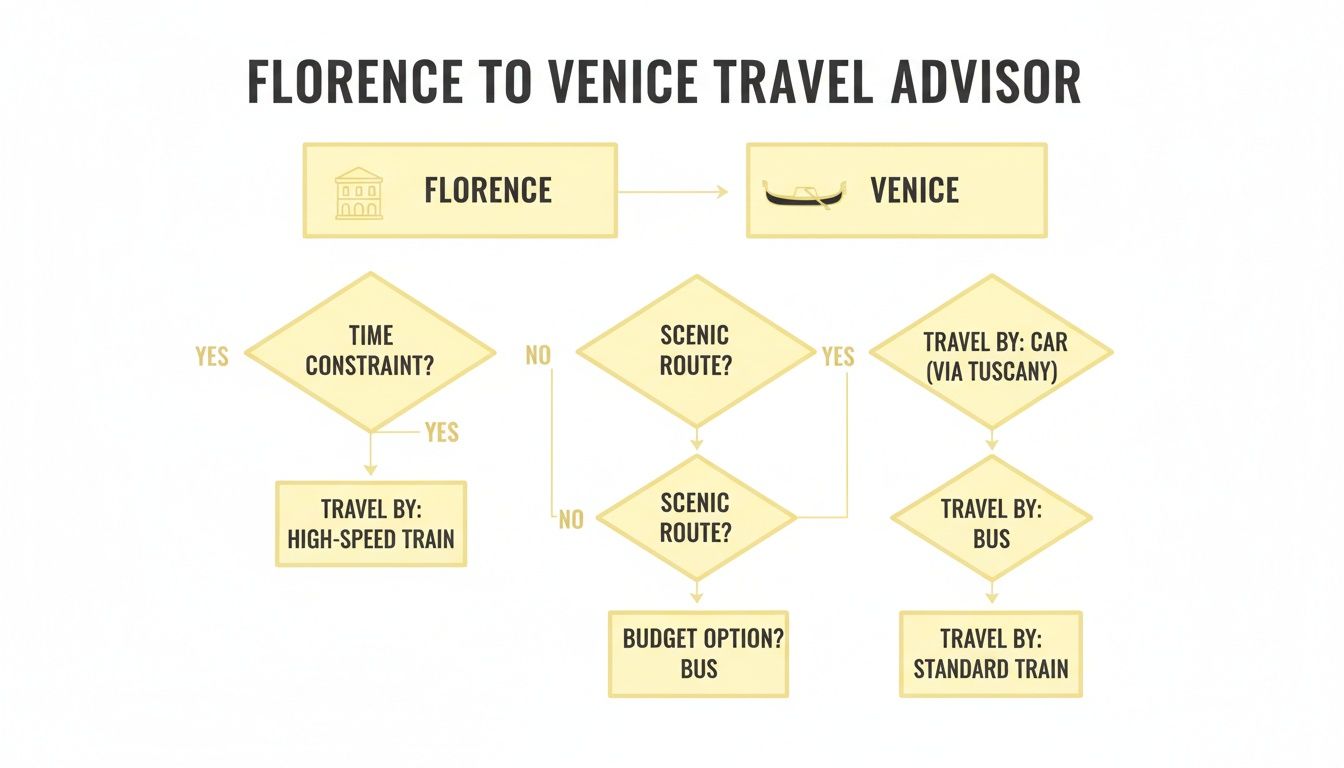
Ultimately, the choice comes down to these two excellent high-speed operators, as they offer the most efficient and enjoyable way to travel between these two cities.
Trenitalia Frecciarossa vs. Italo Treno: A Quick Comparison
To make the choice easier, here's a side-by-side look at what each operator brings to the table for the Florence-Venice route.
| Feature | Trenitalia (Frecciarossa) | Italo Treno |
|---|---|---|
| Vibe & Feel | Classic, state-run reliability. Functional and comfortable. | Modern, sleek, and design-focused. A bit like an airline. |
| Network Reach | Extensive network across all of Italy, including smaller towns. | Focused on major cities and high-speed corridors. |
| Loyalty Program | CartaFRECCIA | Italo Più |
| Onboard Amenities | Bar/bistro car, power outlets, Wi-Fi. | Vending machines, power outlets, generally stronger Wi-Fi. |
| Ticket Pricing | Often competitive, especially with advance booking deals. | Can be cheaper if booked well in advance, very dynamic pricing. |
| Seating | Comfortable cloth seats in Standard, leather in higher classes. | Leather seats standard in all classes, including entry-level. |
Honestly, you can't go wrong with either. I recommend checking both for your travel dates, as pricing and schedules can be the deciding factor.
Beyond High-Speed: The Regional Train Reality
You might see regional trains (Regionale) pop up in your search results with temptingly low prices. My advice? Ignore them for this particular route. Here’s the reality:
- Time: A trip that takes just over two hours on a high-speed train will stretch to four hours or more. You'll lose half a day of your vacation.
- Comfort: These trains are built for short commutes. Think basic, functional seating and very few amenities.
- Convenience: You'll almost certainly have to change trains at least once, which adds hassle and a chance for delays.
Once you’ve got this route down, planning other train journeys across Italy is a breeze. If your travels are taking you further north, check out our guide on taking the train from Venice to Milan, as many of the same tips apply.
How to Book Your Train Tickets Like an Italian
To really travel like a local, you have to book like one. Forget the third-party websites and their markups. Getting the best deal on your Florence to Venice train ticket comes down to using the official channels and knowing the rhythm of their pricing.
Always, always book directly with the operators themselves: Trenitalia or Italo. Both have excellent websites and mobile apps in English. This is the only way to see the full range of fares and avoid the hidden fees that resellers love to tack on.
Finding the Sweet Spot for Booking
Timing is absolutely critical with Italian trains. The golden rule is simple: book ahead, but not too far ahead.
While you can see fares about four months out, the real sweet spot for scoring the best price on a high-speed Florence to Venice train is usually 3 to 4 weeks before you travel. This is when the cheapest promotional tickets are most available, before the dynamic pricing algorithms start cranking the prices up as your date gets closer.
Don’t make the classic mistake of waiting until the last minute. A Super Economy ticket that costs just €19.90 three weeks out can easily skyrocket to over €50 for a standard Base fare if you buy it on the day of your trip. A little planning goes a very long way.
Decoding Italian Fare Types
When you search for tickets, you'll be hit with a bunch of fare names that can feel confusing. At the end of the day, it's a simple trade-off: the cheaper the ticket, the less flexible it is. Understanding this is key to not getting burned.
Here's the simple breakdown of what you'll see:
- Super Economy (Trenitalia) / Low Cost (Italo): These are the rock-bottom prices. They are non-refundable and non-changeable, period. If your plans are 100% locked in, this is your best friend for saving money.
- Economy (Trenitalia) / Economy (Italo): This is the happy medium. You get a nice discount over the full price and are allowed to make one change to your booking, though you'll have to pay a fee plus any difference in the new ticket price.
- Base (Trenitalia) / Flex (Italo): This is the full-priced, completely flexible option. You can change it multiple times and usually get a partial refund if you need to cancel. Only choose this if your itinerary is genuinely up in the air.
For a straightforward, popular route like Florence to Venice, a Super Economy or Low Cost fare is almost always the smartest move if your dates are firm.
Unlocking Local Discounts with Loyalty Programs
Here's a pro tip most tourists completely miss: sign up for the free loyalty programs. Yes, even if you're not an Italian resident.
Take five minutes and join Trenitalia's CartaFRECCIA or Italo Più. It costs nothing.
Why bother? Because they frequently email member-only discount codes and run special promotions, like 2-for-1 deals on Saturdays or 30% off fares for traveling midweek. These are deals you'll never see otherwise. It's a quick sign-up that can genuinely cut your travel costs across Italy.
Getting Around the Florence and Venice Train Stations
The train stations in Florence and Venice are more than just places you pass through—they are the grand gateways to your entire city experience. Knowing how to navigate these bustling hubs is the difference between a stressful scramble and a smooth, truly Italian journey. It sets the tone for everything that follows.
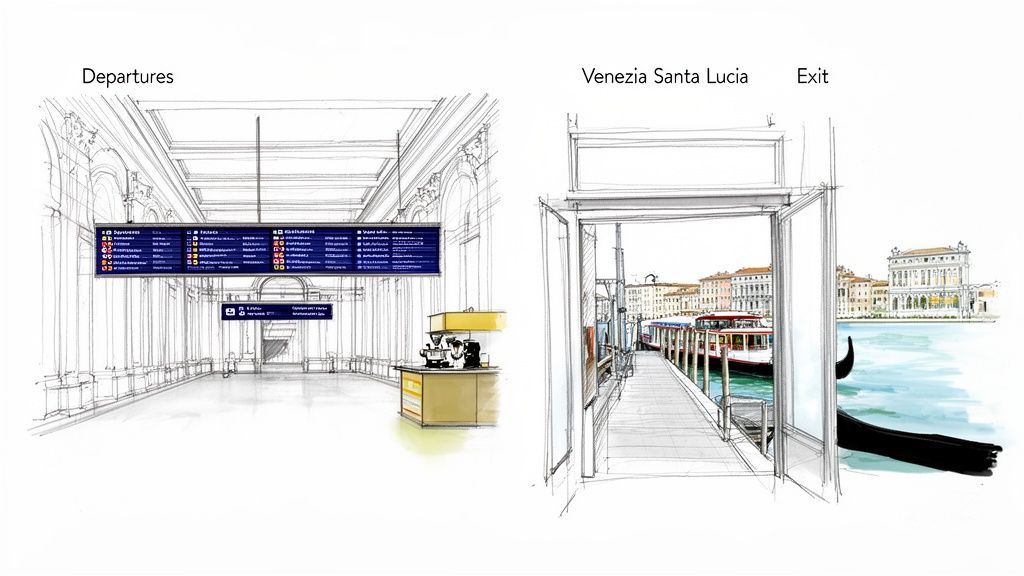
Your trip kicks off at Firenze Santa Maria Novella (SMN), Florence’s main railway station. Thankfully, it's a terminus station, which just means all the tracks end here. This simple layout makes finding your train a lot less confusing. Once you're inside, your first job is to find the huge Partenze (Departures) board.
This digital board is your best friend. It lists your train number, its final destination, and the all-important binario (platform). Don't freak out if your platform isn't listed right away; for the high-speed trains, they often only post it 15-20 minutes before departure.
What to Do Before You Leave Florence
Showing up about 20 minutes early is the sweet spot. It gives you plenty of time to find your platform without breaking a sweat and maybe even grab a quick caffè like a local. For a better coffee, skip the big bars in the main concourse. Walk towards the pharmacy on the ground floor; you'll find smaller, less crowded cafes nearby that do a much better espresso.
A critical tip for any train trip in Italy: ticket validation. If you have a digital ticket with a QR code, you're all set—no action needed. But if you're holding an old-school paper ticket for a regional train (the ones without assigned seats), you absolutely must stamp it in one of the small green and white machines on the platform. Forgetting this can lead to a hefty fine.
If you're planning a trip with multiple stops or have an early train to catch, finding accommodation near major Italian railway stations can be a real game-changer, saving you a frantic morning taxi ride.
That Unforgettable Arrival at Venezia Santa Lucia
This is where the real magic happens. The moment you step outside Venezia Santa Lucia, you’re not met with roads, taxis, and exhaust fumes. Instead, you're greeted by the stunning, almost surreal, sight of the Grand Canal. It is, without a doubt, one of the most dramatic and memorable arrivals in all of travel.
Take a second to soak it all in, but be ready for the massive crowd bottleneck right at the station doors. Your next move is to figure out the vaporetto, Venice's water bus system. Here’s what to do:
- Find the Ticket Booths: Look immediately to your left as you exit the station. You can't miss the ACTV ticket stands for the vaporetto. This is where you can buy single-ride tickets or multi-day passes.
- Know Your Route: The main vaporetto stop, Ferrovia, is directly in front of you. Lines 1 and 2 are your main arteries down the Grand Canal. Think of Line 1 as the "local" route that makes every single stop, while Line 2 is more of an express.
- Dodge the Crowds: If you want to get off the beaten path fast, look for a vaporetto route that veers into the smaller, quieter canals. It’s a much more immersive first glimpse of the city’s enchanting backstreets and hidden corners.
Exploring Cultural Gems Along the Route
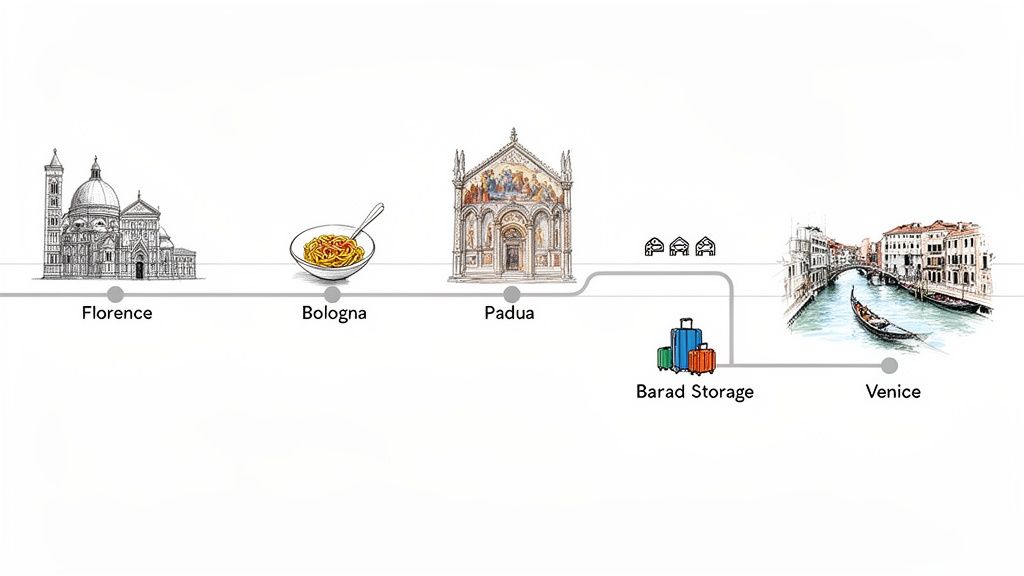
Why just blast from Florence to Venice when the journey itself is part of the adventure? The high-speed line slices right through Italy’s cultural and culinary heartland, giving you a perfect excuse to turn a simple train ride into a multi-city experience.
Think of it less as a commute and more as a strategic detour. Breaking up the trip lets you sidestep the main tourist circuit for a few hours. You get to discover a more authentic side of Italy, find the real rhythm of Italian life, and create a far richer story than just rushing from one major landmark to another.
Bologna: A Life-Changing Lunch Detour
Perfectly positioned midway, Bologna is Italy’s undisputed food capital. Hopping off the train here for a few hours is your chance for a truly life-changing lunch. Forget the spaghetti bolognese you think you know; this is the home of authentic tagliatelle al ragù, and tasting it on its home turf is a rite of passage for any food lover.
Wander under the city's famous porticoes to a traditional osteria in the Quadrilatero, the ancient market district. It's an experience that defines the entire region, miles away from the crowds of Florence and Venice.
Padua: A Glimpse of Authentic Veneto
Just before you reach Venice, you'll find Padua (Padova), a city buzzing with history and a vibrant local scene. It's home to the Scrovegni Chapel, where Giotto's frescoes are a breathtaking masterpiece of Western art that can bring you to your knees.
But beyond the art, Padua offers a more grounded, less tourist-centric version of life in the Veneto region. Explore the bustling market squares of Piazza delle Erbe and Piazza della Frutta, where locals have been shopping for centuries. It’s a peaceful, authentic counterpoint to the magnificent—but often overwhelming—spectacle of Venice. For more ideas on finding these kinds of places, check out our guide on some of the best hidden gems in Europe.
The Logistics of a Smart Stopover
Making this happen is surprisingly simple. You don’t need a complicated plan, just two separate, pre-booked tickets: one from Florence to your stopover city, and another from there on to Venice.
Local Tip: Don’t let your luggage slow you down. Both Bologna Centrale and Padova stations have a deposito bagagli (luggage storage service). For a small fee, you can securely stash your bags for a few hours, freeing you up to explore the city center completely unburdened. This simple trick is the key to making your detour totally stress-free.
Your Florence to Venice Train Questions Answered
Got a few lingering questions? Perfect. These are the most common things travelers ask about the Florence to Venice train, and getting these small details right can make your journey completely seamless. Here are some straightforward answers based on years of zipping between Italian cities.
Do I Need to Validate My Train Ticket?
This is a classic "local knowledge" tip that can save you a world of hurt. Here’s the simple breakdown:
- Digital E-Tickets: If you have an e-ticket with a QR code for a high-speed Frecciarossa or Italo train, you do not need to do anything. Just have it ready on your phone. The conductor will scan it from their device once you’re moving.
- Paper Regional Tickets: If, however, you have a paper ticket for a Regionale (regional) train that doesn't have a specific seat or time assigned, then you absolutely must validate it. Before you board, look for the small green, white, and red stamping machines on the platform. Pop your ticket in to get it time-stamped. Skipping this can result in a steep, on-the-spot fine.
How Much Luggage Can I Bring on the Train?
One of the best things about Italian trains is how relaxed they are about luggage, especially compared to budget airlines. Both Trenitalia and Italo are very generous.
There’s no official weight limit, and you can comfortably bring one large suitcase and one carry-on bag per person without anyone batting an eye. You’ll find luggage racks at the end of each train car for bigger bags and overhead shelves for smaller items like backpacks and totes.
A little pro tip: Try to board as soon as your platform is announced, especially on a busy train like Florence to Venice. Those luggage racks fill up fast, and getting there first means you won't have to wrestle a heavy bag into the overhead space.
Is First Class Worth the Extra Cost?
Honestly, it depends on your budget and travel style. The standard class (called 'Smart' on Italo) is perfectly comfortable and more than enough for the quick two-hour trip. The seats are nice, and you'll have everything you need.
So what do you get for upgrading? Moving up to a higher class like Premium/Business (or 'Prima'/'Club' on Italo) usually gets you wider leather seats, a bit more legroom, and a complimentary welcome drink and a little snack. It can be a nice treat, especially if you want a quieter car to get some work done. For most travelers, though, Standard is the way to go—it’s a nice-to-have, not a need-to-have.
What Happens if I Miss My High-Speed Train?
This is where the fare you booked really matters. It's a classic case of you-get-what-you-pay-for.
If you snagged a super-cheap, non-flexible ticket (like Super Economy or Low Cost), you’ll most likely have to buy a brand-new, full-price ticket for the next available train. Those low prices come with strict rules.
On the other hand, if you bought a more expensive flexible fare (like Base or Flex), you have options. You can usually change your booking to a later train within a certain window, sometimes for a small fee. The golden rule is to always check the specific fare conditions when you book. But the best insurance policy? Just show up at the station a solid 20 minutes before your train is scheduled to leave.
If you're looking for broader trip-planning advice that goes beyond just the train ride, our general travel guides can help you pull all the other pieces together.
At CoraTravels, we believe the best trips are built on understanding the little details that locals know by heart. Our guides give you that insider view, so you can travel with less stress and more curiosity. Discover your next adventure with CoraTravels.