Forget the crowded landmarks and over-photographed sights. This guide is for the traveler who craves authenticity and seeks to understand a place through its most unique customs. We're diving deep into the weird traditions around the world, moving beyond simple descriptions to offer a practical roadmap for respectful engagement. From the bizarre athletic feat of cheese rolling in England to the surprisingly artistic Night of the Radishes in Mexico, these events are more than just spectacles; they are living, breathing expressions of history, community, and identity.
This article provides the essential context you need: the origins, the etiquette, and the on-the-ground details for participating or observing safely. Drawing on insights from local guides and cultural experts, we'll help you step off the beaten path and into the heart of these extraordinary celebrations. Understanding the local context is key. Just as exploring the history of witches in global folklore can illuminate deep-seated cultural beliefs, witnessing these traditions firsthand offers a profound connection to a destination. Here, you'll find the actionable advice necessary to transform your trip from a standard vacation into a genuinely immersive cultural experience.
1. Wife-Carrying (Eukonkanto)
One of the most physically demanding and visually amusing weird traditions around the world is Finland's Eukonkanto, or Wife-Carrying. This sport involves a male competitor racing through a 253.5-meter track, complete with sand, fence, and water obstacles, all while carrying a female teammate. The most popular carrying style is the "Estonian Carry," where the woman hangs upside-down on the man's back with her legs wrapped around his shoulders.
A Deeper Cultural Experience
The tradition’s origin is debated, but most tales link it to the 19th-century brigand Herkko Rosvo-Ronkainen, whose gang allegedly stole women from neighboring villages by carrying them on their backs. Today, this legend has evolved into an official sport, culminating in the World Wife-Carrying Championships held annually in Sonkajärvi, Finland since 1992. The prize? The winner receives his partner’s weight in beer.
Your Guide to an Immersive Visit
To witness this spectacle, plan a trip to Sonkajärvi in early July.
- Go Local: Accommodations in this small town are scarce. Book well in advance to stay locally and experience the full community atmosphere. Alternatively, nearby Iisalmi or Kuopio offer more options.
- Off the Beaten Path: Renting a car is the best way to explore the rural Savonia region and offers flexibility for getting to the event grounds. This allows you to discover smaller villages and lakes away from the main festival crowds.
- Local Guide Tip: Arrive early on race day to secure a prime viewing spot, especially near the infamous water obstacle for the biggest splashes and best photos.
For official dates and participation rules, visit the event’s website: eukonkanto.fi.
2. Throwing of the Tomatoes (La Tomatina)
Among the most joyfully chaotic weird traditions around the world is Spain's La Tomatina, a massive food fight held annually in the town of Buñol. For one hour on the last Wednesday of August, truckloads of overripe tomatoes are dumped into the streets, and thousands of participants pelt each other in a sea of red pulp. This tradition, now an internationally famous festival, turns the entire town into a vibrant, messy, and unforgettable spectacle.
A Deeper Cultural Experience
The festival’s origin dates back to a spontaneous food fight among young people in 1945. What started as a small, local squabble has grown into a globally recognized event. To get the full cultural experience, arrive in Buñol a few days early. The week leading up to the main event is filled with parades, fireworks, and paella-cooking contests, offering a deeper dive into Valencian culture beyond the main square.
Your Guide to an Immersive Visit
To join the world’s biggest food fight, plan your trip to Buñol for the last Wednesday of August.
- Go Local: Secure your entry pass online months in advance, often as part of a tour package from nearby Valencia. This is the most common way for tourists to attend.
- Off the Beaten Path: The easiest way to reach Buñol is by train or bus from Valencia. These services are significantly increased on the day of the festival to accommodate the crowds.
- Local Guide Tip: Wear old clothes you don’t mind ruining and closed-toe shoes. Goggles are essential for protecting your eyes from the acidic tomato juice.
For official dates and ticket information, visit the event’s website: latomatina.info.
3. Bog Snorkeling (Llanwrtyd Wells)
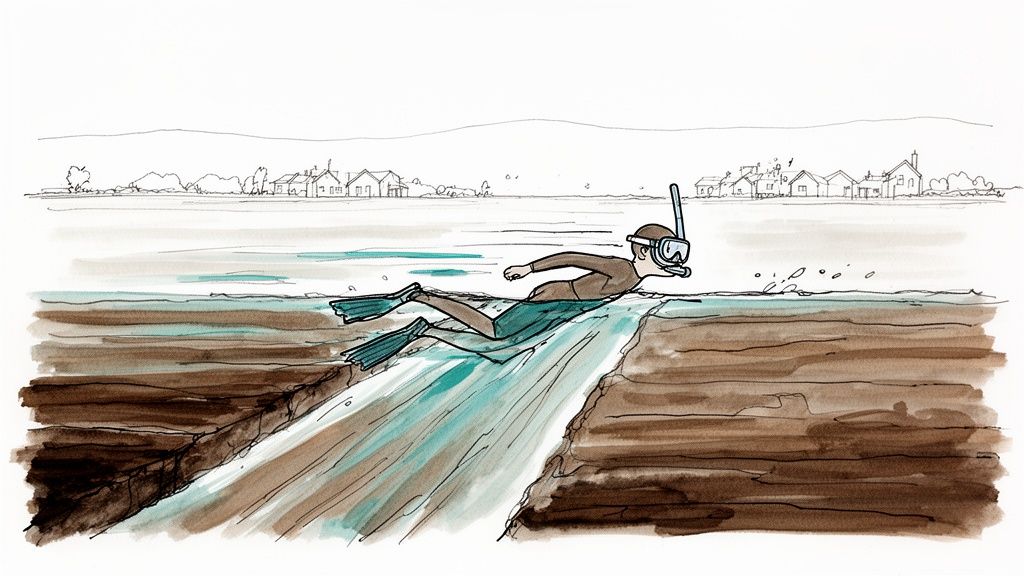
From the murky peat bogs of Wales comes one of the most eccentric weird traditions around the world: bog snorkeling. This unconventional sport requires competitors, clad in wetsuits, snorkels, and flippers, to swim two consecutive 60-yard lengths through a waterlogged trench cut into a peat bog. The catch? Conventional swimming strokes are forbidden, forcing participants to rely solely on flipper power in the cold, muddy water.
A Deeper Cultural Experience
What started as a pub bet in the small town of Llanwrtyd Wells in 1976 has since blossomed into a celebrated international event. The World Bog Snorkelling Championships have been held annually since 1985, drawing competitors and spectators to the Waen Rhydd peat bog. The event was created to boost local tourism and perfectly embodies the quirky, self-deprecating humor of the Welsh people, transforming a bizarre idea into a globally recognized tradition.
Your Guide to an Immersive Visit
To experience this muddy spectacle, head to Llanwrtyd Wells in late August for the World Championships.
- Go Local: Book a room in Llanwrtyd Wells (population ~600) well in advance to fully immerse yourself in the festive atmosphere and support the tiny town that hosts the event.
- Off the Beaten Path: Combine your trip with a visit to the nearby Brecon Beacons National Park for stunning walking trails and a taste of Wales's dramatic landscapes, far from the tourist hubs.
- Local Guide Tip: You can rent wetsuits locally, which is crucial for insulation against the cold bog water. Do not attempt to snorkel without one.
For exact dates and event details, check the official organizers' website: green-events.co.uk.
4. Baby Jumping (El Colacho)
One of the most startling weird traditions around the world is Spain's El Colacho, or Baby Jumping. This ritual takes place in the village of Castrillo de Murcia, where men dressed as yellow-suited devils (the Colacho) leap over infants born in the previous year. The babies are laid on mattresses in the street, and the jump is believed to cleanse them of original sin, ward off evil spirits, and ensure a healthy life.
A Deeper Cultural Experience
Dating back to at least 1620, El Colacho is part of the local Corpus Christi festivities. The Colacho represents the devil, who, by jumping over the babies, absorbs their sins and is then driven out of the town by the forces of good. While its origins are rooted in Catholic symbolism, the practice is a unique local interpretation not officially sanctioned by the Church. Today, it remains a vibrant, community-focused event that draws curious visitors from around the globe.
Your Guide to an Immersive Visit
To witness this unique rite of passage, plan a trip to Castrillo de Murcia during the Corpus Christi festival, typically in late May or June.
- Go Local: Arrive early on Sunday, as the small village fills up quickly. This is a deeply ingrained local custom. Always ask for permission before taking photos of the families or babies, and follow any instructions from organizers.
- Off the Beaten Path: Combine your visit with a trip to the nearby city of Burgos to see its famous cathedral. For more ideas on discovering unique cultural pockets, check out these tips for off-the-beaten-path travel.
- Local Guide Tip: The festival date is tied to Easter, so confirm the exact weekend annually. A local guide can help you navigate the day's events and explain the symbolism in real-time.
For more information, consult the local Burgos tourism board website for festival schedules.
5. Bullet Ant Glove Challenge (Sateré-Mawé Tribe)
Deep within the Brazilian Amazon, the Sateré-Mawé people practice one of the most intense and painful coming-of-age traditions in the world. To prove their manhood, young men must wear a glove woven with dozens of bullet ants, whose sting is likened to being shot, for ten excruciating minutes. The young initiates must endure this ordeal up to 20 times over several months, a testament to their strength, endurance, and readiness for adult responsibilities within the tribe.
A Deeper Cultural Experience
This initiation rite is not a performance but a genuine, deeply spiritual ceremony tied to the Sateré-Mawé worldview. The ants are sedated with a natural herbal solution, woven into the gloves with their stingers facing inward, and awaken angrier than ever. The ritual signifies a warrior's ability to withstand pain without showing weakness, a crucial value in their culture. While documented in anthropological studies, this remains a sacred, living tradition reserved exclusively for members of the community.
Your Guide to an Immersive Visit
Witnessing this powerful ritual requires immense respect and is only possible through responsible, community-approved channels. Participation is strictly forbidden.
- Go Local: Engage only with established indigenous tourism operators that have a direct and ethical relationship with the Sateré-Mawé. This ensures your visit is welcome and benefits the community.
- Off the Beaten Path: This is the definition of off-the-beaten-path travel. The experience requires a deep commitment to responsible tourism and a willingness to travel far from typical tourist infrastructure.
- Local Guide Tip: Always seek permission before taking photos or videos. During sacred rituals, documentation may be prohibited, and respecting these rules is paramount. Support local artisans by purchasing authentic crafts as a direct economic contribution.
6. Night of the Radishes (Noche de Rábanos)
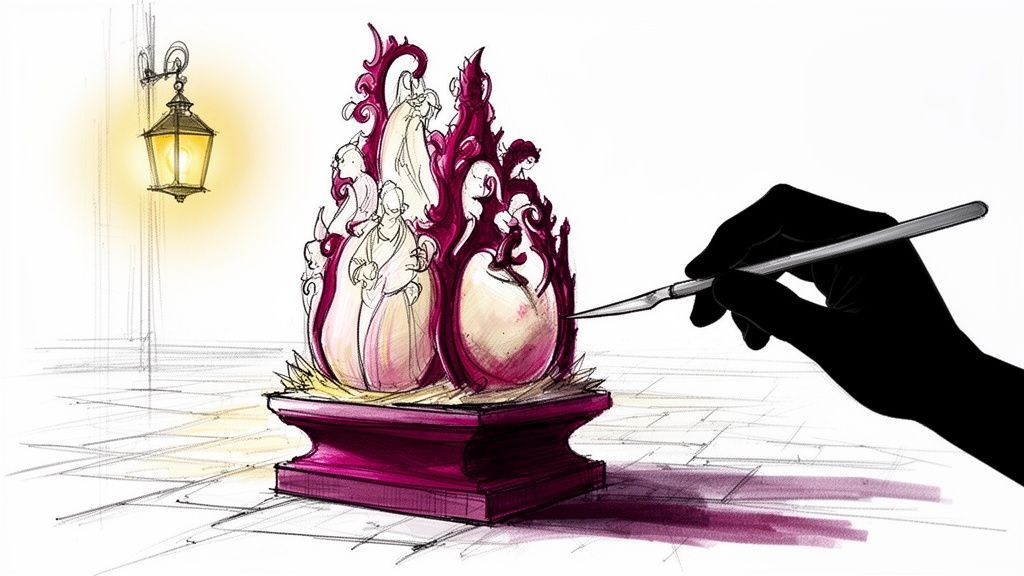
One of the most unique and artistically weird traditions around the world is Oaxaca's Noche de Rábanos, or Night of the Radishes. Every December 23rd, the city's main square, the Zócalo, transforms into an open-air gallery where local artisans display incredibly detailed scenes and figures sculpted from oversized radishes. These special radishes are grown specifically for the event, allowing for intricate carvings that range from religious nativity scenes to complex mythological figures and vignettes of daily life.
A Deeper Cultural Experience
What began in 1897 as a way for local farmers to attract shoppers to their market stalls has blossomed into a major cultural competition. The tradition blends indigenous agricultural practices with Spanish colonial Christmas customs, creating a folk art form that is distinctly Oaxacan. Today, artisans compete for prizes and city-wide acclaim, with their ephemeral masterpieces wilting within hours. This celebration is a vibrant expression of Oaxacan creativity.
Your Guide to an Immersive Visit
To experience this one-of-a-kind festival, plan your trip to Oaxaca City around December 23rd.
- Go Local: The Zócalo will be filled with stalls selling local treats. Be sure to try traditional buñuelos, thin fried pastries often served with syrup, and a warm cup of Oaxacan hot chocolate.
- Off the Beaten Path: While the Zócalo is the main event, explore the side streets where you'll find smaller, spontaneous celebrations and local families enjoying the festive atmosphere away from the biggest crowds.
- Local Guide Tip: The displays are set up in the afternoon. Arrive at the Zócalo by 4 PM to see the carvings at their freshest and to beat the massive evening queues.
For more information on Oaxaca's vibrant cultural events, you can explore the city's tourism website.
7. Tar Barrel Rolling (Ottery St. Mary, Devon)
Among the most fiery and adrenaline-fueled weird traditions around the world is the Tar Barrel Rolling of Ottery St. Mary, England. Every November 5th, this small Devon town ignites as locals, known as "Barrel Rollers," hoist flaming barrels soaked in tar onto their shoulders and run through the crowded streets. This high-stakes tradition, held on Bonfire Night, is believed to ward off evil spirits and has been a cornerstone of local identity for centuries, continuing since at least the 19th century.
A Deeper Cultural Experience
The origins of Tar Barrel Rolling are murky, with some theories linking it to the gunpowder plot of 1605, while others suggest it was a pagan ritual for fumigating cottages. Despite modern fire and safety regulations nearly extinguishing the event, passionate locals secured exemptions to preserve it. The day features a series of barrel rolls, starting with smaller barrels for children in the afternoon and culminating with massive, blazing barrels for the men and women after dark.
Your Guide to an Immersive Visit
To experience this explosive tradition, plan your trip to Ottery St. Mary for November 5th.
- Go Local: Accommodations in the village are extremely limited and book up a year in advance. Consider staying in nearby Exeter and using public transport or a taxi service to reach the town.
- Off the Beaten Path: Arrive early in the afternoon to find parking and secure a viewing spot before the roads close. Explore the town's historic pubs where the "Barrel Rollers" gather before and after their runs.
- Local Guide Tip: Wear old, non-flammable clothing (like denim or wool) and stay alert. For a safer view, find an elevated position away from the main thoroughfare.
For official event timings and safety guidelines, visit the tradition’s dedicated website: www.otterytarbarrels.co.uk.
8. Buzkashi (Afghan Horseback Polo with Goat Carcass)
Originating from the nomadic traditions of Central Asia, Buzkashi is a thrilling and intense sport that stands as one of the most unique traditions around the world. Most popular in Afghanistan, this game involves skilled horsemen, known as chapandazan, competing to drag a headless goat or calf carcass (boz) across a field and into a scoring circle. It's a chaotic, powerful display of horsemanship, strength, and strategy that has been a cultural cornerstone for centuries.
A Deeper Cultural Experience
Buzkashi, translating to "goat pulling," is believed to have originated among ancient Turkic-Mongol peoples, who used it to train their cavalry. Today, it is Afghanistan's national sport, celebrated with major tournaments during the cooler months, particularly around the Afghan new year, Nowruz. Matches in cities like Mazar-i-Sharif are significant social events, attracting large crowds and showcasing the deep-seated equestrian culture of the region.
Your Guide to an Immersive Visit
Witnessing a Buzkashi match requires careful planning and local guidance, as events are often informal.
- Go Local: Engaging an experienced local guide is non-negotiable for safety and access. Your guide will have connections to find out when and where matches are scheduled and can provide cultural interpretation.
- Off the Beaten Path: The security situation in Afghanistan is volatile. Always check current travel advisories from your government before considering a trip. This experience is far from any tourist trail.
- Local Guide Tip: Sit in elevated areas for safety and a better view of the large field. Respect local customs regarding photography, especially in conservative areas, and learn a few Dari phrases to show appreciation for the sport.
9. Thaipusam's Skewer Piercing (Hindu Penance Ritual)
Among the most visually intense and deeply spiritual weird traditions around the world is the Hindu festival of Thaipusam. Celebrated primarily by Tamil communities, this ritual sees devotees fulfilling vows and seeking blessings from Lord Murugan, the god of war, through acts of penance. Many pierce their cheeks and tongues with skewers (vels) or carry elaborate, heavy structures called kavadis supported by hooks embedded in their skin, all while in a trance-like state that devotees say protects them from pain.
A Deeper Cultural Experience
Thaipusam commemorates the day the goddess Parvati gave her son Murugan a divine spear to vanquish the demon Soorapadman. The piercings and burdens are a symbolic offering of gratitude, a test of faith, and a purification of the soul. Witnessing the pre-dawn preparations, where family members support devotees entering a spiritual trance, offers a profound insight into the community's unshakable faith. This is not a performance but a deeply personal, sacred act.
Your Guide to an Immersive Visit
To observe this powerful festival respectfully, visit Malaysia or Singapore during the full moon of the Tamil month of Thai (January/February).
- Go Local: Arrive at major sites like Kuala Lumpur’s Batu Caves before sunrise to witness the most intimate preparations and the start of the procession amongst local families.
- Off the Beaten Path: While Batu Caves is famous, smaller temples in areas like Penang offer a less crowded but equally profound experience of the festival.
- Local Guide Tip: Dress modestly, covering shoulders and knees. This is a sacred ritual, so ask for permission before taking close-up photos of devotees and be mindful of your surroundings, giving participants space.
For precise dates, which change annually based on the lunar calendar, check the websites of major temples like the Batu Caves Sri Subramaniar Swamy Devasthanam.
10. Inti Raymi (Incan Sun Festival Recreation)
Among the most spectacular and deeply rooted weird traditions around the world is Peru's Inti Raymi, the Festival of the Sun. This massive theatrical event is a contemporary recreation of an ancient Incan ceremony honoring the sun god, Inti, and marking the winter solstice. The main celebration in Cusco involves hundreds of actors in vibrant, traditional costumes who reenact historical rituals, processions, and dances, moving from the Qorikancha (Temple of the Sun) to the grand finale at the Sacsayhuamán fortress.
A Deeper Cultural Experience
Originally a cornerstone of Incan spiritual life, the Inti Raymi was suppressed by Spanish colonizers in the 16th century. It was revived in 1944 as a powerful assertion of indigenous identity and cultural pride, blending historical accounts with modern pageantry. Today, it stands as South America’s second-largest festival. The event is a vibrant expression of Peruvian heritage; for more insight into local customs, you can learn more about customs and traditions that shape communities globally.
Your Guide to an Immersive Visit
To experience Inti Raymi in Cusco on June 24th, meticulous planning is key.
- Go Local: Hire a Quechua-speaking guide. They can provide invaluable context, translating the ceremonies and sharing cultural insights that bring the reenactment to life far beyond what you can see as a casual observer.
- Off the Beaten Path: The main events are ticketed and crowded. For a more authentic feel, witness the initial procession starting at Qorikancha from the streets with the local crowds, soaking in the city-wide atmosphere.
- Local Guide Tip: Arrive in Cusco (11,152 ft) 2-3 days early to adjust to the high altitude. Dress in layers, as Cusco's June weather is unpredictable with both strong sun and cold winds.
11. Gion Matsuri (Kyoto's Geisha Festival with Sacred Processions)
One of Japan's most famous and visually stunning weird traditions around the world is Kyoto's Gion Matsuri. This month-long festival in July sees enormous, hand-built floats called yama and hoko paraded through the city's streets, often pulled by dozens of people in traditional attire. It's a breathtaking blend of ancient Shinto rituals, masterful craftsmanship, and vibrant street parties, centered around the historic geisha district of Gion.
A Deeper Cultural Experience
The festival’s origins date back to 869 AD when a plague devastated Kyoto. Emperor Seiwa ordered a procession to appease the gods, which evolved into this annual grand spectacle. Today, Gion Matsuri is not just a religious event but a cultural cornerstone. The celebration includes elaborate ceremonies, traditional music, and dance performances by geiko (Kyoto geisha) and maiko (apprentice geisha), creating an immersive experience that transports visitors back in time.
Your Guide to an Immersive Visit
To truly experience Gion Matsuri, plan your visit for mid-July when the main events take place.
- Go Local: Rent a yukata (a casual summer kimono) to blend in with the locals and enhance your experience. Shops offering rentals are plentiful throughout the city.
- Off the Beaten Path: The nights of Yoiyama (July 14-16 and 21-23) are magical. Streets are closed to traffic, lined with food stalls, and the floats are lit with lanterns. This is where local life truly shines.
- Local Guide Tip: For the main procession (Yamaboko Junkō on July 17), arrive before dawn to secure a good viewing spot along the route, or consider booking paid seating for a guaranteed view.
For a detailed schedule and event updates, visit the official Kyoto tourism website: kyoto.travel.
12. Cheese Rolling (Cooper's Hill, Gloucestershire)
One of the most chaotic and weird traditions around the world is the annual Cheese Rolling at Cooper's Hill in Gloucestershire, England. This event sees brave (or foolish) participants chase a 9-pound wheel of Double Gloucester cheese down an incredibly steep, 200-meter hill. The first person to cross the finish line at the bottom wins the cheese. Due to the hill's gradient, contestants inevitably end up tumbling, making for a truly wild spectacle.
A Deeper Cultural Experience
The tradition’s origins are murky, but records confirm it has been an annual event since at least 1826, with some suggesting it began as a pagan ritual. Despite numerous official bans and safety concerns over the years, locals have fiercely preserved the tradition, often running it unofficially when necessary. This display of community defiance and commitment to heritage makes it more than just a race; it's a living piece of local culture that attracts global attention.
Your Guide to an Immersive Visit
To witness this thrilling event, head to Cooper's Hill on the UK’s Spring Bank Holiday Monday (late May).
- Go Local: The event officially starts at 12 PM, but massive crowds gather hours beforehand. Chat with the locals and the volunteer emergency services to hear stories from past years.
- Off the Beaten Path: This event is inherently off the beaten path, as it's an unofficial gathering in a rural field. The best experience is found by simply embracing the chaotic, community-run atmosphere.
- Local Guide Tip: Wear sturdy, waterproof footwear as the hill is often muddy. Position yourself well away from the direct path of the racers. Do not attempt to participate unless you are prepared for potential injury.
For the most current information and unofficial event dates, check local community pages and news outlets closer to the time.
12 Unusual World Traditions Compared
| Tradition | 🔄 Complexity | ⚡ Resource requirements | 📊 Expected outcomes / Impact | ⭐ Key advantages | 💡 Ideal use cases / Tips |
|---|---|---|---|---|---|
| Wife-Carrying (Eukonkanto) | Moderate — organized course, clear rules | Course infrastructure, couple pair, travel to Sonkajärvi | Cultural spectacle, tourism revenue, competitive winners | Unique, playful spectator sport attracting international teams | Visit July; book accommodation months ahead; best for couples/photographers |
| La Tomatina (Throwing of the Tomatoes) | Low–Moderate — short event but heavy crowd logistics | Massive tomato supply, crowd control, cleanup crews | High-tourism spike, strong social media visibility | Inclusive sensory spectacle; uses surplus produce | Register months in advance; wear goggles/old clothes; arrive very early |
| Bog Snorkeling (Llanwrtyd Wells) | Low — simple course setup but health/safety concerns | Wetsuit/snorkel gear, remote village infrastructure | Niche tourist draw, boosts local economy, small international field | Utterly unique challenge; affordable entry | Visit in August; rent insulation locally; bring anti-itch cream |
| Baby Jumping (El Colacho) | Moderate — ritual timing, community coordination | Local organizers, infants, mattresses, permissions | Deep cultural insight; controversial international reactions | Long historical continuity; strong community bonding | Visit May/June; respect photo rules; use local guides and sensitivity |
| Bullet Ant Glove Challenge (Sateré‑Mawé) | Very high — complex, sacred initiation ritual | Tribal permission only; ethical observer arrangements | Intense cultural initiation; not a tourist spectacle | Deeply authentic indigenous practice, culturally essential | Do NOT participate; observe only with permission; support community ethically |
| Night of the Radishes (Noche de Rábanos) | Low — one-evening exhibition, artisan-focused | Specially grown large radishes, artisan time, plaza staging | Family-friendly cultural display; modest tourist boost | Photogenic folk art; free and sustainable (radishes eaten after) | Visit Dec 23; arrive early evening; combine with Oaxaca food/markets |
| Tar Barrel Rolling (Ottery St. Mary) | High — dangerous, requires exemptions and staging | Inflamed tar barrels, trained local carriers, crowd marshals | Dramatic local spectacle; strong community identity | Spectacular fire event with deep local pride | Attend Nov 5; keep safe distance, wear warm/fire-resistant clothes |
| Buzkashi (Afghan horseback sport) | Very high — many riders, trained horses, fluid rules | Trained horses/riders, large open fields, security considerations | High-energy sport; major local cultural importance | Exceptional horsemanship and spectacle | Verify security situation, hire local guide, use elevated seating/binoculars |
| Thaipusam Skewer Piercing | High — ritual complexity and health considerations | Temples, kavadi builders, medical readiness, crowd control | Profound spiritual event; large-scale community devotion | Deep religious authenticity and transformative practice | Visit Jan/Feb (check lunar date); dress modestly; respect photo limits |
| Inti Raymi (Incan Sun Festival) | High — staged reenactment across archaeological sites | Reenactors, site permissions, tickets, transport to Cusco | Cultural revival, education, tourism influx | Powerful indigenous pride; dramatic historic setting | Book tickets/accommodation early; acclimatize to altitude; bring warm clothing |
| Gion Matsuri (Kyoto) | Very high — month-long logistics, massive floats/teams | Craftspeople, hundreds of pullers, months of prep, crowd management | Major national festival; large tourist volumes and cultural showcase | Deep historical continuity and diverse viewing experiences | Book 6+ months ahead; attend yoiyama evenings; hydrate and plan routes |
| Cheese Rolling (Cooper's Hill) | Low organization, high risk — chaotic start | Cheese wheel, steep hill, medical teams on standby | Entertaining local tradition; frequent injuries | Uniquely British, unpredictable spectacle | Visit late May (Bank Holiday); spectate only unless experienced; wear sturdy clothing |
Embracing the Weird: How to Travel with Curiosity and Respect
From the chaotic joy of La Tomatina to the solemn endurance of Thaipusam, our journey through the world's most fascinating and "weird" traditions reveals a powerful truth: human culture is boundlessly creative. What may seem bizarre to an outsider is often a cherished expression of history, community, and identity, woven into the very fabric of a place. These events are far more than quirky photo opportunities; they are living, breathing moments of connection to a shared past and a collective future.
The experiences we've explored, whether it's the radish-carving artistry in Oaxaca or the fiery spectacle of Tar Barrel Rolling in Devon, underscore the importance of looking beyond the surface. The real adventure lies not just in witnessing these events, but in understanding the "why" behind them. This deeper engagement transforms a simple trip into a profound learning experience, fostering empathy and a genuine appreciation for cultural diversity.
Your Next Steps: From Spectator to Participant
To truly immerse yourself in these unique cultural moments, it’s essential to move from being a passive observer to an engaged, respectful participant. This shift in mindset is the key to unlocking authentic travel experiences that go far beyond the typical tourist trail.
Here are a few actionable steps to take before your next cultural adventure:
- Dive Deep Before You Go: Research is your most valuable tool. Learn about the historical context, the cultural significance, and the specific etiquette of the tradition you plan to witness. Understanding the origins of something like El Colacho or Buzkashi completely changes your perspective.
- Engage with Local Voices: Whenever possible, hire local guides, stay in community-run accommodations, or visit small, family-owned businesses. Ask questions with genuine curiosity. Hearing a local's perspective on the Gion Matsuri or Inti Raymi provides insights you'll never find in a standard guidebook.
- Practice Mindful Observation: Be present and aware of your surroundings. Pay attention to how locals behave and follow their lead. Putting your camera down for a moment to simply absorb the atmosphere can be the most rewarding part of the experience.
The Value of Respectful Curiosity
Approaching these weird traditions around the world with respect is not just about being polite; it's about preserving the integrity of these cultural practices for generations to come. Your actions as a traveler have a direct impact on the communities you visit. By showing respect, you help ensure that these traditions can continue to thrive without being diluted by commercialism or misunderstanding.
Ultimately, mastering the art of thoughtful travel enriches your own life immensely. It builds confidence, broadens your worldview, and creates memories rooted in genuine connection. For a more comprehensive overview on this topic, learning about navigating local cultures with thoughtful etiquette can provide the foundational skills for any cross-cultural journey. The world is full of the wonderfully strange and beautifully unusual; go forth and explore it with an open heart and an inquisitive mind.
Ready to find your next unforgettable cultural adventure? CoraTravels specializes in crafting immersive itineraries built around authentic local experiences and off-the-beaten-path destinations. Explore our curated guides at CoraTravels and start planning a journey that connects you to the heart of a culture.