We've all seen the pictures: the laptop perfectly angled against a Bali sunset, the casual espresso break in a Roman piazza. The idea of working remotely from another country seems closer than ever, but let's be real—success isn't just about swapping your office view for a beach.
True freedom, the kind that lets you actually enjoy that piazza without stressing about Wi-Fi or visas, comes from serious preparation. It's about shifting your mindset from tourist to temporary resident, and seeking a full, immersive cultural experience beyond the main attractions.
The Dream vs The Reality of Working Abroad
The Instagram feed sells a beautiful story, a seamless blend of productivity and paradise. But making that dream a sustainable lifestyle? That's a different game entirely. The move from fantasy to a functional, fulfilling reality is built on four core pillars. Get these right, and you're golden. Ignore them, and that dream can turn into a logistical nightmare pretty fast.
This guide is designed to cut through the filtered fantasy and give you a real-world blueprint. The goal isn't to scare you off, but to arm you with the foresight needed for a smooth transition. Success means looking beyond the postcard spots, getting off the beaten path, and nailing the practical steps that unlock genuine cultural immersion.
The Four Pillars of a Successful Transition
To really thrive while working from another country, you need to build your experience on solid ground. This means sorting out the boring-but-critical stuff long before you even think about booking a flight.
- Navigating Legal Red Tape: This is way more than just a plane ticket. You'll need to dig into visa requirements, get the official green light from your employer, and figure out your tax situation to avoid any nasty surprises.
- Smart Financial Planning: Earning in one currency while spending in another requires a game plan. Think realistic budgets based on local living costs and setting up the right international banking tools to avoid getting killed by fees.
- Living Like a Local: This isn't an extended vacation; it's about setting up a life. That means finding a neighborhood with the right vibe, securing internet that won't drop during a client call, and handling daily logistics like getting a local SIM and figuring out the bus system.
- Genuine Cultural Immersion: This is the payoff. It’s about learning basic etiquette, finding those off-the-beaten-path spots that aren't in the guidebooks, and actually connecting with the community instead of just observing it from a tourist bubble.
It really boils down to swapping a visitor's mindset for a resident's. It's about finding the local cafe with the best Wi-Fi, not just the best view, and learning the rhythm of the neighborhood market outside the main touristic places.
It's easy to get swept up in the romantic vision of working from anywhere. But the people who do it successfully know that behind every great photo is a foundation of practical planning.
Remote Work Abroad Reality Check
Here's a quick comparison of the popular dream versus the necessary reality.
| Pillar | The Instagram Dream | The Practical Reality |
|---|---|---|
| Legal & Logistics | "I'll just use a tourist visa, no one will know." | Securing the correct visa, getting employer approval in writing, and consulting a tax professional. |
| Finances | "It's so cheap there! I'll save a ton of money." | Creating a detailed budget based on actual local costs, factoring in currency exchange rates, and setting up fee-free international banking. |
| Workspace & Daily Life | Working from a hammock on the beach every day. | Finding an apartment with reliable, high-speed internet and a proper desk, or budgeting for a co-working space. |
| Culture | "I'll make friends with locals instantly!" | Learning basic phrases in the local language, understanding cultural etiquette, and actively seeking community, which takes time and effort. |
Making the leap requires embracing the practical side just as much as the adventurous one.
A Growing Movement with Real Challenges
The move to remote work has absolutely exploded. Globally, an estimated 27% of full-time employees are expected to be fully remote by 2026—a massive jump. In the U.S. alone, 36.2 million people now work from home (or anywhere, really).
But this freedom has its own hurdles. Studies show 20% of remote workers struggle with isolation, and about half worry about being out of sight, out of mind when it comes to career growth. You can see more stats on the global remote work landscape on Achievers.com. This makes building a real community and a solid routine more critical than ever when you're thousands of miles from your home base.
Sorting Out Visas, Taxes, and Your Boss
Before you can even start dreaming about which Lisbon neighborhood has the best coffee, there's a trifecta of red tape you’ve got to cut through: your boss, the government, and the tax man. Getting the green light to work from another country is less about the fantasy and more about putting in the hard yards with some diligent, upfront planning. This is the unglamorous groundwork that makes the whole adventure stick.
Your first conversation will almost certainly be with your employer. This isn't just you asking for a cool perk; you need to treat it like a business proposal. Get ahead of their worries—productivity, data security, legal headaches—and come to them with a clear, well-thought-out plan that already has the answers.
This is where you bring in the facts. Globally, 77% of remote workers say their productivity is the same or even better than it was in the office. Many even log about 10% more hours, which shakes out to an extra 16 hours a month. Framing it this way helps shift the conversation from a personal favor to something that can actually benefit the company.
This decision tree gives you a quick visual for the road ahead, separating the big dream from the nitty-gritty reality.
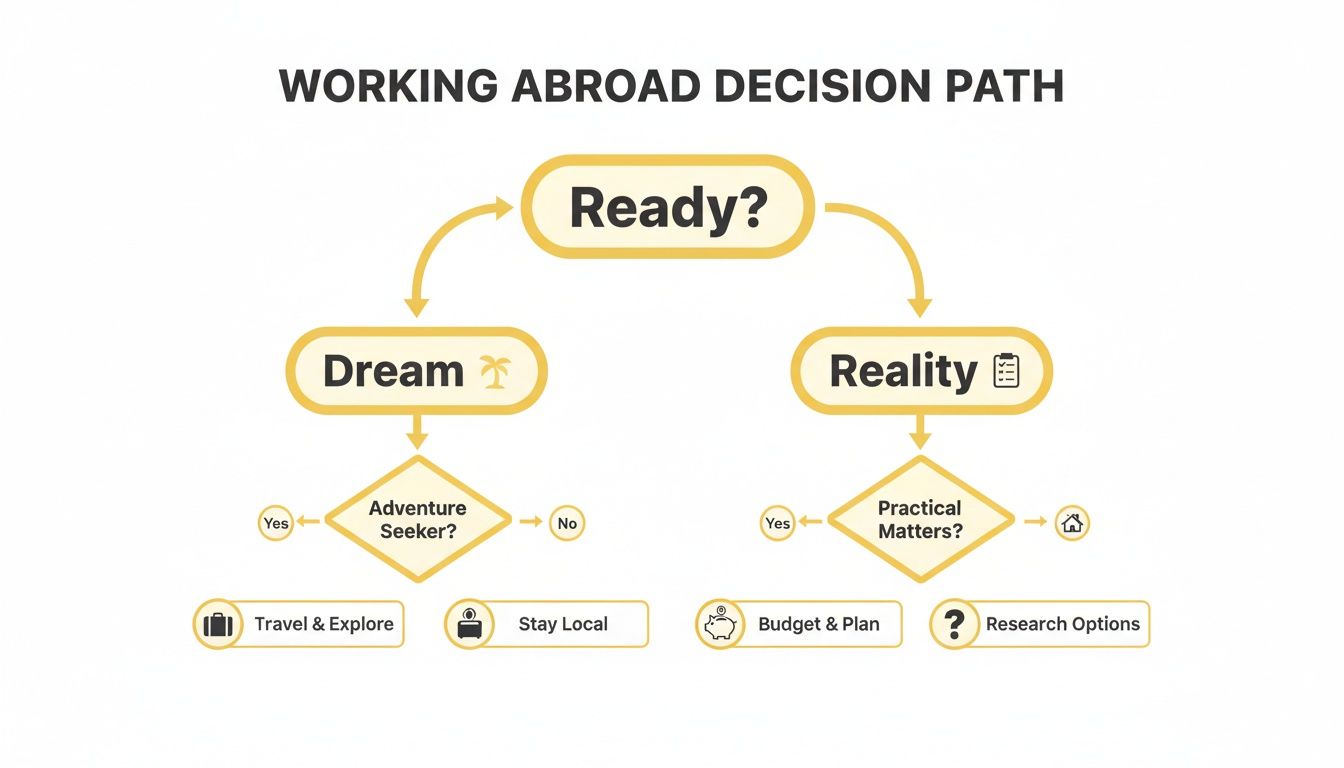
Ultimately, what this shows is that while the dream gets you started, it's the reality—a checklist of legal, financial, and logistical steps—that actually gets you there.
Getting Your Employer on Board
The key to a successful pitch is to think like your manager. What’s going to keep them up at night? More than likely, it’s just making sure your work continues without a single hiccup.
Your proposal should cover these bases:
- How You'll Communicate: Lay out exactly how you'll handle time zones, when you'll be online for core hours, and how you’ll stay visible to the team.
- Your Productivity Setup: Reassure them by mentioning your intended workspace (like a co-working space or an apartment with verified high-speed internet) and your absolute commitment to hitting every deadline.
- Data Security Plan: Explain how you'll keep company information safe, like always using a VPN and sticking to all IT security rules.
- Legal & Tax Responsibility: Make it clear that you will handle your own visa and tax situation so the company isn't on the hook for any legal risks.
The goal is to present this not as a problem for them to solve, but as an equation you’ve already solved. Show them you've considered the potential snags and have real solutions ready to go.
For instance, don't just say, "I'll figure out the time difference." Instead, say, "I'll structure my day to ensure a four-hour overlap with the team's 10 AM to 2 PM EST core hours for real-time meetings and collaboration." This kind of proactive planning shows you're serious and helps build a mountain of trust.
Demystifying Visas and Your Right to Stay
Once your boss gives you the thumbs-up, immigration is your next mountain to climb. The urge to just wing it on a tourist visa is real, but it’s a dangerous game. Most countries are very clear: working, even remotely for a company back home, is illegal on a tourist visa. If you get caught, you could be looking at fines, deportation, and a ban from coming back.
The good news? Dozens of countries now offer digital nomad visas. These are built specifically for people like us, giving you the legal right to live and work there for a year or more, as long as you can prove a steady income.
- Tourist Visa: Usually good for up to 90 days. Working is a no-go and can land you in serious legal trouble.
- Digital Nomad Visa: Allows for longer stays, often 1-2 years with options to renew. It legally allows you to work remotely for your foreign employer. Portugal, Colombia, and Spain have some of the most popular programs out there.
- Other Work Permits: Some places might have other long-stay or specific work permits that could fit your situation. It's crucial to understand all the Canadian work visa types, for example, if you're headed that way.
Doing your visa homework is completely non-negotiable. If you're serious about this, dive into our detailed guide to see if you meet the latest digital nomad visa requirements.
Understanding Your Tax Obligations
Let’s be honest, taxes are the most complicated piece of this entire puzzle. Where you pay them all comes down to your tax residency—a status determined by the country where you spend most of your time, which is often defined as 183 days or more in a single year.
If you become a tax resident in your new country, you'll likely owe them income tax. This doesn't automatically mean you'll be taxed twice, though. Many countries have tax treaties in place to prevent that from happening. For U.S. citizens, concepts like the Foreign Earned Income Exclusion (FEIE) can dramatically reduce or even wipe out your U.S. tax bill while you're abroad.
But tax law is a beast, and it changes dramatically from one country to the next. This is the one area where paying for professional advice is almost always money well spent. A quick consultation with a tax expert who specializes in expatriate issues can save you from making a very expensive mistake down the road.
Setting Up Your Life Beyond the Tourist Trail
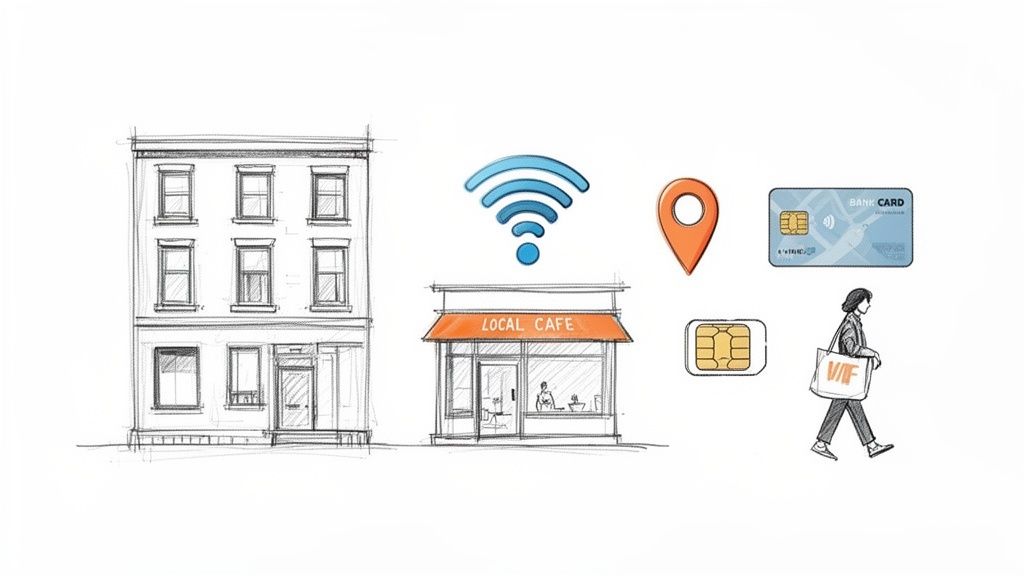
The paperwork is done. The flight is booked. Now for the real part: turning some temporary address into a place you actually live. This is the moment you ditch the tourist map for a local's perspective and build a routine that lets you thrive while working remotely from another country.
Success on the ground is about finding your place far from the main tourist hubs; it's about building an authentic life. This means choosing a neighborhood that fits the local rhythm, getting rock-solid internet, and sorting out the details that make you feel like you belong. Here’s how you get off the beaten path and start truly living there.
Choosing Your Neighborhood Like a Local
Forget the top-ten lists you see on travel blogs. The best neighborhood for you is almost never the one on all the postcards. Instead, think about your actual, day-to-day life. Are you an early riser who loves the buzz of a local market, or do you need a quiet street with a park for afternoon walks? A local guide can be invaluable here.
To find your spot, hunt for community hubs far from the tourist crowds. This could be a bustling local mercado in Mexico City, a neighborhood fika spot in Stockholm, or a street lined with indie shops in an outer borough of Tokyo. Spend a whole day in a potential area. Just watch. See where locals gather, listen to the sounds, and get a feel for the authentic energy.
A few things to keep in mind:
- Transit and Walkability: How easy is it to grab groceries or meet friends without calling a pricey taxi? A walkable, well-connected neighborhood makes a massive difference in your quality of life.
- Local Amenities: Look for the signs of a real community—bakeries, butchers, small parks, libraries. These are the places that will become part of your weekly routine, where you become a familiar face.
- Community Vibe: Is it full of young professionals, families, or a mix of everyone? Finding a place where you feel you fit in is key to not feeling like an outsider for months on end.
Establishing Your Digital Lifeline
For any remote worker, internet isn't a perk; it's oxygen. Your job literally depends on a stable, fast connection. Before you even think about signing a lease, run a speed test on your phone. Better yet, ask the landlord for a screenshot of their latest speed test or chat with a neighbor about their provider.
Beyond your apartment, you need a backup plan. Don't just Google "cafes with Wi-Fi." Instead, look for spots where locals are actually working. These places usually have better connections, more outlets, and an unspoken understanding that you'll be camping out for more than 20 minutes. Coworking spaces are also a brilliant investment, not just for the fiber-optic speeds but for the built-in community.
Of course, working from all these new places means you're hopping on a lot of public networks. A solid VPN is non-negotiable for keeping your work and personal data secure. If you're not sure where to start, an Essential VPN for Remote Workers Playbook can walk you through getting set up properly.
Nailing the On-The-Ground Logistics
Getting the day-to-day stuff sorted is what separates a stressful trip from a comfortable new life. Dedicate your first week to these essentials. Your number one priority should be a local SIM card—it’s cheap, gives you a local number for forms, and serves as a data backup if your apartment Wi-Fi decides to take a vacation.
Next up: banking. While you'll probably use services like Wise for big international transfers, opening a local bank account makes paying rent and buying groceries a thousand times easier (and cheaper, with no foreign transaction fees). You’ll likely need proof of address and your visa, so have all your documents in a folder, ready to go.
The small wins—like figuring out the bus system by yourself for the first time or having a simple chat with the person at the corner store—are what really make a place feel like home. These are the moments that build your confidence and weave you into the community.
Finally, get a handle on your health and safety. Find the nearest clinic or hospital and save their numbers in your phone right away. Look up local safety norms—for example, in some cities, flashing your new laptop on the subway is a terrible idea. And whatever you do, make sure you have comprehensive travel insurance. It’s the one thing you pay for hoping you’ll never, ever have to use it.
Your First Week On-The-Ground Checklist
That first week can feel like a whirlwind. Hitting these key tasks within your first seven days will help you build a solid foundation and get settled in much faster.
| Task | Why It's Critical | A Local's Tip |
|---|---|---|
| Get a Local SIM Card | Provides immediate connectivity, a local phone number for official forms, and a crucial internet backup. | Ask the shopkeeper which provider has the best coverage for your specific neighborhood, not just the city. |
| Open a Local Bank Account | Simplifies paying bills, avoids international transfer fees, and is often required for long-term apartment rentals. | Bring more documents than you think you need, including your passport, visa, and a rental agreement or utility bill. |
| Find Your Go-To Cafe | Establishes a "third place" outside your home for work and social connection, helping to build a routine. | Look for cafes that aren't on main tourist drags. The best ones are often a few streets back, filled with regulars. |
| Master One Transit Route | Builds confidence and independence, allowing you to explore freely without relying on ride-sharing apps. | Use public transit during off-peak hours for your first few trips to learn the system without the stress of crowds. |
Once these are ticked off, you can finally take a breath, relax, and start enjoying the adventure you came for.
The Art of Cultural Immersion
Alright, you’ve nailed the logistics. The visa is stamped, your apartment is set up, and the Wi-Fi is strong enough to handle anything. This is where the real work—and the real fun—begins. Now it’s time to shift from just being in a new place to actually living there for a full cultural experience.
This is the secret to turning a temporary work setup into a life-changing experience. It’s about looking past the tourist trail and learning to read the quiet, everyday rhythms of your new home. Why do people here do things the way they do? Understanding the social quirks, the unspoken rules, and the small daily rituals is what makes working remotely from another country so deeply satisfying.
Decoding Unspoken Social Rules
Every place has a set of invisible instructions for how to behave. Bumping into them by accident can lead to some awkward moments, but learning to respect them shows you're paying attention and you care. This isn't about memorizing a rulebook; it's about observation.
For example, in Germany, you'll find that cash is still surprisingly dominant in smaller cafes and shops, a world away from the tap-to-pay culture of a place like Sweden. In Japan, even the simple act of handing someone a business card is a mini-ceremony, complete with specific two-handed gestures and bows that signal respect.
True immersion starts with curiosity. Instead of judging a custom as strange, ask yourself what it reveals about the local values. Why is punctuality so revered in one culture and more fluid in another? Understanding the 'why' is your bridge to genuine connection.
Watch how locals act on the bus, in the market, or waiting for coffee. Notice their tone of voice, how much personal space they give each other, and the way they greet a shopkeeper. These little observations are your best guide for moving through your new world with a bit more grace.
Language: The Ultimate Key to Connection
Don't panic—you don't need to become fluent overnight. But learning just a handful of key phrases in the local language is probably the single most powerful gesture you can make. It immediately shows people you’re not just another tourist passing through.
Start with the absolute basics:
- Greetings and Farewells: "Hello," "goodbye," "good morning," "good evening."
- Polite Expressions: "Please," "thank you," "excuse me," "I'm sorry."
- Simple Transactional Phrases: "How much is this?" or "I would like..."
This tiny bit of effort can completely change the vibe of your daily errands. A warm "¡Buenos días!" to the baker in Spain or a simple "Konnichiwa" to a clerk in Kyoto can transform a cold transaction into a genuine human moment. It opens doors and sparks conversations you’d otherwise miss out on entirely.
Finding Your Community Off the Beaten Path
The experiences you'll remember most won't be in any guidebook. They happen when you break out of the expat bubble and find your way into the local scene. The goal is to find activities where you're shoulder-to-shoulder with locals, sharing a common interest far from the main tourist areas.
Think about what you love to do back home and seek out the local version. That shared passion is an instant icebreaker that jumps right over any language or cultural gaps.
- Join a Local Sports Club: It could be a neighborhood football league in Buenos Aires, a hiking group in the Swiss Alps, or a yoga studio in Bali. Shared activity is a universal language.
- Take a Skills-Based Class: Sign up for something you could only learn right there, right now. Think a traditional cooking class in Thailand, a pottery workshop in Portugal, or tango lessons in Argentina. You'll learn a new skill and connect with local pros and fellow enthusiasts.
- Volunteer for a Community Project: Find a local cause that matters to you—a beach cleanup, an animal shelter, or a community garden. Volunteering is an amazing way to give back to your temporary home and forge deep connections based on shared values.
These kinds of activities give you a natural reason to meet people. You’ll see the same faces every week, and those polite nods will slowly turn into real conversations. Soon, you'll be getting tips on the best hidden-gem restaurants, learning local slang, and maybe even scoring an invitation to a family dinner. For more ideas, check out our full guide on the essentials of cultural immersion travel.
This is how you truly live abroad—by being curious, respectful, and willing to participate. It's how you find your own rhythm in a new city and let it change you for the better.
Finding Your Rhythm: Productivity and Balance
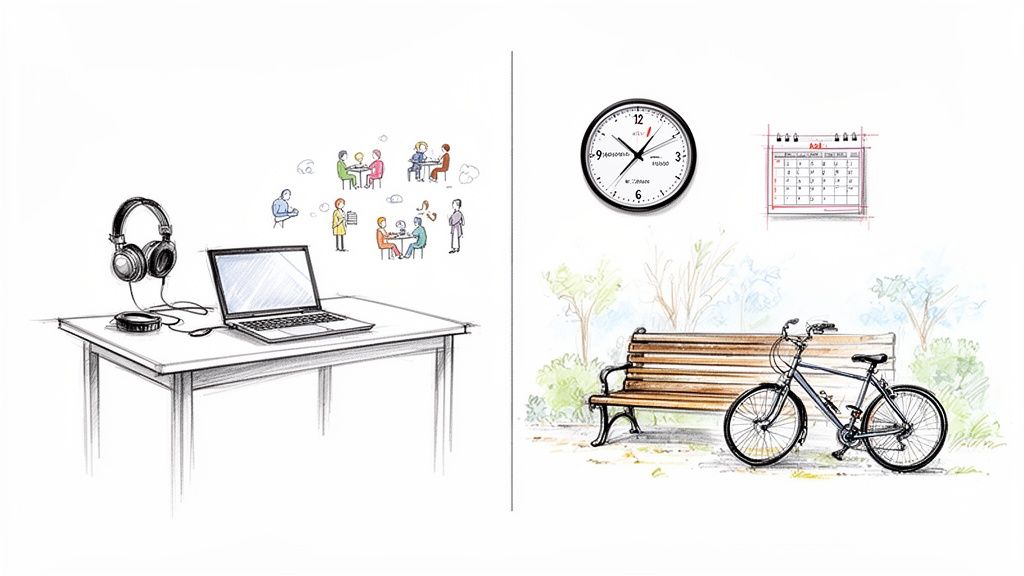
Let's be honest: working remotely from another country is a constant balancing act. It's incredibly easy to fall into one of two traps. You either work nonstop, feeling a low-grade guilt that you aren't out exploring, or you get so swept up in the adventure that your deadlines start to look a little shaky.
The trick is to build a routine that actually supports both sides of your new life. This isn't just about time management. It's about protecting your energy and your sanity, because the initial "wow" factor of a new place can wear off, leaving you face-to-face with burnout and loneliness. Getting a sustainable rhythm down from day one is what turns a frantic trip into a fulfilling chapter.
Structuring Your Workday Across Time Zones
When your team is signing off as your new city is waking up, your old 9-to-5 schedule is officially useless. Don't just try to mirror your home office hours—that’s a fast track to exhaustion. It's time for a new blueprint.
First, pinpoint your "core collaboration hours." These are the non-negotiable windows when you must be online for meetings or instant communication. This might mean you start your workday after lunch or hop on for a couple of hours in the evening.
Outside that core time, you’ve got flexibility. Use it. Many nomads swear by the "split shift." You could knock out a solid block of work first thing in the morning, take a long midday break to hit a museum or local market, and then wrap things up in the late afternoon. This lets you actually enjoy the daylight hours in your new home without sacrificing productivity.
Setting Clear Boundaries to Protect Your Time
Without the physical act of leaving an office, the line between "work time" and "life time" can dissolve completely. This gets even tougher when you're in a city that never sleeps. You have to set and defend your boundaries like your mental health depends on it—because it does.
- Broadcast Your Availability: Make your working hours crystal clear to your colleagues. Use your Slack or Teams status religiously to show when you're head-down, in a call, or officially offline.
- Create a Dedicated Workspace: Even if it’s just a small desk in the corner of your rental, a designated work zone helps your brain switch on and off. Working from bed is the enemy of work-life separation.
- Schedule Your "Off" Time: Block out personal time in your calendar just like you would a client meeting. A language class, a hike, or a simple evening walk—treat these appointments as sacred.
A classic rookie mistake is feeling like you have to be online 24/7 to prove you're not just on vacation. Let your results do the talking. Protect your personal time fiercely; it’s what makes this lifestyle sustainable.
Building a Social Network from Scratch
Loneliness is the unspoken challenge of this lifestyle. It hits hard, and it can feel even more isolating when you're thousands of miles from home. You have to be intentional about building a community; it's just as critical as finding a good Wi-Fi signal.
Don’t just wait for friends to appear. Get proactive. Use apps like Meetup to find groups built around your interests, whether that's hiking, photography, or board games. Joining a local coworking space or a language exchange is another great way to meet people who are in the same boat.
And remember, try to connect with more than just other nomads. Make an effort to meet locals. Frequent the same neighborhood cafe, practice the few local phrases you know, and attend community events. That's how you go from just working in a place to truly living there.
Burning Questions About Working From Anywhere
Diving headfirst into a remote work life abroad is exciting, but it definitely brings up some big questions. We get it. Here are some straight-talking answers to the most common queries we see, designed to clear things up and give you the confidence to make the leap.
So, Can I Just Work on a Tourist Visa?
Look, it's tempting to think you can just fly in on a tourist visa and quietly work from your laptop. The simple, honest answer is no. Most countries are very clear: a tourist visa is for tourism, and any kind of work—even for your company back home—is strictly off-limits.
Getting caught isn't a slap on the wrist. We're talking about hefty fines, getting deported, and even being banned from coming back. It’s just not worth the risk. The right way to do this is to get a digital nomad visa if your destination offers one. It’s more paperwork upfront, sure, but it gives you the legal right to be there and saves you from a world of potential headaches down the road.
How Much Money Should I Realistically Have Saved?
While there's no single magic number, a smart goal is to have three to six months of living expenses tucked away before you go. This isn't just a worst-case-scenario fund. It's your buffer for reality—covering a surprisingly high apartment deposit, visa fees that add up, or just giving you breathing room to settle in before your next paycheck arrives.
Make sure your savings target is based on the cost of living where you're going, not where you are now. Do your homework on local prices for rent, food, and transport to set a realistic budget. Having that financial cushion means you can make choices based on what you want, not out of desperation.
What’s the Biggest Rookie Mistake People Make?
Hands down, the most common pitfall is underestimating how lonely it can get and not putting in the effort to build a community. It’s so easy to get wrapped up in the logistics of visas, flights, and finding a place to live that you forget about your social well-being. But that’s just as crucial for making your stay last.
I’ve seen it time and again: first-timers stick to the well-worn tourist path or only hang out with other expats. They miss out on what makes a place truly special. Real connection happens when you push yourself a little—join a local sports club, take a language class, or volunteer for a cause you care about.
Don't just wait for friends to appear. From the day you land, be intentional about making connections. This is the single biggest thing that separates a short, isolating trip from a rich, life-changing experience.
At CoraTravels, we believe the best way to know a place is to see it through the eyes of the people who call it home. Our guides are packed with local insights to help you get past the tourist traps and find the real heartbeat of a destination. Start planning your own authentic journey at https://coratravels.com.