🇨🇲 Cameroon
Cameroon Travel Guide - Africa in Miniature: Where 250 Languages, Football Legends, and Equatorial Rainforests Meet
1 destinations · Budget level 1
Overview
Cameroon sits at the hinge between West and Central Africa, sharing borders with Nigeria, Chad, the Central African Republic, Congo, Gabon, and Equatorial Guinea. This geographic position has made it one of the continent's most internally diverse nations: the country's 475,000 km² contain equatorial rainforest, highland savanna, Saharan scrubland, Atlantic beaches, and the volcanic peak of Mount Cameroon (4,095m). Over 250 ethnic groups — including the Beti, Bamiléké, Fulani, Bassa, and dozens of others — each maintain distinct languages, ceremonial traditions, and food cultures, making a single country feel like a continent in miniature. Cameroon was jointly colonized by Germany (1884–1916), then France (80% of the territory) and Britain (20%), creating a country with two official languages and a lasting Anglophone-Francophone divide that remains politically charged today. The capital Yaoundé is the administrative heart and cultural crossroads; Douala is the economic engine and port city. French-speaking majority and English-speaking minority coexist with varying degrees of tension, particularly in the Northwest and Southwest regions where an armed separatist conflict has simmered since 2017. Despite complex political challenges, Cameroon's daily life is marked by extraordinary warmth toward visitors, remarkable culinary variety, and a football culture that rivals any on the continent. The Indomitable Lions — five-time African champions and eight-time World Cup qualifiers — are national religion, and Roger Milla remains one of football's most beloved figures worldwide.
Travel tips
Language Reality: French is the working language of Yaoundé and most of southern Cameroon. English is co-official but locally limited to the Northwest and Southwest regions. Young people speak Camfranglais — a fluid street mix of French, English, and local languages — which you'll encounter constantly. A few words of French unlock enormous goodwill; full fluency isn't necessary. Greeting Protocol: Never approach any transaction, request, or interaction without first exchanging pleasantries — 'Bonjour, comment ça va? Et la famille?' before anything else. This applies to shops, taxis, markets, and government offices equally. Skipping the greeting is considered rude in a way that actively damages the interaction. Photography Rules: Military sites, the presidential compound in Etoudi, embassies, and official buildings are strictly off-limits to photography — cameras can be confiscated and detentions occur. Always ask permission before photographing individuals in markets. The general rule: when uncertain, don't. Shared Taxis: The yellow shared taxis in Yaoundé and moto-taxis (bendskin) operate without meters. Call your destination as the taxi approaches, agree the fare before entering, and never get in without a price. FCFA 250 is standard for a shared urban leg; foreigners who don't negotiate pay 3x that. Malaria is Real: Cameroon has endemic malaria year-round. Take prophylaxis seriously, use mosquito repellent from dusk onward, and sleep under nets if guesthouses don't provide air conditioning. Iron Your Laundry: The putzi fly lays eggs in damp clothes hung to dry outdoors. Always iron clothes before wearing — high heat kills any eggs. Locals do this automatically; tourists who don't occasionally regret it. Anglophone Sensitivity: Avoid casual political opinions about Cameroon's Anglophone-Francophone divide. It is a genuine, painful situation with real victims on multiple sides. Listen with curiosity and genuine respect; don't wade in with opinions formed from a Wikipedia summary.
Cultural insights
Cameroonian culture is built on the paradox of extraordinary internal diversity managed through hospitality. With 250+ ethnic groups and as many languages, Cameroonians have developed a practical culture of accommodation — you live alongside people fundamentally different from you, you learn to greet in their language if you can, and you share food without invitation. The concept of 'mboko' (brotherhood/solidarity) — operating across ethnic lines — keeps markets, neighborhoods, and workplaces functioning despite differences that elsewhere spark conflict. Food is the most accessible entry into this culture. Each ethnic group guards its culinary tradition fiercely: the Beti people around Yaoundé claim ndolé as their cultural signature; the Bamiléké of the Western Highlands are known for the volcanic fervor of their ndap (fermented black beans); the coastal Bassa produce the finest bobolo (fermented cassava); the Fulani nomads carry kossam (fermented milk) from the north. In Yaoundé, all these traditions converge within a few kilometers. Cameroonian humor centers on communal suffering: power cuts (the electricity company ENEO is a reliable punchline), government bureaucracy, and the gap between official discourse and lived reality. The word 'débrouillard' (someone who figures things out) is the highest compliment — it describes someone who adapts, improvises, and survives regardless of what the system fails to provide. Football sits at the center of national identity in a way few other things do. The Indomitable Lions' five Africa Cup of Nations victories (1984, 1988, 2000, 2002, 2017) and their historic run to the World Cup quarter-finals in 1990 — behind Roger Milla's four goals and his celebrated corner-flag celebrations — created national mythology that transcends politics, ethnicity, and language. On AFCON match days, the country stops. The Cameroonian diaspora extends from France to the United States and plays an important role in both the economy and cultural exchange, sending remittances that sustain extended families and occasionally returning with skills, capital, and different perspectives that Yaoundé absorbs with characteristic pragmatism.
Best time to visit
Long Dry Season (November–February): The optimal time to visit most of Cameroon, particularly Yaoundé and the southern regions. Temperatures 18–29°C, low humidity, fresh mornings, and manageable roads. December is peak season as the diaspora returns for the festive period — hotels fill up, prices rise, and the social energy is extraordinary. January and February are the quietest, cheapest, and most comfortable months for independent travel. Mount Cameroon treks are best attempted in this window, as are pilgrimages to cultural heritage sites across the country's diverse regions. Short Dry Season (July–August): A brief respite from rains in the middle of the year. Good for highland regions (Bafoussam, Bamenda) where temperatures are genuinely cool. Schools are on holiday and families travel — domestic tourism peaks, coastal areas (Kribi, Limbe) become crowded with Cameroonian holidaymakers. Long Rainy Season (March–June): Heaviest rainfall and highest humidity. Afternoon thunderstorms are intense but typically short. Vegetation is magnificently green. The Écrans Noirs Film Festival in Yaoundé (June) is a cultural highlight. Roads in rural areas can become impassable; stick to tarmac routes. Short Rainy Season (September–October): Lighter rains than March–June. Still green and atmospheric. The end-of-year academic season begins and cities fill with students returning from villages. Avoid (if possible): The peak of rainy season (May–June) for rural travel requiring unsealed roads. December 20–January 5 unless you want full festival immersion — accommodation is tight and expensive.
Getting around
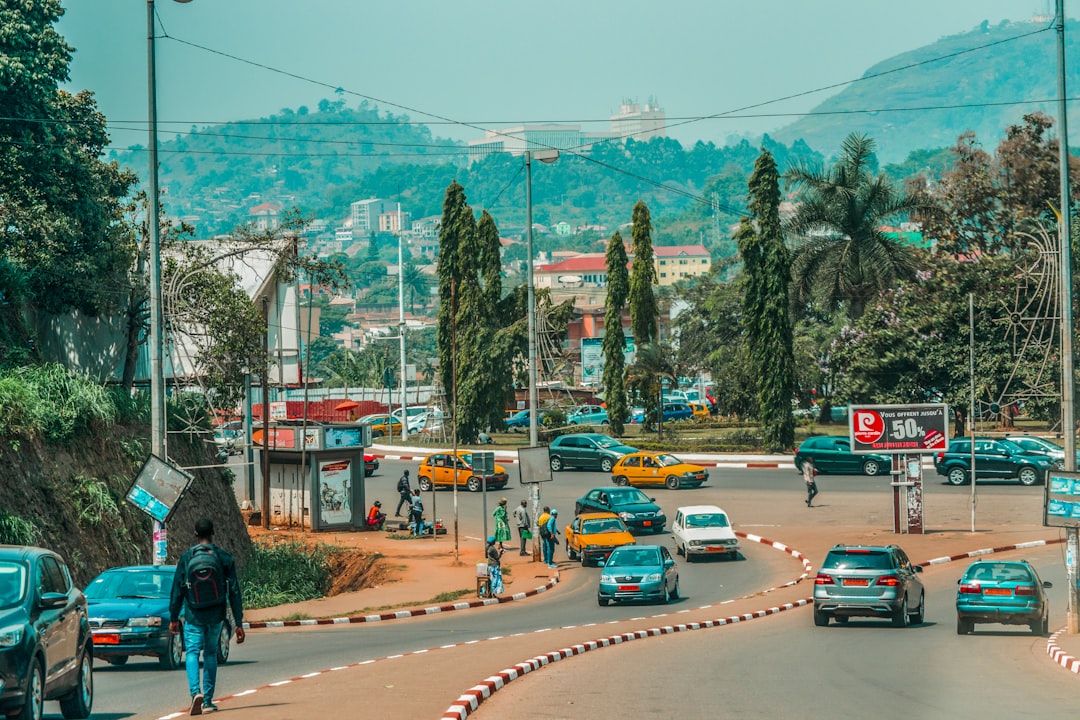
Shared Taxis (Taxis Jaunes): The standard urban transport in Yaoundé and Douala. Yellow taxis circulate on fixed routes; call your destination as they pass and negotiate the fare (FCFA 250 standard shared leg, FCFA 1,000–3,000 for private hire). Never enter without agreeing a price first. Moto-Taxis (Bendskin): Motorcycle taxis navigate the hills and traffic of Yaoundé with agility. FCFA 150–500 for short trips. Fast and cheap but no helmets; assess your comfort with risk honestly. Essential for reaching destinations off main routes. Intercity Buses: Several companies (Buca Voyages, Vatican Express, Finex) operate between major cities. Yaoundé–Douala (3–4 hours, FCFA 3,000–6,000) is the main corridor with frequent departures. Prestige services offer air conditioning and seatbelts for double the price. Book by arriving at the station rather than advance booking for most routes. Yango App (Ride-Hailing): The Yandex-derived app operates in Yaoundé and provides quoted-fare rides without negotiation. FCFA 800–3,000 for most city journeys. The safest option for late-night travel. Train (Camrail): The Yaoundé–Douala train (3h45m) is an underrated journey through equatorial forest and highland landscapes. Comfortable intercity service costs FCFA 5,000–8,000 for the fastest trains. Book at the Yaoundé Terminus station. Worth taking at least one direction for the scenery. Domestic Flights: Camair-Co connects Yaoundé Nsimalen Airport (NSI) to Douala (DLA), Garoua, and Maroua in the north. Prices FCFA 40,000–90,000 depending on route and timing. Essential for reaching northern Cameroon without a multi-day overland journey.
Budget guidance
Budget Travel (FCFA 15,000–30,000/day or $25–50/day): Street food and neighborhood maquis meals FCFA 500–2,500, budget guesthouse FCFA 10,000–20,000/night, shared taxis and moto-taxis FCFA 500–2,000/day, local beer FCFA 500–700 — this is the authentic Cameroonian budget, covering everything essential with considerable local immersion. Mid-Range (FCFA 40,000–80,000/day or $65–135/day): Mid-range hotel FCFA 35,000–60,000/night, proper restaurant dining FCFA 3,000–8,000 per meal, Yango rides, occasional site entries, excursions to Kribi or Limbe — comfortable without sacrificing authentic contact with the city. Comfortable Travel (FCFA 100,000+/day or $165+/day): Business hotels (Mercure, Onomo, Hilton) from FCFA 70,000–200,000/night, full restaurant meals in Bastos restaurants, private taxis, organized excursions — the diplomatic/NGO-worker standard, comfortable but largely insulated from local life. Note: FCFA (XAF, the Central African CFA franc) is pegged to the Euro at FCFA 655.96 = €1. ATM withdrawals and card payments work in major hotels and supermarkets; cash is essential everywhere else. Bargaining is normal in markets — opening prices for foreigners are typically double local rates.
Language
Cameroon's linguistic reality is one of Africa's most complex. Two official languages — French and English — reflect the colonial partition, but neither dominates street-level communication in the same way. In Yaoundé and the francophone south (80% of the country), French is the operating language for business, government, and education. In the Anglophone Northwest and Southwest regions, English serves the same role. But between ethnic groups and in cross-cultural settings, various other systems operate. Camfranglais (also called Francanglais) is the spontaneous urban creole invented by Yaoundé's youth — a fluid, creative mix of French, English, Pidgin English, and local languages. 'On va go' (We're going), 'Je suis come back' (I'll be right back), 'C'est comment?' (How are you?) — grammatically chaotic, culturally alive, and spoken by millions. Ewondo is the Bantu language of the Beti people indigenous to the Yaoundé plateau; the city's name derives from it. Greeting someone with 'Akiba' (Ewondo for hello) in Yaoundé produces immediate warmth. Fulfulde (Fulani language) serves as a trade language across the north. Bassa, Bamiléké, Duala, and Hausa each have significant regional presence. For practical survival in Yaoundé: French gets you everywhere. A few Ewondo words get you respect. Camfranglais gets you accepted. Key French phrases: 'Bonjour' (bon-ZHOOR) = Hello; 'Combien?' (kom-BYAHN) = How much?; 'C'est trop cher' (say tro SHEHR) = Too expensive; 'Où est...?' (oo ay) = Where is...?; 'L'addition' (lah-dee-SYOHN) = The bill.
Safety
Cameroon is generally safe for visitors practicing standard urban awareness, though the political situation in the Anglophone Northwest and Southwest regions (ongoing separatist conflict since 2017) makes those areas inadvisable without specific local knowledge and contacts. Yaoundé and Douala are working capitals with manageable safety profiles — petty theft in crowded markets, bag snatching near taxi stations, and occasional phone theft are the primary risks. Exercise standard precautions: keep phones in pockets rather than on display, use bags that close, be alert in Marché Mfoundi and the Mvan bus station. Avoid displaying expensive cameras and jewelry in markets. Night travel: use Yango rather than street taxis after 10 PM, especially for women traveling alone. The areas around Place Ahmadou Ahidjo in central Yaoundé are considered higher-risk by locals for pickpocketing; avoid lingering there. Photography near the presidential compound in Etoudi, embassies, and any military installation is strictly prohibited — confiscation and questioning can follow. The Anglophone/Northwest-Southwest conflict: avoid travel to Bamenda, Buea, and surrounding areas without verified local guidance; the situation shifts and requires real-time advice. Health: malaria is endemic year-round; take prophylaxis, use repellent, sleep under nets. Yellow fever vaccination is mandatory for entry. Tap water is unsafe; drink bottled water. Emergency numbers: 117 (police), 119 (fire), 118 (SAMU — emergency medical services). Private hospital care in Yaoundé (Hôpital General, Hôpital La Croix du Sud) is reliable for non-critical care; for serious medical situations, evacuation to Douala or Europe is the medical community standard recommendation. Travel insurance including medical evacuation coverage is strongly advised.
Money & payments
Cameroon uses the Central African CFA Franc (FCFA / XAF), shared with five other Central African nations. The CFA franc is pegged to the Euro at a fixed rate: FCFA 655.96 = €1 (approximately FCFA 600 = $1 USD at time of writing). This peg provides currency stability unusual in the region. ATMs are available at major banks in Yaoundé (Afriland First Bank, SCB Cameroun, BICEC, Ecobank) with withdrawal limits typically FCFA 150,000–300,000 per transaction. Cards work at hotels, major supermarkets (Dovv Centre, Score), and some restaurants in Bastos; cash is required for everything else — markets, street food, taxis, neighborhood shops. Mobile Money is growing: MTN Mobile Money and Orange Money handle domestic transfers widely and are increasingly accepted at small businesses. Bring euros or dollars to exchange — better rates than using only ATMs. Bargaining is expected in all informal markets; opening prices for visible foreigners are typically 2–3x the local rate. Start at 60% of asking price and meet in the middle. Tipping is appreciated but not mandatory — 10% at sit-down restaurants, rounding up for taxi drivers and small services is the local norm.