
Michigan's story is written not just in its bustling cities and Great Lakes shorelines, but in the silent structures left behind. These forgotten locations are powerful testaments to industrial ambition, societal shifts, and nature's patient reclamation, offering a unique window into the state's complex history.
This guide moves beyond typical tourist trails to offer a deeper, more respectful way to experience these sites. Forget generic lists. We provide the essential context and practical advice needed for a truly immersive journey, focusing on ethical exploration and responsible discovery. You'll find specific details on access, safety, and the crucial legal boundaries you must respect.
More importantly, we connect you with the local fabric surrounding each location. Discover the off-the-beaten-path diners, viewpoints, and community stories that transform a simple visit into a meaningful cultural experience. This curated roundup is your key to responsibly uncovering the soul of abandoned places in Michigan. We're here to help you travel as a thoughtful observer, understanding the stories held within these walls and landscapes, not just documenting their decay. Prepare to explore the state's poignant and beautiful echoes with curiosity and respect.
1. The Packard Plant - Detroit Industrial Urban Exploration
The Packard Plant in Detroit is more than just a ruin; it’s a 3.5 million square-foot monument to America's industrial past and a stark symbol of urban transformation. Opened in 1903, this sprawling complex was once a state-of-the-art facility, producing some of the world's most luxurious automobiles. After its closure in the late 1950s, the plant began a slow decay, becoming one of the most famous abandoned places in Michigan and an icon of post-industrial decline.
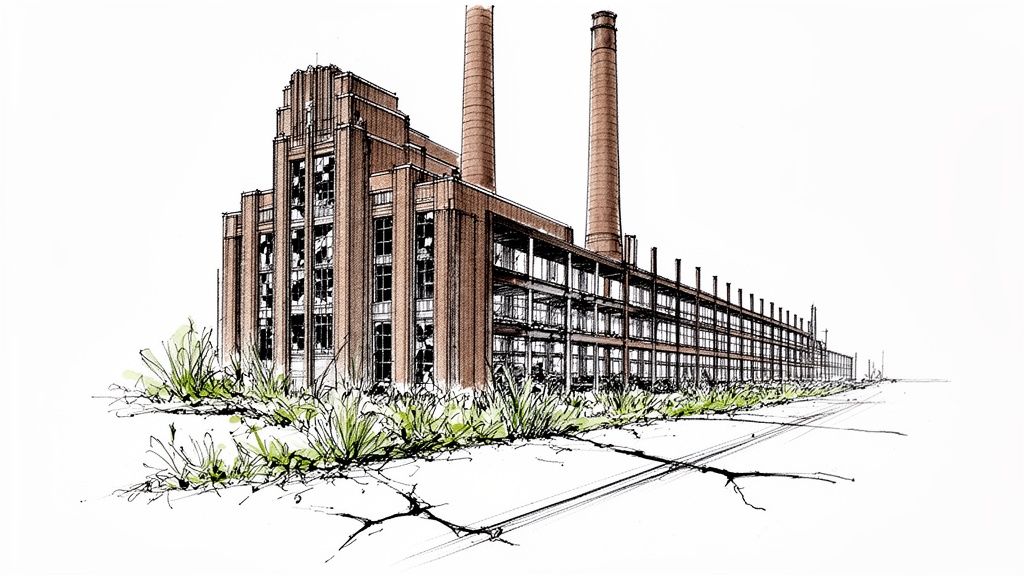
Today, its skeletal remains draw photographers, historians, and urban explorers from around the globe, all seeking to witness its haunting scale firsthand. Its graffitied walls and crumbling infrastructure tell a powerful story of both immense success and profound economic shifts, making it a must-see for anyone interested in Detroit's complex history.
Access and Safety: A Word of Caution
Exploring the Packard Plant is a complicated affair. For years, it was an open but dangerous site for unsanctioned exploration. However, since being purchased by a new developer, large-scale demolition and redevelopment efforts are underway.
- Trespassing: Direct access is strictly prohibited and illegal. The site is actively monitored, and trespassing is dangerous due to structural instability, hazardous materials, and active demolition.
- Best Views: For safe and legal viewing, explore the perimeter from East Grand Boulevard. The sheer size of the complex is still palpable from public sidewalks.
- Guided Tours: While official tours are not currently offered due to redevelopment, keep an eye on local preservation groups or historical societies for potential future opportunities.
Immersive Local Experience
For those fascinated by sites like the Packard Plant and the broader concept of responsible industrial exploration, you might find valuable insights in articles covering general urban adventures. Capturing the essence of such locations requires respect and preparation.
Local Guide: To truly feel the plant's impact, visit the nearby Heidelberg Project, an outdoor art environment that offers a powerful community-based contrast to the industrial decay. Afterward, grab a slice at Buddy's Pizza on Conant Street, the birthplace of Detroit-style pizza, where generations of auto workers once ate. This creates a full cultural circuit, connecting industrial history with living local culture.
Remember that while the plant is a popular subject, its story is intertwined with the lives of the Detroit community. Approaching it with respect for its history and the surrounding neighborhood is paramount.
2. Fort Mackinac - Historic Military Ruins on Mackinac Island
Fort Mackinac offers a unique entry on our list of abandoned places in Michigan, blending preserved history with haunting, untouched ruins. Established by the British in 1780 during the American Revolutionary War, this limestone fortress perched atop the bluffs of Mackinac Island once commanded the strategic Straits of Mackinac. While much of the fort is a meticulously restored living history museum, significant portions of its outlying structures and original foundations remain in a state of arrested decay, providing an authentic window into 18th and 19th-century military life.
Exploring these unrestored areas allows visitors to step away from the polished exhibits and connect directly with the past. The crumbling stone walls and overgrown foundations tell a powerful story of frontier survival, conflict, and eventual obsolescence. This juxtaposition of a living museum against authentic ruins makes Fort Mackinac a compelling destination for those seeking a deeper, more immersive historical experience.
Access and Safety: A Word of Caution
Unlike many truly abandoned sites, Fort Mackinac is part of Mackinac State Historic Parks and is a managed tourist attraction. This makes access straightforward but also subject to specific rules.
- Access: The fort is accessible via a paid ticket. You can reach Mackinac Island by ferry from Mackinaw City or St. Ignace. Once on the island, you can walk or bike up to the fort entrance.
- Safety: The restored areas are safe and well-maintained. When exploring the designated ruin sites, stay on marked paths. These areas are preserved "as is" and venturing off-trail can damage fragile historical structures and pose a risk of injury.
- Best Times: Visit during the shoulder seasons (late May or September) to avoid the largest summer crowds. Take an early morning ferry to enjoy the grounds in the quiet morning light.
Immersive Local Experience
Capturing the essence of Fort Mackinac involves balancing its manicured and wild sides. For those intrigued by the stories of settlements that fade over time, exploring historical precedents like the ghost towns in South Dakota can offer a broader perspective on American frontier history.
Local Guide: For a truly off-the-beaten-path experience, rent a bike and cycle the 8.2-mile M-185 loop around the island before or after your fort visit. Stop at British Landing on the far side, a historic site less frequented by tourists. Later, escape the main street crowds and have a drink at the Gate House, a historic hotel at the bottom of the fort hill, to soak in the atmosphere away from the fudge shops.
Remember that the entire island is a National Historic Landmark. Approaching the fort and its ruins with a sense of respect for its immense historical and cultural significance is essential for its preservation.
3. Eloise Psychiatric Hospital - Westland Urban Decay
The Eloise Psychiatric Hospital in Westland is a deeply storied complex that reflects over a century of American mental health history. What began as a poorhouse and farm in 1839 grew into a massive, self-sustaining city, complete with its own police force, fire department, and power plant. At its peak, this institution housed over 10,000 patients and staff, pioneering treatments and representing the immense scale of institutional care in the 20th century. Its gradual closure, which began in the late 1970s, left behind a haunting architectural legacy.
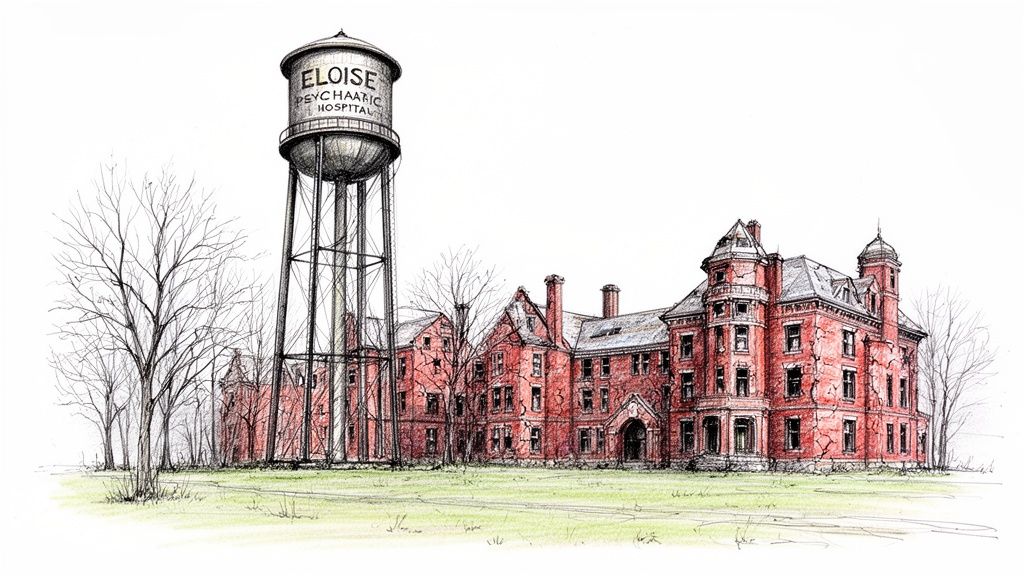
Today, only a few of the original 70-plus buildings remain, standing as solemn reminders of the thousands of lives that passed through its doors. The remaining structures are a powerful draw for those interested in social history, institutional architecture, and the complex narratives surrounding mental health treatment in America, making it one of the most compelling abandoned places in Michigan.
Access and Safety: A Word of Caution
The remaining Eloise buildings are on private property, and their future is a subject of ongoing development and preservation debates. Respect for the site's history and legal boundaries is crucial.
- Trespassing: Accessing the buildings is strictly illegal and extremely dangerous. The remaining structures are in severe states of decay. The area is monitored, and trespassers will be prosecuted.
- Best Views: The most prominent remaining building, the Kay Beard Building, is visible from Michigan Avenue. This allows for safe and legal photography from a public distance.
- Guided Tours: The site's new owners have transformed parts of the property into a paranormal attraction, "Eloise Asylum." While this is a commercial venture, it offers the only legal way to see the interior of the main building. Check their website for tour availability.
Immersive Local Experience
Capturing the essence of Eloise requires a thoughtful approach that honors its history as a place of human experience, not just a ruin. The site's somber atmosphere demands a respectful and historically informed perspective.
Local Guide: To grasp the full story, visit the Westland Historic Village Park, which has exhibits dedicated to the hospital's history. Afterward, drive a few miles to the historic Nankin Mills, another local landmark tied to the area's development. This provides crucial context that transforms your view of the remaining buildings from simple ruins to profound historical artifacts within a broader community narrative.
Approaching Eloise with sensitivity is paramount. Remember that it was a home, a workplace, and a place of treatment for generations of Michiganders. Its legacy is complex, and visitors should treat the grounds with the respect owed to a historical site of such significance.
4. Nantucket Ghost Town - Fayette Historic State Park
Far from the industrial ruins of southern Michigan lies Fayette Historic State Park, a ghost town offering a completely different kind of abandonment. This isn't a story of slow decay but of sudden departure. Built in 1867 as an iron smelting boomtown, Fayette was abandoned just 24 years later in 1891 when the industry collapsed. Today, it stands as a remarkably preserved open-air museum on the serene Garden Peninsula.
Unlike other abandoned places in Michigan, Fayette is meticulously maintained, allowing visitors to step directly into the past. Over 20 original structures, including the company store, a hotel, and workers' homes, stand against the stunning backdrop of Snail Shell Harbor. It’s a powerful, immersive glimpse into the harsh realities of 19th-century industrial life in a remote company town.
Access and Safety: An Official Historic Site
As a designated state park, Fayette is safe, legal, and encouraged to explore. Access requires a Michigan Recreation Passport, which can be purchased at the park entrance. The site is well-managed with clear pathways and interpretive signs.
- Location: The park is located at 4785 II Road, Garden, MI 49835, in the Upper Peninsula. The drive itself is a scenic journey into a more remote part of the state.
- Accessibility: Most of the historic townsite is accessible via level walking paths, making it suitable for most visitors. Some historic building interiors may have limited accessibility.
- Best Time to Visit: Visit on a weekday in late spring (May) or early fall (September) to avoid summer crowds and enjoy the peaceful atmosphere.
Immersive Local Experience
Capturing Fayette is about documenting a moment frozen in time. The juxtaposition of weathered wooden buildings against the vibrant blue waters of Lake Michigan provides endless photographic opportunities. For those who appreciate preserved historical sites, exploring places like Fayette is a unique experience, much like discovering the well-maintained ghost towns discussed in articles on abandoned places in Arizona.
Local Guide: Chat with the park rangers on-site. They are passionate historians who can share detailed stories about the families who lived and worked in Fayette. For a true taste of the U.P., stop at a local fish market in Manistique or Escanaba on your way to or from the park for some fresh smoked whitefish, a regional delicacy that connects you to the area's fishing heritage.
Plan to spend at least half a day here to fully absorb the history. Read the interpretive displays to understand the town’s social hierarchy, from the furnace manager’s stately home to the simple dwellings of immigrant laborers.
5. Michigan Central Station - Detroit Architectural Icon
Once the tallest train station in the world, Michigan Central Station is a monumental Beaux-Arts masterpiece that has defined Detroit's skyline since 1913. For decades after its closure in 1988, this 18-story architectural icon stood as a hollowed-out, hauntingly beautiful symbol of urban decay. Its grand waiting room and towering office block became one of the most documented abandoned places in Michigan, capturing the imagination of photographers and filmmakers worldwide.

Today, the station is the centerpiece of one of the most ambitious historic restoration projects in the country. Purchased by Ford Motor Company in 2018, it is being transformed into a futuristic mobility innovation hub. Its story has evolved from a somber ruin into a powerful symbol of Detroit's revitalization, offering a unique opportunity to witness architectural history being reborn.
Access and Safety: A Word of Caution
As an active and high-profile construction and restoration site, Michigan Central Station is no longer accessible for unsanctioned exploration. The era of sneaking through its vacant halls is definitively over, replaced by a new chapter of managed access.
- Trespassing: The property is strictly off-limits and illegal to enter without authorization. It is secured and monitored 24/7.
- Best Views: The exterior can be safely and legally viewed from the surrounding streets in the Corktown neighborhood. The park in front of the station, Roosevelt Park, offers a fantastic vantage point for photography.
- Guided Tours: Check the official Michigan Central website for announcements about public tours and opening events. As the project nears completion, opportunities to see the restored interior will become available.
Immersive Local Experience
Capturing the station's essence now means documenting its transformation. The juxtaposition of historic grandeur with modern restoration work creates a compelling visual narrative.
Local Guide: For a full cultural experience, explore the surrounding Corktown neighborhood, Detroit's oldest. Grab a classic burger at Nemo's Bar, a historic spot that has witnessed the station's entire lifecycle, or visit a local coffee shop like Astro Coffee. Engaging with the community provides a deeper context for the station's impact on the city beyond its architectural shell.
This architectural icon’s journey from a beloved ruin to a beacon of innovation makes it a unique and evolving landmark. Approaching it with respect for its past and an appreciation for its future is key to understanding its place in Detroit's story.
6. Abandoned Copper Mines - Keweenaw Peninsula
The Keweenaw Peninsula, jutting into the vast waters of Lake Superior, is not just a place of scenic beauty but an open-air museum of America's first great mineral rush. The remnants of the Copper Country mining boom (1840s-1960s) dot the landscape, offering a tangible connection to the industrial past. Here you'll find towering hoist houses, crumbling stamp mills, and entire company towns that speak to the immense wealth and immense hardship that defined the region.
These sites are more than just abandoned places in Michigan; they are silent storytellers of technological innovation and the immigrant labor communities that powered a nation. From the world-renowned Quincy Mine to the lesser-known ruins scattered throughout the peninsula, the area provides a profound industrial archaeology experience unlike any other.
Access and Safety: A Word of Caution
The Keweenaw Peninsula offers a unique mix of preserved historical sites and genuinely abandoned ruins, each requiring a different approach.
- Trespassing: Many ruins are on private property or part of the Keweenaw National Historical Park. Always obey "No Trespassing" signs. Unmarked ruins can be extremely dangerous, with hidden shafts, unstable structures, and contaminated soil.
- Best Views: The Quincy Mine Hoist Association offers safe, guided tours that take you deep underground. For surface exploration, many ruins like the Central Mine location are publicly accessible and interpreted with historical markers.
- Guided Tours: For a safe and enriching experience, book a tour at the Quincy Mine in Hancock or the Delaware Copper Mine in Mohawk. These tours provide historical context and safe access to preserved underground tunnels.
Immersive Local Experience
Capturing the Copper Country requires an appreciation for both its grand scale and its human details. The contrast between industrial decay and nature's reclamation offers powerful photographic opportunities.
Local Guide: Before exploring, grab a pasty from a local shop like Roy's Pasties & Bakery. This iconic local food was the hearty, portable lunch of the miners, and eating one provides a literal taste of history. To understand the human story, visit the Finnish American Heritage Center in Hancock. The cultural fabric of the Keweenaw was woven by immigrant miners, and their legacy is still vibrant in the community today.
Approaching these sites with curiosity about the people who worked there transforms a simple visit into a deeply immersive cultural experience, connecting the silent ruins to the living heritage of the region.
7. Humongous Fungus (Crystal Falls) & Ghost Forests - Environmental Ruins
Not all abandoned places in Michigan are man-made. The state’s vast forests hold their own kind of ruins: ecological remnants that tell stories of disease, industry, and natural transformation. Near Crystal Falls in the Upper Peninsula resides the "Humongous Fungus," a colossal Armillaria gallica organism spanning nearly 100 acres. This ancient fungus, thousands of years old, contributes to the creation of "ghost forests" by slowly killing host trees, leaving behind skeletal landscapes that are both eerie and beautiful.
These environmental ruins are living monuments to ecological cycles of death and rebirth. They offer a unique kind of exploration, connecting visitors to the deep, often invisible, histories of the land. Visiting these sites provides a profound lesson in nature's resilience and the powerful forces that shape our world, far from any factory floor.
Access and Safety: A Word of Caution
Exploring these natural sites requires respect for delicate ecosystems. The Humongous Fungus is located within a public forest area, but its exact boundaries are not marked with tourist signs, making it a true off-the-beaten-path destination.
- Legality: The fungus is on public land managed by the Michigan DNR, and visiting is legal. However, the goal is observation, not interference. Do not disturb the soil, break branches, or remove any natural elements.
- Location: The primary site is in the Iron County forest off of US-2, near Crystal Falls. There isn't a single "spot," but rather a large affected area. A good starting point for exploration is the Bewabic State Park area.
- Safety: This is wild forest terrain. Be prepared with proper hiking gear, navigation tools (GPS and map), and be aware of wildlife. Cell service can be unreliable.
Immersive Local Experience
Capturing the essence of an environmental ruin is about documenting subtle details and grand, silent landscapes. This type of exploration offers a different pace and perspective than urban ruins.
Local Guide: To enrich this off-the-beaten-path trek, stop in the small town of Crystal Falls and visit the Harbour House Museum to learn about the local logging and iron mining history that shaped these very forests. This context helps you see the landscape not just as a natural wonder, but as a place deeply intertwined with human history, adding layers to your hike.
Visiting across different seasons reveals dramatic changes. Spring may show new life emerging around the decay, while the starkness of late autumn highlights the skeletal tree structures. It’s a powerful reminder that abandonment and decay in nature are just one part of a continuing cycle.
7 Abandoned Michigan Sites: Quick Comparison
| Site | 🔄 Implementation complexity | ⚡ Resource requirements | ⭐ Expected outcomes | 💡 Ideal use cases | 📊 Key advantages |
|---|---|---|---|---|---|
| The Packard Plant - Detroit Industrial Urban Exploration | High — structural hazards, limited legal interior access, safety planning required | Moderate — travel from Detroit, guided tour bookings, protective gear | ⭐⭐⭐ — strong visual/photographic and educational payoff | Urban exploration, industrial photography, documentary research | Iconic industrial architecture and abundant photo subjects; accessible exterior and organized tours |
| Fort Mackinac - Historic Military Ruins on Mackinac Island | Low — maintained site with museum operations and visitor services | Low — ferry fare, admission, seasonal scheduling | ⭐⭐⭐ — high educational and experiential returns (living history) | Family/history tourism, living-history events, accessible heritage education | Preserved, interpreted site with reenactments and panoramic views; safe and visitor-friendly |
| Eloise Psychiatric Hospital - Westland Urban Decay | High — sensitive history, restricted/demolished structures, legal limitations | Low–Moderate — research, coordination with historical societies, respectful approach | ⭐⭐ — strong research and reflective value but limited on-site access | Academic research, preservation advocacy, respectful historical interpretation | Important medical/institutional history; prompts ethical conversations about deinstitutionalization |
| Nantucket Ghost Town (Fayette) - Fayette Historic State Park | Low — well-managed state park with marked access and conservation rules | Moderate — remote travel, day planning, seasonal lodging | ⭐⭐⭐⭐ — exceptional authenticity and interpretive value | Immersive historic village study, preservation-focused visits, quiet photography | Exceptionally preserved 19th-century town within a state park; minimal modern intrusion and strong interpretation |
| Michigan Central Station - Detroit Architectural Icon | Medium — structural concerns but increasing access due to active restoration | Moderate — downtown access, tour availability varies with construction phases | ⭐⭐⭐⭐ — high impact for architecture, urban history, and revival narratives | Architecture studies, urban renewal documentation, photography | Iconic Beaux‑Arts landmark undergoing revitalization; powerful symbol of decline and renewal |
| Abandoned Copper Mines - Keweenaw Peninsula | Medium–High — uneven terrain, safety hazards; many sites require guided tours | High — remote travel, physical fitness, pre-booked tours, seasonal limits | ⭐⭐⭐ — strong educational and geological/industrial insights | Industrial archaeology, geology, guided underground exploration | Multiple legal access points and guided mine tours; rich mining heritage and dramatic landscapes |
| Humongous Fungus (Crystal Falls) & Ghost Forests - Environmental Ruins | Medium — remote hikes and ecological interpretation needed; some permit requirements | Low–Moderate — hiking gear, possible guides or permits, seasonal access | ⭐⭐⭐ — valuable ecological insights and photographic interest | Ecological study, nature photography, conservation education | Demonstrates industrial/environmental impact and recovery; quiet, low-cost access to natural history |
Your Journey Through Michigan's Past: Continuing the Exploration
Our journey through Michigan's abandoned places reveals a landscape rich with stories of ambition, decline, and the enduring power of nature. From the skeletal remains of Detroit's industrial might at the Packard Plant to the quiet, preserved history of the Fayette Historic State Park, each location serves as a tangible link to a different era. These are not merely ruins; they are open-air museums that chronicle the state's economic shifts, social changes, and environmental transformations.
The sites we've explored, including the haunting Eloise Psychiatric Hospital and the once-bustling copper mines of the Keweenaw Peninsula, underscore a powerful theme. They highlight the impermanence of human endeavors and the resilience of both nature and memory. Visiting these abandoned places in Michigan is more than an adventure; it's an immersive history lesson that you can't get from a textbook.
Key Principles for Responsible Exploration
As you plan your own explorations, remember that the quality of your experience is directly tied to your approach. The most rewarding visits are built on a foundation of respect, safety, and genuine curiosity.
- Prioritize Safety and Legality: Always be aware of your surroundings. Never enter structurally unsound buildings, and pay close attention to "No Trespassing" signs. The safest and most enriching way to see many of these sites is through official tours or from public property.
- Embrace the "Leave No Trace" Ethic: The golden rule of urban exploration is to take only photographs and leave only footprints. Preserving these sites as you found them ensures that their stories can be discovered by future generations of explorers.
- Engage with Local Communities: The real story of these places lives on in the communities that surround them. Enhance your visit by stopping at a local diner, visiting a small museum, or hiring a local guide who can provide invaluable context and off-the-beaten-path insights.
Your Next Steps into Michigan’s Hidden History
This guide is just a starting point. Michigan's landscape is dotted with countless other forgotten locations, each with its own unique narrative waiting to be uncovered. The true adventure lies in continuing the search and connecting with the deeper cultural fabric of the state.
Use the principles outlined here to seek out your own discoveries. Talk to locals, research historical archives, and always approach these silent monuments with the reverence they deserve. By doing so, you transform a simple visit into a meaningful act of historical preservation and cultural engagement. You become a steward of these stories, ensuring that the echoes of Michigan's past continue to resonate for years to come.
Ready to build your own immersive Michigan itinerary? The CoraTravels app helps you discover off-the-beaten-path locations and connect with local culture, turning a simple trip into an unforgettable exploration. Plan your next adventure and find more hidden gems at CoraTravels.